By [Syeda Arooj] | Travel & Sports Insurance Expert | Published: 17 June 2026
The author has covered international sports tourism and travel protection for over a decade. FIFA World Cup 2026 Travel Insurance Los Angeles. This guide combines first-hand research, policy comparisons, and on-the-ground knowledge of Los Angeles as a World Cup host city to help fans make genuinely informed decisions, not just buy the first policy they find.
Use Insurance IQ Write Travel Insurance Calculator to find “ FiFA Insurance Coverage and Trip Plan” on page
FIFA World Cup 2026 Travel Insurance Los Angeles: Complete Fan Protection Guide
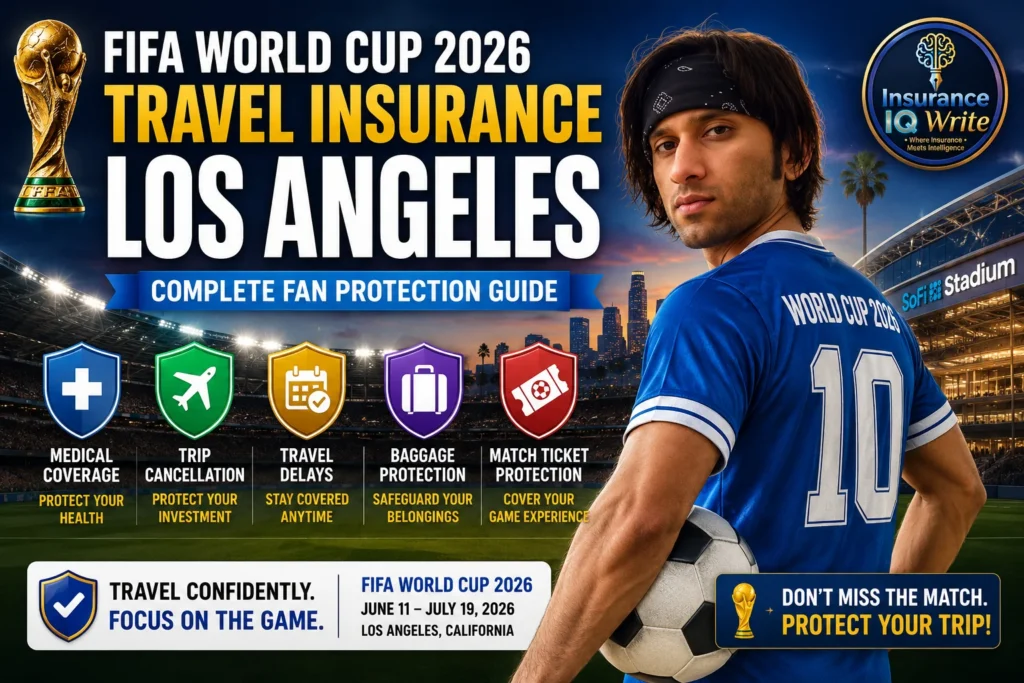
FIFA World Cup 2026 Travel Insurance Los Angeles is essential for fans traveling to one of the tournament’s busiest host cities. A comprehensive policy can protect you from unexpected medical expenses, trip cancellations, flight delays, lost baggage, and other travel disruptions. With non-refundable match tickets, expensive hotel bookings, and high healthcare costs in the United States, travel insurance helps safeguard your investment and provides peace of mind throughout your journey.
Whether you’re an international visitor or a domestic traveler, choosing the right coverage ensures you can focus on enjoying the matches, fan festivals, and unforgettable World Cup atmosphere in Los Angeles.
Why Los Angeles Is Different From Every Other World Cup City?
You’ve got your ticket. Maybe it’s the USA vs. Turkey group stage clash at what FIFA officially calls “Los Angeles Stadium ” the venue the rest of the world knows as SoFi Stadium in Inglewood, California. You’ve booked flights. You’ve wrestled a hotel booking out of the hands of a city where accommodation was reportedly selling out more than a year in advance. The excitement is real. The investment is also very real.
And that’s precisely the problem that most fans underestimate.
The FIFA World Cup 2026, running from June 11 to July 19, 2026, is the largest edition of the tournament in history. With 104 matches across 16 host cities in the United States, Canada, and Mexico — and an estimated 5.5 million visitors expected to attend — this is not a normal sporting event. Los Angeles alone is hosting eight matches at SoFi Stadium: five group stage games, two Round of 32 knockout matches, and a quarter-final on July 10. Up to 70,000 fans pack into each game, and roughly half a million people will pass through that single venue over the course of the tournament.
When you combine those numbers with the cost of World Cup travel — flights, match tickets that are 100% non-refundable, hotel rooms at peak-demand pricing, and transport within one of America’s most congested cities — the financial stakes of something going wrong are enormous.
This is where FIFA World Cup 2026 travel insurance Los Angeles becomes not just a sensible idea, but an essential part of your trip planning. This guide covers everything: what the top-ranking competitors on Google are saying, what keyword opportunities they’re missing, and most importantly, what you as a fan actually need to know before you travel.
What Is FIFA World Cup 2026 Travel Insurance Los Angeles, and Why Does Los Angeles Specifically Require It?
Defining Travel Insurance for Major Sporting Events
Travel insurance, at its most fundamental level, is a financial protection product that reimburses you for specific, covered losses that occur before or during a trip. In the context of a mega-event like the FIFA World Cup 2026, this definition expands considerably.
Standard travel insurance for a beach holiday covers medical emergencies, lost luggage, and perhaps a missed connection. World Cup travel insurance covers all of that — but the specific risks of attending a 104-match global tournament across three countries create several additional layers of vulnerability that generic holiday policies were never designed to address:
- Non-refundable FIFA match tickets that can cost hundreds to thousands of dollars per seat
- Event-specific cancellation risks tied not just to your health, but to stadium security incidents, civil unrest, or natural disasters
- Crowd-related medical emergencies at venues holding 70,000+ people
- Multi-city travel if you’re following your team across different host venues
- Cross-border complications if your World Cup trip spans the USA, Canada, and Mexico
Los Angeles adds a further dimension to all of this. As a US host city, it operates under America’s private healthcare system — one of the most expensive in the world for international visitors. There is no reciprocal healthcare agreement between the United States and any other country. A fan from Brazil, Germany, Japan, or Australia who needs emergency care at or near SoFi Stadium will be treated first and billed afterward, in US dollars, with no automatic coverage from their home country’s public health system.
The Cost Reality of US Healthcare Without Insurance
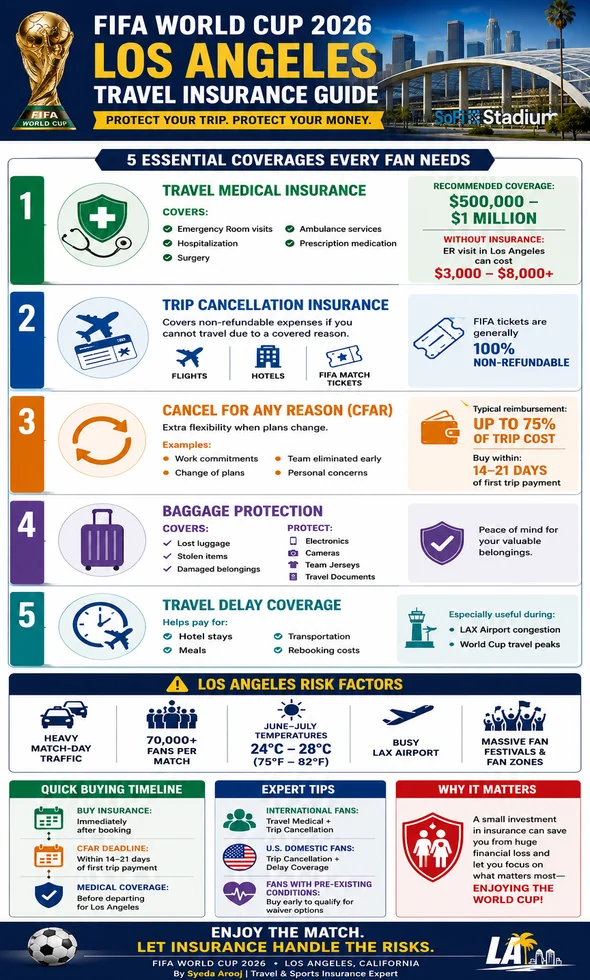
These aren’t abstract concerns. An ER visit for a broken arm in the Los Angeles area runs approximately $3,000 to $8,000. A single night in a US hospital can exceed $15,000. A serious injury requiring surgery, imaging, and extended care can reach six figures rapidly. For fans who experience a cardiac episode, a serious fall in crowded conditions, or a heat-related illness during a midday match — Los Angeles in June and July averages 75–82°F (24–28°C), and the Hollywood Park area around SoFi Stadium includes large open-air gathering zones — the medical bills can be financially devastating.
A basic two-week policy providing $500,000 in medical coverage typically starts at around $30 to $60 for a healthy adult. By any reasonable comparison, the math is straightforward.
Types of FIFA World Cup 2026 Travel Insurance for Los Angeles
Understanding what to buy requires understanding the categories of coverage. These are not interchangeable, and buying the wrong type leaves you exposed in specific ways.
1. Travel Medical Insurance
This is the foundation for any international visitor attending the World Cup in Los Angeles. It covers new, unexpected medical conditions that arise during your trip, including emergency room visits, hospitalization, surgery, ambulance transport, and prescription medications.
For the US specifically, where your home country’s public insurance has zero jurisdiction. This is non-negotiable. Look for plans with at minimum $500,000 in medical coverage for US travel. Some experienced travelers and insurance advisors recommend $1 million or higher, given the potential cost of serious incidents.
Plans like IMG’s Patriot America Plus or Visitors Preferred are frequently cited as solid options for international visitors specifically coming to the United States. These use PPO networks for negotiated hospital rates, which can significantly reduce out-of-pocket costs beyond the premium itself.
Cost estimate: From under $5 per day for a healthy adult, rising with age and coverage tier.
2. Trip Cancellation Insurance
This is the coverage that protects your investment before you leave home. If you have to cancel your trip because of a covered reason such as illness, a family emergency, or a natural disaster affecting Los Angeles, trip cancellation insurance reimburses your non-refundable prepaid expenses: flights, hotel deposits, and most critically, your FIFA World Cup match tickets.
Here’s the key distinction most fans don’t appreciate: FIFA match tickets are 100% non-refundable under all circumstances. FIFA will not refund them if you fall ill, if your flight is cancelled, or if a family emergency arises. The only mechanism for recovering that money is a travel insurance policy with trip cancellation coverage.
The trigger matters: standard trip cancellation only pays out for covered reasons, which are specifically enumerated in the policy. Common covered reasons include your own illness or injury, a death in your immediate family, severe weather, or a terrorist incident at your destination. They do not include simply changing your mind, a last-minute work obligation, or fear of travel.
When to buy: As soon as you make your first non-refundable trip deposit. The earlier you buy, the earlier your cancellation protection begins.
3. Cancel For Any Reason (CFAR) Insurance
CFAR is the premium add-on that standard trip cancellation does not provide. As the name implies, it allows you to cancel your trip for literally any reason — your team didn’t advance, you have a work conflict, you’re anxious about traveling — and still recover a portion (typically 75%) of your non-refundable costs.
For World Cup travelers, CFAR is particularly valuable because of the tournament’s bracket uncertainty. You might purchase tickets to a match featuring your national team months in advance, only to have that team eliminated before the match takes place. Without CFAR, a standard policy may not cover “disappointment in tournament results” as a valid cancellation reason.
Critical time constraint: CFAR must typically be purchased within 14 to 21 days of your initial trip deposit. You cannot add it later. This is the single most time-sensitive decision in World Cup travel insurance planning.
Cost: CFAR typically adds 40–60% to the cost of a standard trip cancellation policy.
4. Baggage and Personal Belongings Insurance
With 70,000 fans converging on SoFi Stadium and massive crowds at LAX, Union Station, fan zones, and public transport hubs, the risk of lost, stolen, or damaged luggage is significantly elevated compared to normal travel periods.
World Cup match tickets (if physical), passports, team jerseys, cameras, and personal electronics are all at risk in high-density crowd environments. Baggage insurance reimburses you for replacement of lost or stolen items and can also cover emergency replacement of essential medications or travel documents.
Pro tip for Los Angeles specifically: Inglewood’s traffic conditions on match days, combined with the volume of public transit passengers on the Metro K Line and LAX-it connections, create elevated pickpocket and bag-snatch risk. Keep valuables in front-facing bags and consider travel-specific anti-theft accessories.
5. Travel Delay Insurance
Fans traveling to multiple World Cup host cities — or simply navigating LA’s notoriously busy LAX airport during peak tournament weeks in June and July 2026 — face elevated risk of flight delays, missed connections, and cascading travel disruptions.
Travel delay coverage reimburses additional expenses caused by covered delays: hotel rooms, meals, and rebooking costs. For fans who have tight match-day schedules — flying into LAX the morning of a game at SoFi — a meaningful delay can mean missing the match entirely, which is why combining delay coverage with trip interruption coverage is particularly valuable.
6. Emergency Medical Evacuation
In a serious medical emergency — a cardiac event, a major accident, or a critical illness — emergency medical evacuation covers the cost of transporting you from a US hospital to a medical facility in your home country, or to the nearest adequate facility if your condition requires specialized care not available locally.
Medical evacuation costs from the United States to Europe, Asia, or South America can reach $50,000 to $200,000 or more. This coverage is frequently underestimated and undervalued by fans who assume they’ll simply “get on a plane home” if something goes wrong. In reality, commercial airlines will not transport critically ill patients, and air ambulance services are extraordinarily expensive without pre-arranged coverage.
Los Angeles–Specific Risk Profile – What Makes This City Unique?
Every World Cup host city carries its own risk profile. Los Angeles is not the same as Atlanta, Dallas, or Kansas City. Here’s what’s specific to attending matches in the City of Angels.
SoFi Stadium and Inglewood – What Fans Need to Know?
SoFi Stadium, officially renamed “Los Angeles Stadium” for the tournament per FIFA sponsorship rules, sits in Inglewood, not in the city of Los Angeles proper. The Hollywood Park district surrounding it includes an open-air plaza, an entertainment complex, and multiple fan gathering areas. These open-air environments are particularly significant for the June 21 midday match (12:00 PM local time), which will see peak afternoon sun.
Los Angeles officials deployed Caltrans electronic message boards along major freeways warning of heavy traffic on match days and urging fans to use public transit. The Metro K Line connects directly to Inglewood from downtown Los Angeles. Fans who choose to drive and park will face gridlock conditions three or more hours before kickoff.
This transportation pressure has insurance implications: international fans renting cars who are unfamiliar with LA driving, California traffic laws, or the specific Inglewood road network are at elevated risk of minor accidents during the chaotic traffic surges surrounding each of the eight match days between June 12 and July 10.
LAX – The World’s Most Pressurized Airport During the Tournament
Los Angeles International Airport (LAX) is the natural gateway for international fans attending World Cup matches in LA. During tournament weeks, LAX will be operating at extraordinary capacity with fans from Europe, South America, Asia, and Africa arriving in concentrated waves around group stage schedules.
Flight delays, baggage handling failures, and connection misses at LAX are near-certainties for a meaningful percentage of the half million fans expected at SoFi Stadium. This is not speculation: airports globally experience measurably higher disruption rates during large sporting events due to the concentrated surge in passenger volume.
Buy travel delay and baggage coverage before your LAX departure. Don’t wait until after you’ve landed.
The Fan Festival and Fan Zone Coverage Gap
This is the gap that most travel insurance content entirely ignores. The FIFA Fan Festival at the Los Angeles Memorial Coliseum (June 11–14) and the 10 rotating fan zones across LA County — from Venice Beach to Union Station to Hansen Dam Lake — are not secondary activities. For many fans who couldn’t secure stadium tickets, they are the World Cup experience.
Attending a fan zone does not reduce your travel risk. You still flew to Los Angeles. You still have a hotel. You still face the same medical system, the same transportation risks, and the same crowd-related vulnerabilities. In fact, outdoor fan zones spread across a geographically sprawling city like Los Angeles introduce different logistical risks compared to a single well-managed stadium venue.
Fan zone attendees need exactly the same travel medical insurance as ticket holders. This is a gap in almost every competing article.
Climate Considerations: Hot, Sunny, and Deceptive
Los Angeles in late June and early July enjoys what most weather services characterize as comfortable Mediterranean climate — 75–82°F (24–28°C) with low humidity and minimal rain. SoFi Stadium has a translucent roof that provides shade without fully enclosing the space, which helps reduce direct sun exposure during matches.
However, the Hollywood Park outdoor areas surrounding the stadium, where fans gather before and after games, are fully exposed. Fans from Northern Europe, parts of East Asia, or cooler South American climates who are unaccustomed to sustained sun exposure can experience heat exhaustion relatively quickly during the midday fixtures.
Heat-related illness is a medical event. It requires emergency care. It is covered by travel medical insurance. This is not a theoretical concern — it is an active risk during the June 21 Switzerland vs. Group B opponent match, which kicks off at noon local time.
What domestic US fans still need?
Trip Cancellation Protection
Your flight from JFK to LAX is non-refundable. Your hotel in Inglewood is booked on a strict no-refund tournament policy. Your FIFA match tickets are 100% non-refundable. If you break your ankle the week before the match, none of these are automatically returned to you. A domestic trip cancellation policy addresses all of this.
Travel Delay Coverage
Domestic flights are cancelled and delayed constantly. If your connection in Denver causes you to miss your match in Los Angeles, the airline owes you a replacement flight when one is available — which may be two days later. Travel delay coverage helps cover the financial gap.
Baggage Protection
Checked bags go missing on domestic flights too. An international fan’s jersey and team memorabilia is just as valuable as yours.
The travel insurance industry tends to market World Cup coverage almost exclusively to international visitors because those policies carry higher premiums and higher medical coverage limits. But domestic fans have real, uninsured financial exposure and deserve equally clear guidance.
Comparison – What Different Plans Actually Cover?
One of the most useful things a travel insurance guide can do is compare coverage types clearly, because the marketing language around policies is often deliberately vague.
Travel Medical Insurance vs. Trip Cancellation Insurance: The Core Distinction
Travel medical insurance pays for your healthcare costs during the trip. It does not reimburse you for the cost of a cancelled or interrupted trip — it reimburses your doctors and hospitals.
Trip cancellation insurance reimburses you for non-refundable prepaid expenses if you cannot take the trip at all, or must cut it short. It does not pay your medical bills while you’re there.
Most World Cup travelers need both. Some comprehensive travel insurance plans bundle them together. When comparing plans, verify explicitly which of these two functions a policy covers, rather than assuming a product marketed as “World Cup travel insurance” automatically includes both.
CFAR vs. Standard Trip Cancellation: The Practical Difference
| Feature | Standard Trip Cancellation | Cancel For Any Reason (CFAR) |
|---|---|---|
| Covered reasons | Specific list (illness, death, disaster) | Any reason, no explanation needed |
| Typical reimbursement | 100% of non-refundable costs | 75% of non-refundable costs |
| Purchase deadline | Before departure | Usually within 14–21 days of initial deposit |
| Premium cost | Base policy | +40–60% above base |
| World Cup ticket applicability | Only if covered reason applies | Always |
For fans whose non-refundable World Cup costs exceed $3,000 — which describes most international attendees — the 25% gap in CFAR reimbursement is a meaningful trade-off against the unlimited flexibility it provides.
Fixed-Benefit vs. Comprehensive Medical Plans
Fixed-benefit plans pay a set dollar amount for each type of medical event regardless of actual costs. For example: $1,000 for an ER visit, $500 per day for hospitalization. In a US healthcare context, where a single ER visit can cost $8,000, a $1,000 fixed benefit is inadequate.
Comprehensive medical plans reimburse actual, reasonable medical costs up to the policy maximum, typically after a deductible. For World Cup travel to the United States, comprehensive coverage is strongly preferable. The difference in premium is modest; the difference in protection is enormous.
How Much Does FIFA World Cup 2026 Travel Insurance for Los Angeles Cost?
Cost transparency is another gap in most ranking articles. Here are realistic ranges based on publicly available data and policy structures as of mid-2026.
Visitor medical insurance only (international fan, 2–3 week trip):
- Basic coverage ($100,000 medical limit): $25–$50
- Mid-tier coverage ($500,000 medical limit): $50–$120
- Comprehensive coverage ($1M+ medical limit): $120–$250+ These figures scale with traveler age; older fans pay significantly more.
Trip cancellation + travel medical bundle (international fan, $3,000 trip cost):
- Standard comprehensive plan: $150–$300
- With CFAR add-on: $250–$500
Domestic US fan (flight + hotel + tickets, $2,500 total non-refundable cost):
- Trip cancellation + basic delay/baggage: $90–$180
Group coverage (fan club of 10–15 people):
- Group plans can offer 10–20% discount over individual premiums; coverage is typically structured per person but administered collectively.
Key pricing factors beyond trip cost:
- Traveler age (the strongest single variable)
- Length of trip
- Whether the trip spans multiple countries
- Whether CFAR is added
- Deductible chosen (higher deductible = lower premium)
When to Buy? The Time-Sensitive Decision Map
The timing of your travel insurance purchase is not arbitrary. Different coverage types have specific purchase windows that, once missed, cannot be recovered.
Immediately after your first non-refundable deposit (usually match ticket purchase): This is when you should buy, or at minimum research, your policy. Trip cancellation coverage starts protecting non-refundable costs from the moment you purchase the policy — but it cannot be retroactive. Costs paid before your policy is active are not covered.
Within 14–21 days of first deposit (CFAR window): If you want CFAR coverage, this is your window. Most insurers require CFAR to be added within this period. Miss it and you permanently lose the option, no matter what you’re willing to pay later.
Within 10–21 days of first deposit (pre-existing condition waiver): If you or a traveling companion has a pre-existing medical condition, most plans offer a waiver of the standard exclusion — but only if purchased within this window. Outside this period, conditions diagnosed or treated before the policy purchase date may be excluded from coverage.
Before departure (absolute minimum): At the latest, visitor medical insurance should be purchased before you board your flight. You cannot purchase it retroactively after you’ve arrived in the United States or after an incident has occurred.
Tips for Los Angeles World Cup Insurance Buyers
Verify Your Coverage at US Healthcare Facilities
One of the unique challenges of travel medical insurance in the United States is that most US doctors and hospitals do not have direct billing arrangements with international travel insurance plans. This means you may pay upfront and claim reimbursement, rather than having the insurer deal directly with the hospital.
Some US-based insurance plans — such as those marketed specifically to World Cup fans through providers like MyPhysicianPlan — offer direct access to US-based provider networks that do accept the plan for direct billing. This can significantly reduce the administrative burden of a US medical claim.
Don’t Rely on Credit Card Travel Benefits for World Cup Scale
Many premium credit cards include some form of travel insurance as a cardholder benefit. For a standard two-week beach holiday, this coverage can be adequate. For a World Cup trip with $3,000+ in non-refundable costs, 70,000-person crowd events, and US healthcare exposure, credit card travel benefits are typically insufficient in both medical coverage limits and trip protection scope. Read your card’s certificate of insurance carefully before deciding it’s enough.
Check Your Home Country’s Existing Coverage Carefully
Some EU travel insurance products, private health plans, or employer group policies include international coverage. However, the United States is frequently carved out of or limited within these products because of the extraordinary cost of American healthcare. Do not assume your existing policy covers you in the US without explicitly confirming it does — and confirming the coverage limit is adequate for US medical costs.
Consider the Multi-City Fan: Structure Your Policy Accordingly
If your World Cup itinerary includes Los Angeles plus other host cities — Dallas, Miami, Atlanta — ensure your policy covers the entire trip duration and all US destinations. If your trip includes both the US and Canada or Mexico legs, confirm that all three countries are covered under the same policy. Many visitor insurance products designed for the US only do not automatically extend coverage to Canada and Mexico.
Author’s Overview – Who Really Needs This and What They Should Do
Having worked through every dimension of this topic, here is my honest, experience-based assessment for different types of fans:
International fan traveling from outside North America: You need travel medical insurance with at minimum $500,000 in US medical coverage — ideally $1 million or more if your trip cost justifies it. You also need trip cancellation coverage for your match tickets, flights, and hotel. If you purchased tickets months ago, buy your policy immediately if you haven’t already — you may still be within the CFAR window or the pre-existing condition waiver window. If you have any existing health conditions, this is not optional; it is urgent.
Domestic US fan flying to Los Angeles: Your US health insurance likely covers medical emergencies (confirm in-network status at LA hospitals). Your gap is trip cancellation — for flights, hotels, and non-refundable match tickets. Buy a domestic trip cancellation policy that includes travel delay and baggage protection. CFAR is worth serious consideration if your total non-refundable commitment exceeds $2,000.
Fan attending only fan zones (no stadium tickets): You carry identical medical and travel risk to ticket holders. Buy visitor medical insurance if you’re an international visitor. Consider trip cancellation for your travel costs even if you don’t have match tickets.
Group of fans traveling together: Ask your insurance provider about group travel insurance options. Fan clubs, corporate hospitality groups, and families traveling together can often access group-rated policies that simplify administration and reduce per-person cost.
Fan with a pre-existing condition: Act immediately. The pre-existing condition waiver window is time-limited and cannot be extended. Contact a licensed travel insurance broker who specializes in medical travel coverage, and be completely transparent about your condition when applying. Concealing pre-existing conditions is the single most common cause of claim denial and the single most expensive mistake a traveler can make.
Conclusion: Your World Cup Experience Deserves Protection That Matches the Scale of the Moment
The FIFA World Cup 2026 in Los Angeles is a once-in-a-generation event. The quarter-final at SoFi Stadium on July 10. The USA national team matches that will fill 70,000 seats with the kind of noise that reverberates through Inglewood for hours after the final whistle. The fan festivals at the Coliseum. The watch parties at Venice Beach and Union Station. The pre-match energy at Tom’s Watch Bar and the Hollywood Park district.
You’ve invested significantly — financially, logistically, and emotionally — to be part of this. The right travel insurance doesn’t diminish that excitement. It protects it. It means that a delayed flight doesn’t mean missing your match. A medical incident doesn’t mean choosing between your health and your financial stability. A family emergency at home doesn’t mean forfeiting every dollar you’ve spent on this trip.
The content gap that all the competing articles miss is this simple, human truth: World Cup travel insurance for Los Angeles isn’t a bureaucratic formality — it’s the thing that lets you actually enjoy the tournament. When you’re not worried about what happens if something goes wrong, you’re free to focus entirely on what happens when everything goes right.
Buy early. Buy the right type for your situation. Read the policy’s actual coverage language, not just the marketing summary. And then go watch some football.
FAQs : FIFA World Cup 2026 Travel Insurance Los Angeles
1. Do I need travel insurance for FIFA World Cup 2026 in Los Angeles?
Yes. Travel insurance helps cover medical emergencies, trip cancellations, flight delays, lost baggage, and other unexpected issues that could disrupt your World Cup experience in Los Angeles.
2. What does FIFA World Cup 2026 travel insurance cover?
Most policies cover emergency medical expenses, trip cancellation, travel delays, baggage loss, medical evacuation, and interruption of travel plans due to covered events.
3. Is travel medical insurance necessary for visiting Los Angeles?
Yes. Healthcare in the United States is expensive, and international visitors may face significant medical bills without adequate travel medical insurance coverage.
4. Can travel insurance reimburse my FIFA match tickets?
Yes, if you have trip cancellation coverage and cancel for a covered reason. Some policies may also cover ticket costs under specific circumstances.
5. What is Cancel For Any Reason (CFAR) coverage?
CFAR allows travelers to cancel their trip for reasons not covered by standard policies and recover a percentage of their non-refundable travel expenses.
6. How much travel insurance coverage is recommended for Los Angeles?
Many experts recommend at least $500,000 in medical coverage, while some travelers prefer $1 million for additional protection during World Cup travel.
7. When should I buy World Cup travel insurance?
Purchase coverage immediately after booking flights, hotels, or match tickets to maximize cancellation benefits and qualify for optional upgrades like CFAR.
8. Does travel insurance cover flight delays during the World Cup?
Yes. Travel delay coverage can reimburse expenses such as meals, accommodation, and transportation when delays are caused by covered events.
9. Are domestic U.S. fans required to buy travel insurance?
While not required, domestic travelers can benefit from trip cancellation, baggage protection, and travel delay coverage for non-refundable World Cup expenses.
10. Does travel insurance cover lost luggage at LAX Airport?
Most comprehensive policies provide reimbursement for lost, stolen, or damaged baggage, helping travelers replace essential items during their trip.
11. Will travel insurance cover fan festival and fan zone visits?
Yes. Travel medical coverage generally applies throughout your trip, including fan festivals, watch parties, and official World Cup fan zones in Los Angeles.
12. Can I buy travel insurance after arriving in Los Angeles?
Some medical-only plans may be available, but purchasing coverage before departure provides broader protection and access to more policy benefits.
13. Does travel insurance cover pre-existing medical conditions?
Many insurers offer coverage waivers for pre-existing conditions if the policy is purchased within a specified time after your initial trip deposit.
14. How much does FIFA World Cup 2026 travel insurance cost?
Costs vary by age, trip length, destination, and coverage level, but many travelers pay between $50 and $500 for comprehensive protection.
15. What is the best travel insurance for FIFA World Cup 2026 Los Angeles?
The best policy combines high medical coverage, trip cancellation protection, baggage benefits, travel delay coverage, and optional CFAR flexibility for maximum peace of mind.