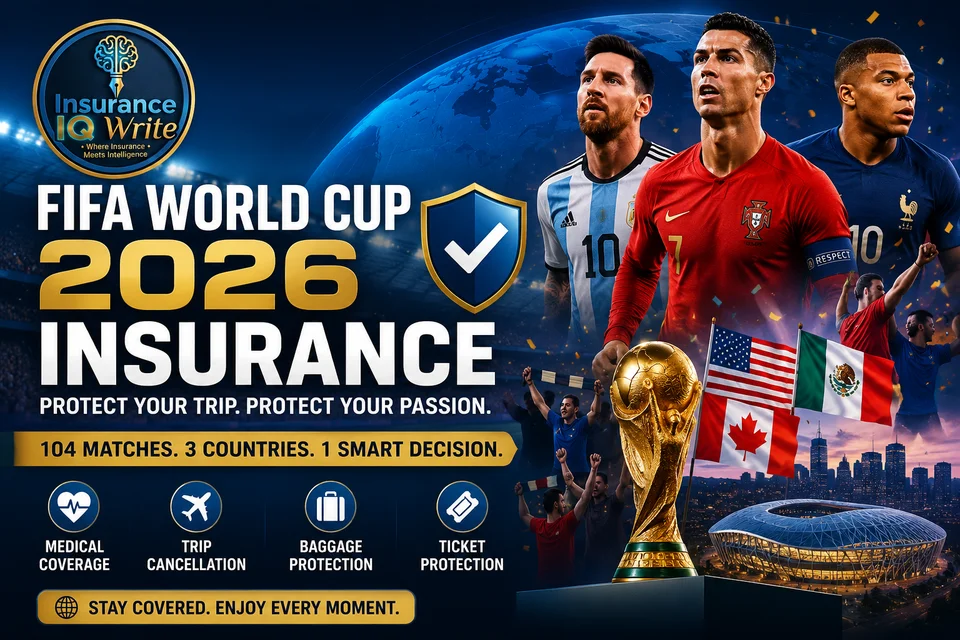
“104 Matches. 3 Countries. 0 Refunds. That’s Exactly Why FIFA World Cup 2026 Insurance Exists.”
FIFA World Cup 2026 Insurance: Everything You Need Before Booking That Ticket
By [Arooj Fatima ] | Last Updated: 04 June 2026′
FIFA World Cup 2026 insurance is necessary because I booked my tickets for the 2014 World Cup in Brazil eight months in advance. No insurance. Then I got food poisoning in São Paulo two days before my Group D match, spent 26 hours in a private clinic, and watched Argentina play on a hospital television screen. The bill? The equivalent of $1,900 USD. My non-refundable ticket? Gone. The total financial hit from that week was just under $5,000.
I will never attend a major tournament without proper insurance again.
FIFA World Cup 2026 is the biggest sporting event in human history, with 48 teams, 104 matches, 16 cities across three countries (USA, Canada, Mexico), and an estimated 5.5 to 7 million visitors. The logistical complexity alone makes this tournament unlike anything we’ve ever planned for. Add the fact that US hospital bills regularly exceed $15,000 for a single overnight stay, and FIFA’s ticket policy states all sales are final, and the case for insurance writes itself.
This guide cuts through the noise. No vague advice, no soft upsells, just what you actually need to know, what it costs, what it doesn’t cover, and how to choose the right FIFA World CUP 2026 Insurance policy for your specific trip.
Why FIFA World Cup 2026 Insurance Is Different From Normal Travel Insurance?
Most travel insurance guides are recycled content written for generic holidays. World Cup 2026 carries risks that don’t apply to typical vacations, and those differences matter when choosing a policy.
The Three-Country Problem
This is the first World Cup ever played across three nations simultaneously. If you’re following your team through the group stage into the knockout rounds, you may cross from the US into Mexico and back into Canada within a single week. Many standard travel insurance plans are written for single-destination travel. A FIFA World Cup 2026 insurance policy that covers you in Dallas may have geographic exclusions that leave you unprotected the moment you cross into Mexico.
The solution: always verify your policy explicitly covers all three countries, the United States, Canada, and Mexico, before purchasing.
The Non-Refundable Ticket Reality
FIFA’s 2026 ticket policy is unambiguous: once payment is processed, tickets cannot be refunded. The sole exception is Team Specific Tickets (TST) for a match where your team has already been eliminated, in which case FIFA issues a refund minus a retention fee.
This means if you buy a quarterfinal ticket today and break your leg in June, you lose that money unless insurance covers it — and only specific policy types will.
US Healthcare Costs Are Not a Joke
If you’re travelling from outside the United States, your domestic health insurance almost certainly provides zero coverage in America. This is not a small risk. A hospital emergency room visit for a twisted ankle can generate a bill over $3,000. Chest pain? Expect $12,000–$25,000. A single night in a US ICU can exceed $30,000.
For Mexico, the added concern is medical evacuation. If you suffer a serious injury or illness in a remote Mexican city and require air ambulance evacuation to a US facility, the cost starts at $30,000 and can reach $80,000. This alone makes evacuation coverage non-negotiable for fans attending Mexican matches.
Types of Coverage You Need (And One You Probably Don’t)
1. Emergency Medical Insurance – Non-Negotiable
This covers doctor visits, hospital stays, ambulance fees, travel insurance for the World Cup 2026, and emergency surgery at your travel destination. For a 39-day World Cup trip (June 11–July 19), a policy with $600,000 in medical coverage typically costs $30–$80 for younger travellers, rising to $80–$200+ for those over 60.
What it covers: In the FIFA World Cup 2026 insurance, illness, injury, emergency dental, and ambulance. What it doesn’t: Routine check-ups, elective procedures, pre-existing conditions (unless declared and waived)
2. Emergency Medical Evacuation – Non-Negotiable for Mexico
Separate from general medical coverage, evacuation insurance covers the cost of transporting you to an appropriate medical facility. Given that air evacuation from Mexico can exceed $80,000, your policy limit should be at minimum $100,000 — preferably $250,000 or higher.
3. Trip Cancellation Insurance – Essential
This reimburses non-refundable prepaid expenses (flights, hotel, match tickets) if you cancel before departure for a covered reason. Covered reasons typically include: your own medical emergency, death of an immediate family member, severe weather event at your destination, terrorism, and certain job-related emergencies.
What it doesn’t cover: You simply changing your mind. Schedule changes made by FIFA. Your team losing and you deciding not to go.
4. Trip Interruption Insurance – Underrated
Similar to cancellation but kicks in after you’ve already departed. If you’re in Dallas for the quarterfinals and a family emergency sends you home early, trip interruption reimburses unused prepaid costs and the cost of last-minute flights home. This is often bundled with cancellation coverage.
5. Cancel For Any Reason (CFAR) – Worth It for Expensive Trips
CFAR is a paid add-on that reimburses 50–75% of non-refundable costs regardless of the cancellation reason. No documentation needed. No qualifying event required. If you simply decide not to go, you still get back a majority of your money.
Critical rule: CFAR must typically be purchased within 14–21 days of your first trip deposit. You cannot add travel insurance for the World Cup 2026 at the last minute.
Is it worth it? Run the math. If your total non-refundable outlay is $6,000 (tickets, flights, hotels) and CFAR adds 40% to your premium, you’re spending maybe an extra $40–$80 to protect $3,000–$4,500 in potential reimbursement. For high-spend World Cup trips, the math almost always favours CFAR.
6. Baggage and Personal Effects – Useful But Check Limits
Standard baggage coverage pays $1,000–$2,500 for lost or stolen luggage, but single-item limits are typically $300–$500. If you’re travelling with a camera, laptop, or premium kit, you may need separate electronics coverage. Also note: coverage for cash theft is usually capped very low ($250 or less).
7. FIFA Ticket Protection Add-On – Read the Fine Print
FIFA offers its own Ticket Protection product at the point of purchase, which it “strongly recommends.” This is not the same as trip cancellation insurance. FIFA’s own ticket protection is narrower — it covers specific scenarios like your own serious illness or injury, death of an immediate family member, or your serious accident occurring after ticket purchase. It does NOT cover cancellation due to job loss, visa denial, or financial hardship. It is useful as a baseline but is not a substitute for comprehensive third-party coverage.
Important: FIFA’s Ticket Protection + a comprehensive third-party policy together provide the most complete protection. Using only one or the other leaves gaps.
What Gets Covered and What Doesn’t?
Understanding the FIFA World Cup 2026 insurance through abstract descriptions is frustrating. Here are realistic World Cup fan scenarios that illustrate exactly how coverage applies.
Real-World Scenario Examples
Scenario A: Medical Emergency in Dallas Fan from Argentina, attending USA vs. Argentina group stage match. Suffers heat exhaustion and dehydration. Taken to ER.
- Without insurance: ER bill arrives for $4,200.
- With medical travel insurance ($500K coverage, $250 deductible): Fan pays $250. Insurer covers $3,950.
- Lesson: Dallas summer heat is genuinely dangerous. This scenario is not hypothetical — July 2026 temperatures in Dallas regularly hit 38–42°C.
Scenario B: Flight Cancellation — Missed Match Fan flying New York → Dallas for Round of 16. Flight cancelled due to severe storms. Next available flight is the following morning, 16 hours after kickoff.
- Trip delay coverage: Reimburses hotel overnight ($180) and meals ($60) during the delay.
- What it does NOT cover: The cost of the missed match ticket.
- Lesson: Trip delay insurance covers your accommodation and meals during a delay. It does not replace the experience of a match you miss. CFAR would have allowed you to claim back the ticket cost if you cancelled entirely before travel.
Scenario C: Medical Evacuation from Mexico City Fan from Germany suffers a severe cardiac event at Estadio Azteca. Requires emergency air transport to a Houston hospital.
- Without evacuation coverage: Air ambulance bill arrives for $58,000.
- With evacuation coverage ($250K limit): Fully covered.
- Lesson: This is why evacuation coverage is the highest-stakes decision in your entire insurance plan. It’s also inexpensive — adding $250K evacuation coverage to a policy typically costs $20–$60 more.
Scenario D: Team Eliminated — trip cancellation World Cup tickets Canadian fan bought a Canada knockout match ticket. Canada loses in the Round of 32. The fan no longer wants to attend the replacement match.
- Standard Trip Cancellation World Cup tickets: Not covered. “Changed my mind” is not a covered reason.
- FIFA Ticket Protection: Not covered for this reason.
- CFAR add-on: Covered — reimburses 50–75% of the ticket cost.
- Lesson: If you bought Team Specific Tickets, FIFA refunds you (minus a fee) if your team is eliminated. For non-team-specific tickets, only CFAR protects you.
Scenario E: Stolen Wallet and Passport in Fan Zone Fan attending a fan festival in Los Angeles has wallet, phone, and passport stolen from a bag.
- Baggage/personal effects coverage: Reimburses cash up to $250, phone up to the single-item limit ($300–$500 depending on policy), and travel document replacement costs.
- Medical coverage: Not applicable.
- Lesson: Travel assistance services (24/7 helplines included in most comprehensive policies) are invaluable here — they help coordinate passport replacement through the nearest embassy, arrange emergency funds, and provide translation support.
Provider Comparison: Best Travel Insurance World Cup 2026″
Rather than recommending one provider (which would be commercially motivated), here is an honest FIFA World Cup 2026 Insurance comparison of what each type of provider does well.
| Provider Type | Best For | Watch Out For |
|---|---|---|
| Allianz / Generali | US-based fans, comprehensive bundles | Geographic restrictions on multi-country plans |
| IMG / Trawick | International visitors to the US, pre-existing conditions | Higher premiums for older travellers |
| INF Elite | Senior travellers, pre-existing condition waivers | Lower overall coverage ceilings |
| AXA | Ticket-specific cancellation coverage | Limited evacuation coverage on base plans |
| Visitor Guard | Multi-country plans, group discounts | Less well-known claims process |
| Insubuy (broker) | Comparing multiple plans in one place | Not a direct insurer |
MG / Trawick: IMG travel insurance plans
Key Questions to Ask Any Provider
Does this policy explicitly cover the United States, Mexico, and Canada?
What is the single-incident medical limit?
What is the evacuation limit?
Does it cover pre-existing conditions (with a waiver)?
Is CFAR available, and what is the purchase deadline?
What is the minimum delay threshold for trip delay coverage to activate?
What FIFA World Cup 2026 Insurance Won’t Cover? The Honest List
Every guide tells you what insurance covers. Few tell you what it doesn’t. Here is what fans consistently get wrong:
FIFA Schedule Changes: If FIFA postpones or reschedules a match, standard trip cancellation does not cover your costs. Only CFAR partially reimburses here.
Your Team’s Performance: If you bought a ticket to see your team and they’re eliminated in the previous round, standard insurance has no role to play (unless you specifically hold Team Specific Tickets that FIFA refunds).
Dynamic Ticket Price Changes: If the resale price of your ticket drops after you bought it at peak price, that is not an insured loss.
Drug or Alcohol-Related Incidents: If you’re injured while intoxicated, most policies exclude or heavily limit claims related to the incident.
Pre-Existing Conditions Without Declaration: If you fail to declare a pre-existing condition at the time of purchase and later need treatment for it, your claim will almost certainly be denied.
Civil Unrest (Partial): Some policies cover trip cancellation if your government issues a formal travel warning after you purchased the policy. But if the warning was issued before you bought the policy, it’s typically not covered. Always check the date of any existing advisories before purchasing.
What You Should Know Before You Book? City-by-City Risk Snapshot
FIFA World Cup 2026 Insurance needs vary depending on which cities you’re visiting. Here is a brief breakdown of the host-city risk profile relevant to insurance decisions.
Dallas / Arlington (USA): Extreme summer heat is the primary risk. July temperatures regularly exceed 38°C. Heat exhaustion and dehydration are common at outdoor fan events. Medical travel insurance is essential here more than almost any other venue.
Los Angeles (USA): Air quality (smog + wildfire smoke), traffic-related delays, and petty theft in tourist zones are the main considerations. Baggage and personal effects coverage is particularly relevant.
New York / New Jersey (USA): High cost of healthcare if something goes wrong. Stadium transit logistics create missed-connection risks.
Mexico City / Guadalajara / Monterrey (Mexico): Altitude sickness is a genuine concern in Mexico City (2,240m elevation). Medical evacuation coverage is non-negotiable for all Mexican venues. Petty crime in tourist areas makes personal effects coverage important. (source official FIFA 2026 host cities page )
Toronto / Vancouver (Canada): Lower healthcare costs than the US for emergencies (as Canada’s provincial health systems can bill foreign visitors but at lower rates), but travel insurance is still important for trip cancellation, interruption, and baggage.
How Much Does FIFA World Cup 2026 Insurance Actually Cost?
Most guides give vague ranges. Here are worked examples using realistic scenarios.
Example Trip Budget: $4,500 Total Non-Refundable Costs (2 match tickets at $350 each, return flights $1,800, 7 nights hotel $1,500, miscellaneous deposits $150)
| Coverage Type | Estimated Premium (Healthy 35-year-old) |
|---|---|
| Medical only ($500K) + Evacuation ($250K) | $35–$60 |
| Medical + Evacuation + Trip Cancellation | $80–$140 |
| Full comprehensive + CFAR add-on | $150–$220 |
For a 60-year-old with a declared pre-existing condition (well-managed hypertension):
- Same comprehensive plan: $280–$450
- With pre-existing condition waiver: Add $60–$120 to those figures
Group of 5 friends (all healthy, aged 28–35):
- Individual comprehensive plans: $80–$140 × 5 = $400–$700 total
- Group policy (where available): $320–$600 — modest savings but simpler administration
Bottom line: For a $4,500 World Cup trip, expect to spend 2–5% of trip value on insurance. For high-spend trips (hospitality packages, multiple matches, premium accommodation), that number stays roughly proportional.
Comparison: FIFA’s Own Ticket Protection vs. Third-Party Cancel for Any Reason World Cup(CFAR)
This is the head-to-head nobody else has written.
| Feature | FIFA Ticket Protection | Third-Party CFAR |
|---|---|---|
| Coverage scope | Ticket cost only | All non-refundable trip costs |
| Covered reasons | Narrow (illness, death, serious accident) | Any reason |
| Reimbursement rate | Up to 100% of ticket | 50–75% of total costs |
| Purchase window | At time of FIFA ticket purchase only | Within 14–21 days of first deposit |
| Includes travel support | No | Yes (24/7 assistance hotline) |
| Medical coverage | No | Not applicable (separate policy needed) |
| Verdict | Good for ticket-specific protection | Better value for total trip protection |
Recommendation: Buy FIFA’s Ticket Protection at checkout (it’s affordable and covers your ticket specifically), then separately purchase a comprehensive travel policy with Cancel for Any Reason World Cup CFAR from a third-party insurer. This two-layer approach gives you the best protection for your total financial exposure.
Author’s Thoughts: FIFA World Cup 2026 Insurance
I’ve been writing about travel and sports events for over a decade. The FIFA World Cup 2026 insurance conversation frustrates me because it always focuses on the same checklist: medical, cancellation, and baggage, without acknowledging the psychological dimension.
Here is what I’ve observed: the people who skip insurance are not stupid. They’re optimistic. They’ve travelled before without incident. They look at a $180 insurance premium and think, “I’ll take the risk.” And for most trips, they’re right to feel that way.
But the World Cup is not most trips.
The financial stakes are uniquely high because the tickets are expensive, non-refundable, and emotionally loaded. The geographic complexity is uniquely high in three countries, multiple currencies, and multiple health systems. The crowd density creates uniquely elevated theft and injury risk. And the US healthcare system creates uniquely catastrophic financial exposure.
The argument for FIFA World Cup 2026 Insurance is “something bad will probably happen.” It’s that the potential downside of something bad happening is large enough that a relatively small premium makes complete financial sense.
One more thing: buy the CFAR add-on. Not because you plan to cancel. But the permission to cancel if life goes sideways without having to prove a covered reason to a claims adjuster is worth something. Peace of mind is an undervalued commodity when you’re spending $5,000 on a sporting event.
Conclusion: FIFA World Cup 2026 Insurance Guide
FIFA World Cup 2026 is a genuinely once-in-a-generation event. For the first time in history, three countries are hosting simultaneously, the field has expanded to 48 teams, and the tournament runs for 39 days. If you’re attending whether for one match or following your team to the final, you’re making a significant financial and emotional investment.
FIFA World Cup 2026 Insurance isn’t the exciting part of World Cup planning. But the fans who regret skipping it are the ones who can tell you exactly how much an ER visit costs in Atlanta, or how much an air ambulance from Guadalajara charges per flight hour.
The good news: comprehensive coverage for a World Cup trip costs less than most fans expect — typically 2–5% of total trip value. That’s a small price to pay for complete peace of mind.
Quick action checklist:
- Buy CFAR within 14–21 days of your first deposit
- Confirm your policy covers the USA State Departments, Canada, AND Mexico explicitly
- Check that evacuation coverage is at least $100,000 (preferably $250,000+)
- Declare all pre-existing conditions — hiding them invalidates your claims
- Buy FIFA’s own Ticket Protection at checkout as an additional layer
- Save all receipts, confirmation emails, and booking references
Enjoy the football. Let the insurance sit quietly in the background.
Frequently Asked Questions: FIFA World Cup 2026 Insurance
Question 1: Is travel insurance mandatory for FIFA World Cup 2026?
A: No. None of the three host countries, the USA, Canada, or Mexico, legally requires visitors to hold travel insurance. However, the US State Department and the Government of Canada both strongly recommend it, and the financial risks of attending without coverage are significant, particularly due to US healthcare costs.
Question 2: Does travel insurance cover my FIFA World Cup match tickets?
A: Standard trip cancellation insurance can cover non-refundable ticket costs if you cancel for a covered reason (serious illness, death of an immediate family member, severe weather, etc.). For any reason whatsoever, only a Cancel for Any Reason (CFAR) add on will reimburse you typically at 50–75% of the ticket value.
Question 3: What if FIFA cancels or reschedules a match?
A: Standard travel insurance does not cover FIFA scheduling decisions. If a match is postponed or rescheduled, your out-of-pocket costs are generally your responsibility unless you hold CFAR coverage, which may partially reimburse non-refundable expenses.
Question 4: Do I need separate insurance for each country I visit?
A: Only if you buy a single country policy. Many providers now offer multi country plans that explicitly cover the USA, Mexico, and Canada in a single policy. Always verify geographic coverage before purchasing; do not assume.
Question 5: Is FIFA’s own Ticket Protection enough?
A: FIFA’s Ticket Protection covers your ticket cost under specific circumstances. It does not cover flights, hotels, or other trip expenses, nor does it provide medical coverage or evacuation. It is a useful layer of protection for your tickets specifically, but not a substitute for comprehensive third-party travel insurance.
Question 6: What about pre-existing condition travel insurance”?
A: Most comprehensive policies offer a pre-existing condition waiver if you purchase within a specified window (often 14–21 days of your first deposit) and you are medically fit to travel at the time of purchase. Always declare your conditions honestly failing to disclose a condition that later generates a claim is grounds for denial.
Question 7: How much does World Cup travel insurance cost?
A: For a healthy traveller aged 25–40 on a 39-day trip with comprehensive coverage (medical, evacuation, cancellation, CFAR), expect to pay $150–$220. For travellers over 60 with declared pre-existing conditions, $350–$500 is a realistic range. Costs scale with the total insured trip value and the traveller’s age.
Question 8: What happens if my luggage is stolen at a fan zone?
A: Personal effects and baggage coverage typically reimburses stolen items up to policy limits, with individual item caps of $300–$500 and cash caps of around $250. File a police report immediately, as insurers require this as proof of theft for any claim. Contact your 24/7 assistance line, which can also help you access emergency funds and coordinate document replacement.
Question 9: Should I buy group insurance for a fan club trip?
A: If you’re travelling in a group of five or more, group travel insurance can simplify administration and offer modest savings. Each member receives individual coverage under a single policy. Useful for organised fan clubs, corporate hospitality groups, or families travelling together.
Question 10: When is the best time to buy World Cup travel insurance?
A: Buy as soon as you make your first non-refundable deposit typically when you purchase your flights or match tickets. This is especially important if you want CFAR, which must be purchased within 14–21 days of your first deposit. Waiting until close to departure limits your options and eliminates CFAR eligibility.
About the Author
Arooj Fatima is a travel insurance specialist and sports travel writer with over a decade of experience covering major international sporting events, including the FIFA World Cup, UEFA Champions League finals, and Olympic Games. Having personally attended four World Cups across four continents, Arooj Fatima writes from direct experience of the logistical, financial, and medical challenges international fans face. Their work focuses on cutting through commercial noise to give travellers actionable, unbiased advice.
Disclaimer
This article is for informational purposes only and does not constitute financial or insurance advice. Always read your policy documents in full and consult a licensed insurance broker for advice specific to your circumstances. Insurance premiums and coverage terms quoted are illustrative estimates based on publicly available data as of June 2026 and may vary by provider, traveller profile, and purchase date.