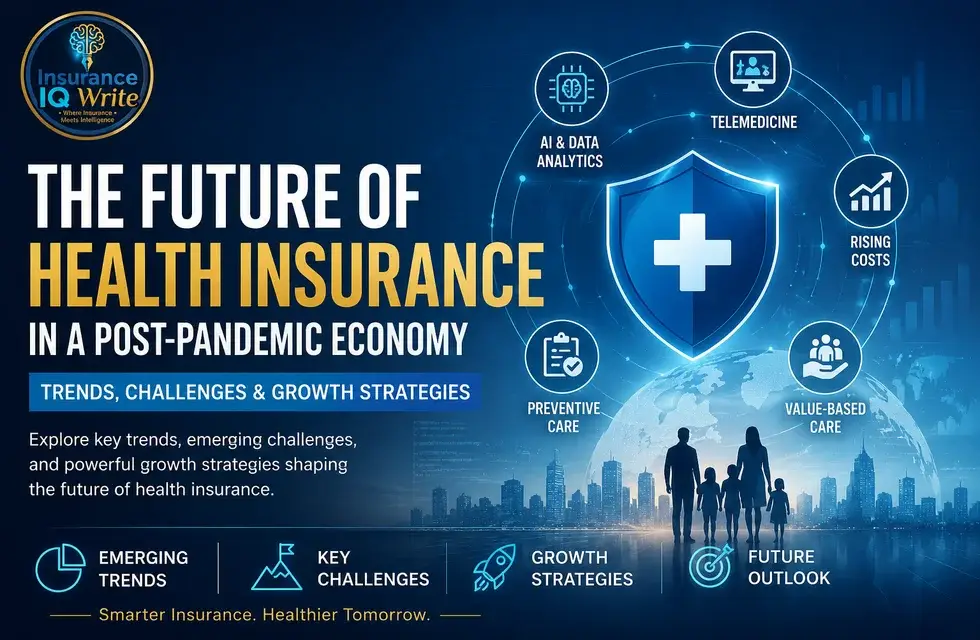
“Health insurance is no longer just protection—it is becoming the backbone of a digital, post-pandemic healthcare economy. In this new era, insurers who fail to adopt AI, data, and preventive care will struggle to survive.”
The Future of Health Insurance in a Post-Pandemic Economy
Introduction
The future of health insurance in a post-pandemic economy refers to the evolving role of insurance systems in a world reshaped by COVID-19, where healthcare needs, risks, and delivery models have permanently changed. It is not just about covering medical expenses anymore; it is about building a smarter, faster, and more preventive healthcare ecosystem supported by technology and data.
In simple terms, after the pandemic, health insurance companies are no longer operating in a predictable environment. They now face rising medical costs, increased claim frequency, and a growing demand for digital healthcare services. At the same time, people expect quicker claim approvals, cashless treatment, and access to telemedicine services from their insurance providers.
This transformation is driving insurers to adopt artificial intelligence, predictive analytics, and mobile-based platforms to improve efficiency and customer experience. For example, instead of waiting for hospitalization, insurers now encourage preventive checkups and early diagnosis through wellness programs.
Overall, the future of health insurance in a post-pandemic economy is shifting from a reactive model—where companies pay for sickness—to a proactive model that focuses on preventing illness, reducing risk, and improving long-term health outcomes for individuals and societies.
What is a Post-Pandemic Economy in Healthcare?
A post-pandemic economy in healthcare refers to the transformed healthcare and financial system that emerged after COVID-19, where medical services, insurance, and health spending patterns have permanently changed. In this economy, healthcare is no longer limited to hospitals but includes digital services like telemedicine, online consultations, and remote patient monitoring.
Health insurance companies now operate in a high-demand, high-risk environment with rising medical costs and increased focus on preventive care. It also highlights stronger reliance on technology, data, and government policies to manage healthcare systems more efficiently, improve access, and prepare for future health crises.
A post-pandemic economy refers to the economic system that emerged after COVID-19, where:
- Healthcare demand increased permanently
- Digital healthcare became mainstream
- Insurance claims became more frequent and complex
- Governments increased healthcare regulation
Key Transformation
- Traditional insurance → Digital-first insurance
- Hospital-centric care → Home + telemedicine care
- Reactive treatment → Preventive healthcare models
Why Health Insurance in a Post-Pandemic Economy is Changed?
The future of health insurance in a post-pandemic economy has changed due to major shifts in healthcare demand and delivery after COVID-19. One key reason is the rise in medical claims and healthcare inflation, which forced insurers to redesign risk models.
Digital healthcare, including telemedicine and online claims, has replaced traditional hospital-only systems. People are now more health-conscious, increasing demand for preventive and wellness coverage.
Governments have also tightened regulations for transparency and efficiency.
At the same time, AI and data analytics are improving fraud detection and speeding up services. These combined factors explain why the industry has transformed significantly.
Why Health Insurers Are Under Pressure – And What Comes Next?
The Profitability Problem
Health insurance looks like a stable business from the outside. It rarely is from the inside.
The fundamental problem is timing: premiums are set months before claims arrive, and medical costs keep outpacing pricing models. In 2024, the U.S. health insurance industry’s net earnings fell from $25 billion to just $9 billion, with the profit margin dropping from 2.2% to 0.8% and the combined ratio crossing 100.1%, meaning insurers paid out more than they collected.
Three forces drove this.
Post-pandemic, patients returned for years of deferred care.
Expensive GLP-1 weight-loss drugs added a claims category most underwriters had never priced for.
Medicaid restructuring left insurers with sicker-than-expected enrollees: the average Medicaid managed care loss ratio rose from 88% to 91% in 2024. the highest in a decade. Meanwhile, ACA rules cap administrative overhead at 15–20% of premiums, requiring large-group insurers to spend at least 85% of premium revenue on clinical services. When costs spike, that thin buffer disappears fast
Major Trends in Health Insurance Industry
1. Digital Transformation of Insurance
Insurance companies are now using:
- AI claim processing
- Chatbots for customer support
- Mobile health apps
Example:
A patient now submits hospital bills through an app and gets approval within minutes instead of days.
2. Rise of Telemedicine Coverage
The rise of telemedicine coverage means health insurance now includes online doctor consultations and remote healthcare services as a standard benefit.
Telemedicine usage increased dramatically after COVID-19.
Telemedicine has moved from a niche convenience to mainstream healthcare delivery. In 2019, only 11% of patients reported having used telehealth in recent surveys, 76% expressed active interest in it (McKinsey).
Provider adoption has followed: nearly 87% of U.S. hospitals offered some telemedicine services by 2024, up from 72.6% in 2018. On the market side, the global telehealth and telemedicine market is projected to grow from $94.14 billion in 2024 to $180.86 billion by 2030, at a CAGR of 11.5%
- Online doctor consultations
- Remote diagnostics
- Digital prescriptions
Insurance companies now include telehealth as a core benefit.
3. Healthcare Inflation Pressure
Healthcare inflation pressure refers to the ongoing rise in medical costs, including hospital charges, treatments, and medications, increasing the financial burden on patients and insurers.
The long-term cost gap between healthcare and the broader economy is well-documented. According to the Peterson-KFF Health System Tracker, since 2000, the price of medical care has increased by 121.3%, while prices for all other consumer goods and services rose by 86.1% over the same period. This structural gap is expected to widen.
According to the OECD’s Health at a Glance 2025, OECD countries allocated on average 9.3% of their GDP to health in 2024 — above pre-pandemic levels — and both health spending and the health workforce are expected to continue rising, driven by technological change, rising expectations, and ageing populations.
OECD projections show that over the next two decades, growth in health spending from public sources is likely to outstrip economic growth across member countries.
Medical costs are rising globally due to:
- Advanced treatments
- Aging populations
- Increased chronic diseases
Fact: Healthcare inflation is often higher than general inflation in most countries.
4. Value-Based Insurance Models
Value-based insurance models are health insurance systems that focus on improving patient health outcomes rather than just paying for medical treatments, encouraging preventive care, and providing cost-effective, high-quality healthcare services.
Instead of paying for treatment, insurers now focus on:
- Patient health outcomes
- Preventive care
- Early diagnosis
Risk Pool Redesign
Risk pool redesign is the restructuring of insured groups using updated health and digital data to better balance risk and set fair premiums in the post-pandemic era.
Insurance risk pools are changing because:
- More people use healthcare services
- Post-COVID health complications increased
- Mental health claims surged
5. AI Adoption in Healthcare Is Growing
AI adoption across health systems has accelerated sharply in a short window of time. According to McKinsey’s 2024 Healthcare AI Survey conducted in Q4 2024, found that 85% of healthcare leaders from payers, health systems, and healthcare services groups were already exploring or had adopted generative AI capabilities.
Physicians are following suit: as of 2024, 66% of physicians reported using some form of health AI, up from 38% the prior year — a 78% year-over-year increase. On the financial side, a Deloitte survey found that 75% of healthcare leaders are actively scaling generative AI, and 60% of those who have implemented it are already seeing positive ROI or expect to imminently.
According to McKinsey, the potential savings are put in stark terms: AI could generate $200–360 billion in annual net savings, representing 5–10% of total U.S. healthcare spending.
Real-Life Example To Understand Health Insurance in a Post-Pandemic Economy
Before COVID:
- You go to hospital → insurance pays bill
After COVID:
- You use app → consult doctor online → preventive care suggested → fewer hospital visits
This reduces cost but increases digital dependency.
Comparison Table: Pre vs Post Pandemic Health Insurance
| Factor | Pre-Pandemic | Post-Pandemic |
|---|---|---|
| Claims process | Manual | Digital & automated |
| Healthcare model | Hospital-based | Hybrid (online + offline) |
| Customer expectations | Slow service | Instant claims |
| Risk management | Historical data | AI predictive models |
| Coverage focus | Treatment | Prevention + wellness |
Challenges Facing Health Insurance Companies
1. Rising Claim Costs
- North America & Europe: Aging populations and advanced treatments (like cancer therapies) drive very high claim costs.
- South Asia (e.g., Pakistan, India): Rising hospital admissions and private healthcare costs are the main pressure points.
- Middle East: Expensive private hospitals and expatriate coverage increase insurer payouts.
2. Fraud Detection Issues
- Developed countries: Digital systems reduce fraud, but complex cyber fraud is increasing.
- Developing countries: Manual documentation gaps and fake billing remain major challenges.
- Emerging markets: Lack of unified health databases makes fraud harder to track.
3. Customer Trust Gap
- US & Europe: Customers demand instant digital claims and full transparency.
- Asia: Trust issues arise due to slow claim approvals and policy confusion.
- Africa & rural regions: Limited awareness of insurance processes increases dissatisfaction.
How Regulation Shapes the Game Differently by Region?
The same product, sold in three different regions, operates under three fundamentally different sets of rules.
In the U.S., federal and state frameworks overlap in ways that raise compliance costs and limit pricing flexibility. The result is a system that is expensive but fragmented: 36% of U.S. adults in 2025 reported skipping or delaying care due to cost, compared to just 3.6% across the EU.
In Europe, social insurance models constrain the private market but are adding new complexity through data governance. The EU’s European Health Data Space Regulation entered into force in March 2025, reshaping how insurers can access and use patient data for underwriting with major implications for AI-driven pricing models.
Europe’s tightening regulatory agenda is visibly shifting M&A activity toward the Americas and Asia-Pacific, where oversight is lighter.
Asia-Pacific is the growth frontier, but fragmented national frameworks across China, India, and Southeast Asia mean there is no single playbook. What works in one market may be legally restricted in the next.
Opportunities for Growth For Health Insurance In a Post-Pandemic Economy To Regional Markets
AI and Data Analytics
Where it arises:
- USA, UK, Europe: Large hospitals and insurance databases enable advanced AI risk prediction
- India, Pakistan, Southeast Asia: Growing digital health records and fintech adoption
- Middle East: Smart healthcare initiatives (especially UAE, Saudi Vision 2030)
Driven by: big data, hospital digitization, and rising claim complexity
Mobile Insurance Platforms
Where it arises:
- Asia (India, Pakistan, Bangladesh): High smartphone usage and mobile-first populations
- Africa: Mobile money ecosystems (like M-Pesa-style systems)
- Global urban markets: Demand for instant digital claim processing
Driven by: smartphone penetration and need for fast, paperless services
Preventive Healthcare Programs
Where it arises:
- USA & Europe: Employer-based insurance wellness incentives
- Urban Asia: Corporate health packages and fitness culture
- Australia & Canada: Government-supported preventive care systems
Driven by: rising chronic diseases and healthcare cost reduction goals
Micro Insurance Plans
Where it arises:
- South Asia (Pakistan, India, Nepal): Low-income population coverage needs
- Africa: Rural healthcare protection gaps
- Latin America: Informal workforce without employer insurance
Driven by: affordability gap and financial inclusion policies
Health Insurance in a Post-Pandemic Economy-Global Market Outlook
The global insurance industry is expected to grow steadily, driven by:
- Increasing healthcare awareness
- Aging populations
- Digital transformation
However, profit margins are under pressure due to rising costs and unpredictable health risks.
Health Insurance Trends 2026
AI in Underwriting and Claims AI automates risk assessment and claim processing, making approvals faster, more accurate, and cost-efficient. This is no longer an emerging experiment. 90% of insurers are actively evaluating generative AI, and 55% have moved into early or full-scale deployment.
The operational impact is measurable: insurers using advanced AI systems report up to 75% faster processing speeds and 99% accuracy in risk assessments. Market growth reflects this urgency — the global AI in insurance market is projected to grow from $13.45 billion in 2026 to $154.39 billion by 2034, at a CAGR of 35.7%.
Wearable Health Tracking Insurance companies use data from smart devices to monitor health and offer personalized premiums and wellness incentives. Adoption is already widespread: more than 60% of adults wear wearables for fitness tracking, 42% for sleep and heart monitoring, and 36% for preventive care. The hardware market underpinning this trend is substantial.
The wearable healthcare devices market is valued at $22.6 billion in 2026 and projected to reach $51 billion by 2036. An estimated 614.1 million wearable devices are expected to ship globally in 2026 alone
Predictive Risk Scoring: Advanced analytics predict future health risks, allowing insurers to adjust policies and prevent costly claims before they occur.
The adoption of these tools is accelerating fast: 47% of insurers now use AI-driven pricing models in real time, and machine learning in underwriting has improved accuracy by 54%. Predictive analytics has also boosted fraud detection rates by 28%, enabling insurers to prevent or recover hundreds of millions in losses each year.
Blockchain in Insurance Blockchain ensures secure, transparent, and tamper-proof records for faster and fraud-resistant claim processing. The business case is clear: insurance fraud inflates global claims outlays by more than $40 billion each year, and 5–10% of all submissions contain a fraudulent element.
A problem blockchain directly addresses through immutable shared ledgers. Market investment is responding accordingly: the blockchain in the insurance market grew to $3.08 billion in 2025 and is expected to reach $25.84 billion by 2030, a CAGR of 51.5%. Early adopters are already seeing results.
Allianz rolled out a multi-country blockchain claims hub that cut investigation cycle times by 35%.
Expert Insight On Health Insurance in a Post-Pandemic Economy
The future of health insurance in a post-pandemic economy is not about paying hospital bills anymore. It is about preventing the need for hospitalization itself.
Companies that fail to adopt digital transformation will struggle, while those that integrate AI, telemedicine, and predictive healthcare models will dominate the next decade.
The Business Models Most Likely to Win
Not every model in health insurance is equally exposed to these pressures. Three stand out as structurally stronger.
Integrated care and coverage — where insurers also manage clinical delivery — aligns incentives in a way pure risk-transfer cannot. Companies that control both the insurance relationship and the care interaction can intervene earlier and reduce unnecessary utilization before it hits claims.
Value-based care contracting ties provider payments to outcomes rather than volume, so everyone benefits when members stay healthy. According to McKinsey estimates,
this approach, combined with AI-driven automation, could generate $200–360 billion in annual net savings — 5–10% of total U.S. healthcare spending.
B2B insur-tech platforms may be the most overlooked model. Rather than bearing underwriting risk, these companies sell the AI and automation infrastructure to traditional carriers. The contrast with consumer-facing insur-techs is telling: companies like Lemonade still operate at a net loss, while B2B infrastructure providers demonstrate stronger unit economics. The platform model scales without the exposure.
The models least likely to survive are traditional fee-for-service structures with no technology investment, no care management capability, and actuarial assumptions that were written before GLP-1 drugs and post-pandemic utilization became the new normal.
How Real Insurers Are Actually Using AI and Telemedicine?
The gap between talking about AI adoption and doing it varies enormously by company. Here is what the largest insurers in the world are actually doing and what it is delivering.
UnitedHealth Group – AI at Industrial Scale
UnitedHealth is the furthest along of any Western insurer in terms of sheer deployment volume. The company runs over 1,000 AI applications in production, half using generative AI, half traditional AI, with chatbots handling 65 million customer calls in 2024 and supporting 18 million doctor searches in Q1 2025 alone.
On the claims side, 90% of claims are already auto-adjudicated through rules-based software, with AI now being tested to resolve missing data in the remaining 10%. Clinically, AI transcribes patient visits at Optum facilities to reduce documentation burdens on doctors.
It is not without controversy. The company faces a class-action lawsuit alleging it used a flawed AI algorithm called nH Predict with a reported 90% error rate to deny Medicare Advantage claims, alongside ongoing DOJ investigations into Medicare fraud practices.
UnitedHealth’s experience illustrates both the opportunity and the risk: automation at this scale moves fast enough to generate results and scrutiny simultaneously.
Aetna (CVS Health) — Embedding AI into the Member Journey
Aetna’s approach is less about volume and more about integration. Rather than adding AI as a bolt-on chatbot, Aetna launched a generative AI-powered conversational experience in November 2025, embedded throughout its end-to-end digital experience, not relegated to a chat window, allowing members to navigate benefits, understand coverage, and get personalized recommendations in one place.
The scope of investment behind this is significant: it sits within CVS Health’s $20 billion multi-year digital investment, with generative AI features expanded to a broader member population in early 2026.
On the clinical side, Aetna’s Clinical Collaboration program went live across 17 hospitals in late 2025, projected to reduce 30-day readmissions and length of hospital stays by 5% when fully implemented. This is exactly the kind of early intervention model that lowers claims costs before they happen, moving the insurer from passive payer to active care partner.
Ping An Insurance – The Most Advanced Model in the World
If UnitedHealth represents Western AI ambition, Ping An represents what the endpoint looks like. The Chinese insurer has been building its AI and health ecosystem for over a decade, and the results are in a different league. Five years ago, nearly all accident and health claims at Ping An required human intervention.
Today, nearly 60% are fully automated, with some settling in as little as 51 seconds.
The clinical capability is equally striking. Ping An’s AI systems can identify over 11,300 diseases with 95.1% accuracy, while AI-enabled tools for complex cases reach around 90% accuracy. Nearly 12 million users accessed AI doctor services annually, and consultation costs in Q4 2024 fell 45% year on year.
On customer service, Ping An handles around 80% of its customer interactions, approximately 1.5 billion per year, through AI systems.
The financial payoff from this integration is real. According to OECD Health at a Glance 2025 Ping An’s net profit surged 47.8% year on year, with total revenue reaching RMB1.14 trillion ($160 billion). Executives are now targeting the AI investment to double the company’s price-to-book ratio, which would add approximately $174 billion to its market value.
What Separates the Leaders from the Rest?
The contrast between these companies and slower-moving incumbents is measurable. A WTW survey found that insurers that invested more heavily in advanced analytics and AI between 2022 and 2024 achieved combined ratios six points lower and premium growth three points higher than slower adopters.
In a business where a single percentage point of combined ratio improvement can mean hundreds of millions in profit, that gap is decisive.
The lesson from UnitedHealth, Aetna, and Ping An is consistent: the value from AI is not coming from isolated pilots. It comes from connecting underwriting, claims, customer service, and clinical management into a single data-driven system — and being willing to invest at a scale that makes the integration real.
Conclusion
The future of health insurance in a post-pandemic economy is no longer centered on simply covering medical expenses—it is about building a resilient, technology-driven healthcare ecosystem that prioritizes prevention, efficiency, and accessibility.
The pandemic exposed the limitations of traditional insurance models and accelerated the shift toward digital platforms, AI-powered decision-making, and patient-focused care.
As healthcare demand continues to rise and costs increase, insurers must adopt smarter risk management strategies and embrace innovation to remain competitive. From telemedicine integration to predictive analytics, the industry is moving toward a proactive approach that reduces long-term risks and improves overall health outcomes.
By 2030, the most successful insurers will not be those that process claims most efficiently but those that prevent claims from occurring through predictive analytics, AI-assisted care, and integrated healthcare ecosystems.
FAQs: The Future of Health Insurance in a Post-Pandemic Economy
1. What is the future of health insurance in a post-pandemic economy?
The future of health insurance in a post-pandemic economy is focused on digital transformation, preventive healthcare, and AI-driven systems that improve claim processing, reduce costs, and enhance patient outcomes.
2. How has COVID-19 changed the health insurance industry?
COVID-19 increased medical claims, accelerated digital insurance adoption, and pushed companies to adopt telemedicine, AI analytics, and faster online claim systems.
3. What are the key health insurance trends in 2026?
Major health insurance trends in 2026 include AI-based underwriting, wearable health tracking, blockchain claim processing, and predictive risk management systems.
4. What is digital health insurance transformation?
Digital health insurance transformation refers to the shift from manual processes to automated systems using mobile apps, AI, and online platforms for claims, customer service, and policy management.
5. How does AI impact health insurance companies?
AI helps insurance companies predict risks, detect fraud, automate claims, and offer personalized health insurance policies based on user data and behavior.
6. What is healthcare inflation impact on insurance?
Healthcare inflation increases hospital costs, treatment expenses, and medicine prices, which forces insurance companies to adjust premiums and redesign risk models.
7. What is insurance risk management after COVID-19?
Insurance risk management after COVID-19 involves using real-time data, AI analytics, and updated risk pools to better handle unpredictable health events and rising claims.
8. Why is preventive healthcare important in health insurance?
Preventive healthcare reduces long-term medical costs by encouraging early diagnosis, wellness programs, and healthier lifestyles, lowering overall insurance claim pressure.
9. What are value-based insurance models?
Value-based insurance models focus on patient health outcomes instead of just treatment costs, encouraging quality care and preventive health services.
10. How do mobile insurance platforms improve customer experience?
Mobile insurance platforms allow users to submit claims, track policies, and access healthcare services instantly, improving speed, transparency, and convenience.
Author’s Bio
Shahzad Mukhtiar is the CEO and Content Writer at Insurance IQ and a graduate of the University of Wales. He writes about health insurance, InsurTech, and digital transformation, including The Future of Health Insurance in a Post-Pandemic Economy: Trends, Challenges, and Growth Strategies.