
Home insurance is designed to protect one of your most valuable assets your home. A single misunderstanding can cost thousands in denied claims.
Home Insurance Myths Explained: 12 Common Misconceptions You Need to Know
Most homeowners only discover gaps in their insurance when it’s too late.
Introduction
Home insurance myths explained refers to clearing common misunderstandings about how home insurance policies actually work. Many homeowners assume home insurance covers all damages, but standard coverage often excludes floods, earthquakes, or wear and tear. Another myth is that insurance reflects a home’s market value, while it typically covers rebuilding costs.
Many homeowners believe they are fully protected, only to discover gaps in coverage when they file a claim. These misunderstandings often called home insurance myths can lead to financial loss, denied claims, and inadequate protection.
Understanding these home insurance myths helps individuals choose the right home insurance coverage, avoid costly mistakes, and ensure proper financial protection. Knowing the facts allows homeowners to make informed decisions and stay prepared for unexpected situations.
According to industry patterns, a significant portion of claim disputes arise not from lack of coverage, but from policy misinterpretation meaning people assumed they were covered when they were not.
After understanding home insurance myths, the next question rise in mind “Why home insurance is misunderstood?” Home insurance is often misunderstood because policies use complex language, exclusions are not clearly explained, and people assume all damages are covered. Many homeowners don’t review details regularly, leading to gaps between expectations and actual coverage when claims arise.
In 2025–26, rising climate risks, stricter underwriting rules, and changing insurance policies have made it even more important to understand what your policy actually covers and what it does not. As insurers adjust coverage terms and costs, confusion grows. Social media misinformation and lack of clear communication from providers further amplify misunderstandings among homeowners.
This guide breaks down the 12 most common home insurance myths, explains the reality behind them, includes real-world examples, and provides actionable insights to help homeowners avoid costly mistakes.
Use Insurance IQ Write “home insurance calculator” to identify and calculate risks, recommend coverage, and monthly premiums.
What are Home Insurance Myths?
Home insurance myths are false or misleading beliefs about what insurance policies actually cover. These myths often come from
- assumptions made by homeowners
- outdated information
- misunderstandings of policy wording
- marketing oversimplification
- Simplified advice from agents
- Assumptions based on “common sense
- Misinterpretation of policy documents
- Outdated online information
- Most policies are more complex than people realize, especially regarding exclusions, deductibles, and coverage limits. This complexity creates confusion and confusion creates myths.
Why Home Insurance Myths Are Increasing in 2026?
Home insurance myths are increasing in 2026 because people rely more on quick information instead of verified sources. Social media, short videos, and word-of-mouth often spread half-truths about home insurance coverage. For example, a homeowner might believe all water damage is covered after watching a video, but later discovers flood damage needs separate insurance. Rising insurance costs also lead people to choose cheaper policies without understanding limits, assuming full protection.
In daily life, someone may skip reading policy details and depend on assumptions. As policies become more complex, misunderstanding grows, making it easier for home insurance myths to spread widely.
Rising climate-related exclusions
- Inflation increasing rebuild costs
- AI-driven underwriting changes
- Regional risk pricing (flood/fire zones)
- More exclusions hidden in policies
- Climate-driven insurance restrictions
Some example from globally to understand the reasons to increasing home insurance myth in recent years.
- In United States, many homeowners think all hurricane damage is covered, but flood insurance is usually separate.
- In United Kingdom, some believe older homes can’t be insured, which is not true with the right policy.
- In Australia, people assume bushfire damage is always covered, but policies may have limits.
- In India, homeowners often skip insurance, thinking it’s unnecessary unless required by banks.
- In Pakistan, many rely on verbal advice and misunderstand what home insurance actually covers.
These country-based examples highlight how home insurance myths spread in different everyday contexts.
Home Insurance Myths vs Home Insurance Reality
Comparison Table
| Myth | Reality |
|---|---|
| Covers everything | Many exclusions exist |
| Market value insured | Rebuild cost applies |
| All disasters included | Add-ons required |
| Small claims don’t matter | They can affect premiums |
| All belongings covered | Limits apply |
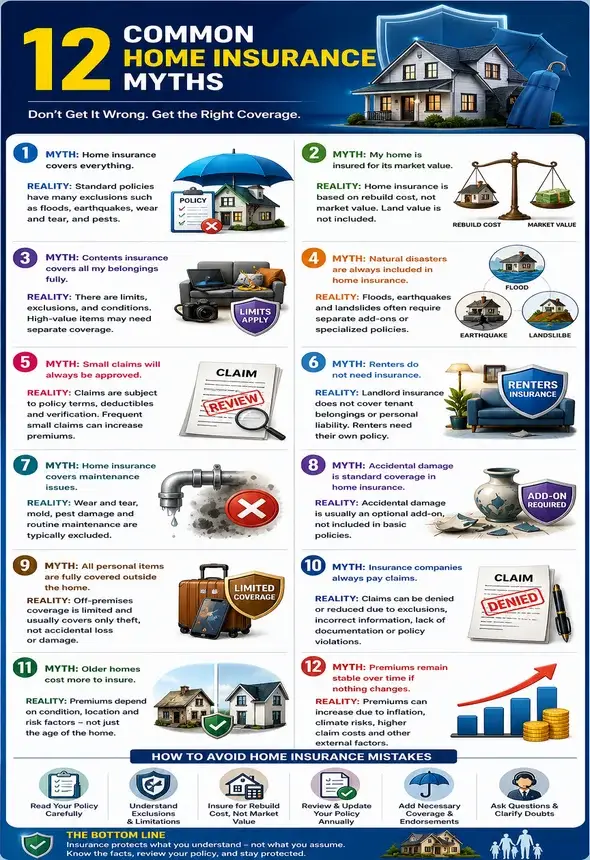
12 Common Home Insurance Myths Explained( Examples)
1. Home insurance covers everything
Reality: Standard home insurance policies only cover specific risks listed in the agreement. Common exclusions include floods, earthquakes, gradual wear and tear, and sometimes high-value items beyond limits. Additional coverage or separate policies are often required for full protection.
Example: In United States, a homeowner files a claim after basement flooding caused by heavy rain, but it gets rejected because flood insurance wasn’t included. Similarly, in Pakistan, someone assumes theft of expensive jewelry is fully covered, but the payout is limited due to policy caps.
Insight: Understanding what your home insurance policy includes, and excludes helps avoid unexpected financial loss and ensures you choose the right coverage for your needs.
2. My home is insured for its market value
- Reality: Home insurance is usually based on the rebuilding cost, not the market value. Market value includes land price and location factors, while insurance focuses only on the cost to repair or rebuild the structure using materials and labor.
- Example: In United Kingdom, a homeowner assumes their high property value means full coverage, but the insurer only pays the rebuilding cost, which is lower i.e. A home worth £500,000 in the market may cost only £320,000 to rebuild.
- Insight: Knowing the difference between market value and rebuilding cost helps you avoid overpaying premiums or being underinsured when damage occurs.
3. Contents insurance covers all my belongings fully
Reality: Contents insurance has limits, exclusions, and conditions. High-value items like jewelry, electronics, or artwork often have coverage caps unless separately declared. i.e. $1,000–$2,500. Damage from neglect, wear and tear, or certain events may also not be covered.
Example: In Australia, a homeowner assumes a stolen laptop and jewelry will be fully reimbursed, but the insurer only pays up to a set limit. In India, someone loses valuables during a burglary but receives partial compensation due to undeclared high-value items.
Insight: Reviewing policy limits and declaring expensive belongings ensures your contents insurance truly protects what matters most.
4. Natural disasters are always included in home insurance
Reality: Standard home insurance policies do not automatically cover all natural disasters. While events like fire or storms may be included, floods, earthquakes, and landslides often require separate add-ons or specialized coverage depending on the country and insurer.
Example: In United States, a homeowner expects hurricane flooding to be covered but finds it excluded without flood insurance. In Japan, earthquake damage is not included in basic policies and needs separate earthquake insurance.
Insight: Always check your policy for specific disaster coverage so you are not financially exposed during unexpected natural events.
5. Small claims will always be approved
Frequent small claims can increase premiums or lead to policy cancellation.
- premium increase risk
- claim history tracking
Reality: Even small home insurance claims are subject to policy terms, verification, and deductibles. If the damage is due to an excluded cause, poor maintenance, or falls below the deductible, the claim may be denied or not paid in full.
Example: In Canada, a homeowner claims for a minor ceiling leak, but it is rejected because it resulted from long-term neglect rather than a sudden incident. In Pakistan, a small burglary claim is reduced after the deductible is applied, leaving the owner to cover part of the loss.
Insight: Even small claims require proper documentation and valid coverage—approval is never guaranteed automatically.
6. Renters do not need insurance
Landlord insurance does NOT cover tenant belongings. i.e. landlord vs. tenant coverage gap
Reality: Renters insurance is essential because a landlord’s insurance only covers the building, not the tenant’s personal belongings or liability. Items like electronics, furniture, and clothing are not protected without a renter’s policy.
Example: In United States, a fire damages an apartment, and the tenant loses all personal items, but the landlord’s insurance does not compensate them. In United Kingdom, a renter faces theft of valuables but receives no payout because they had no contents insurance.
Insight: Renters insurance is a low-cost way to protect personal property and avoid unexpected financial loss in everyday living situations.
7. Home insurance covers maintenance issues
Wear and tear, mold, and pest damage are typically excluded.
Reality: Home insurance does not cover routine maintenance or problems caused by wear and tear. It is designed for sudden and accidental damage, not gradual deterioration or neglect. Issues like leaking roofs mold from poor ventilation, or broken appliances due to age are typically the homeowner’s responsibility.
Example: In Australia, a homeowner tries to claim for a roof leak caused by long-term wear, but the insurer rejects it as maintenance-related. In Pakistan, a damaged water pipe due to rust is not covered because it failed over time, not suddenly.
Insight: Regular home upkeep is essential, as insurance only protects against unexpected and accidental damage, not neglect or aging systems.
8. Accidental damage is standard coverage in home insurance
Reality: Accidental damage is usually not included in basic home insurance policies. It is often an optional add-on that must be purchased separately. Without it, everyday accidents inside the home may not be covered.
Example: In United Kingdom, a homeowner accidentally drops a TV while moving furniture, but the insurer refuses the claim because accidental damage was not included. In India, a child breaks a window during play, but the policy only covers fire and theft, not accidental breakage.
Insight: Always check whether accidental damage is included in your policy, especially if you want protection from common household mishaps.
9. All personal items are fully covered outside the home
Reality: Home insurance often provides limited “personal belongings outside the home” cover, and it usually comes with strict conditions, lower payout limits, and exclusions. Items may only be covered for specific risks like theft, not accidental loss or damage. High-value items may also require separate coverage. Items stolen outside may have limited or partial coverage.
Example: In United States, a phone is stolen while traveling, but the claim is only partially paid due to coverage limits. In Canada, a laptop damaged in a café accident is not covered because accidental damage outside the home wasn’t included.
Insight: Always check off-premises limits in your policy coverage outside the home is usually restricted, not unlimited.
10. Insurance companies always pay claims
Claims can be denied due to exclusions or incorrect disclosures.
Reality: Insurance companies only pay claims that meet the policy terms and conditions. A claim can be rejected or reduced if the damage is excluded, incorrect disclosures, insufficient documentation, the information provided is incorrect, the deductible is not met, or proper proof is missing.
Example: In United States, a homeowner’s claim is denied after water damage is found to be due to long-term leakage, which is excluded. In India, a theft claim is partially rejected because the homeowner failed to provide receipts for high-value items.
Insight: Insurance is not automatic payout protection. It works strictly based on policy rules, documentation, and verified conditions.
11. Older homes cost more to insure
Reality: Older homes are not always more costly to insure. Premiums depend on condition, maintenance, location, and risk factors not just age. A well-maintained older home can sometimes cost less to insure than a newer property in a high-risk area. Risk level depends on condition, not age alone.
Example: In United Kingdom, a well-renovated Victorian house has lower premiums because it is regularly maintained, while a newly built home near a flood-prone zone costs more. In Australia, an older brick home in a low-risk suburb is cheaper to insure than a modern house in a bushfire area.
Insight: Insurance cost is based on risk and condition, not just the age of the property.
12. Premiums remain stable over time if nothing changes
Reality: Home insurance premiums can still increase even if your property and personal situation stay the same. Factors like inflation, rising construction costs, climate risks, and changes in insurance regulations can affect pricing.
Example: In United States, a homeowner sees higher renewal costs due to increased rebuilding material prices after widespread storms. In Canada, premiums rise because of higher claim costs in the region, even though the homeowner made no changes to their house.
Insight: Insurance pricing is influenced by broader economic and environmental trends, not just individual property changes, so premiums can fluctuate over time.
Home Insurance Myths in Real World Insight
A data-driven look at home insurance behavior shows that most “myths” come from consumer misunderstanding not policy failure.
Surveys by organizations like the Insurance Information Institute consistently reveal that over 60% of homeowners underestimate what standard policies cover, especially regarding disasters like floods and earthquakes. This is not due to hidden exclusions, but because these risks require separate policies, something clearly stated in policy documents but often overlooked.
Claims data also reinforces the gap. According to industry reports, a large share of denied claims is due to coverage mismatches (e.g., assuming wear-and-tear or maintenance issues are covered). Insurers approve the majority of claims that fall within defined policy terms, suggesting that the system works as designed—but expectations are misaligned.
Another key data point: policy comprehension. Studies from the National Association of Insurance Commissioners show that fewer than 30% of policyholders fully read or understand their policy documents. This creates reliance on assumptions, social media advice, or outdated beliefs, fueling myths like “home insurance covers everything.”
Digital behavior trends add more context. Search data shows rising queries like “why my claim denied”and“was what does home insurance not cover,” indicating reactive learning rather than proactive understanding.
In short, the evidence points to an information gap: policies are structured and regulated, but consumer literacy hasn’t kept pace. Myths persist not because insurers fail to deliver, but because many users engage with insurance only after a loss, when misunderstandings become costly realities.
Some Facts, Figures, and Trends; Home Insurance Myths
Here are 5 data-backed global facts, figures, and trends that show home insurance myths are driven by knowledge gaps—not policy failure:
- Overconfidence vs reality gap: Around 85% of homeowners feel confident about their insurance, but only 29% actually understand basic terms correctly, highlighting a major perception gap.
- Widespread misunderstanding of coverage: More than 50% of homeowners globally don’t fully understand their policy, and 41% wrongly believe flood damage is covered, despite it requiring separate insurance.
- Low policy engagement: Over 53% of homeowners have never read their full insurance policy, and about 20% admit they don’t understand it at all, reinforcing that myths stem from lack of engagement.
- High coverage, low clarity paradox: In markets like Canada, 99% of homeowners have insurance, yet 20%+ are unfamiliar with what it covers, proving the issue is not access, but understanding.
- Global growth vs literacy gap: The global home insurance market is projected to grow from $247B (2023) to $429B by 2030, yet rising demand coexists with poor consumer literacy—fueling myths rather than fixing them.
Insight: These trends clearly show that home insurance systems are functioning and expanding globally—but consumer knowledge is not keeping pace, which is why myths persist.
Real-Life Examples of Home Insurance Myths or Misunderstandings (Case Studies)
Case Study 1: Flood Damage Not Covered
After heavy monsoon rains, Ali’s home in Karachi was flooded, damaging furniture and wiring. Confident his home insurance covered “natural disasters,” he filed a claim only to learn flood damage required a separate policy. His insurer had clearly listed this exclusion, but Ali had never reviewed it.
The result: thousands in out-of-pocket losses. The issue wasn’t policy failure—it was a common misunderstanding of what standard coverage actually includes.
Case Study 2: Underinsured Home Rebuild Issue
Sarah insured her home in London based on market value, not rebuild cost. After a fire destroyed most of the structure, her payout fell far short of reconstruction expenses due to rising material and labor costs. Her policy worked as written—but her coverage limit was outdated. Like many homeowners, she hadn’t updated her sum insured annually.
This myth—that market value equals rebuild cost—left her significantly underinsured at the worst possible time.
Case Study 3: Jewelry Theft Partial Reimbursement
When a burglary hit Maria’s apartment in New York City, several valuable jewelry items were stolen. She assumed full reimbursement under her home insurance. However, her policy had sub-limits for high-value items, covering only a fraction of the loss. The insurer honored the terms, but Maria hadn’t added a rider for expensive jewelry. This misunderstanding—believing all valuables are fully covered—cost her financially, even though the policy itself functioned correctly.
How to Avoid Home Insurance Mistakes In 2026?
- Check claim settlement ratio & complaint data: Don’t just compare premiums—review insurer performance data from bodies like the Insurance Information Institute or National Association of Insurance Commissioners to see how reliably claims are paid.
- Account for inflation with “extended replacement cost: Basic policies may not keep up with sudden construction cost spikes. Add buffers (e.g., 20–30% extended coverage) to avoid rebuild shortfalls.
- ·Understand “actual cash value” vs “replacement cost”:Many claims pay depreciated value unless you upgrade. This difference can cut payouts significantly if misunderstood.
- Verify temporary living expense (ALE) limits:If your home becomes uninhabitable, check how long and how much your policy will cover for rent, hotels, and daily costs.
- Disclose home-based business activity:Running a business from home? Standard policies often exclude business equipment and liability unless specifically added.
- · Check coverage for shared or rented properties: If you rent out part of your home or list it short-term, your policy may not cover tenant-related risks without endorsements.
- · Review policy triggers (named perils vs all-risk) : Know whether your policy covers only listed risks or everything except exclusions—this drastically changes claim eligibility.
- · Confirm liability coverage limits and legal protection : Many homeowners underestimate liability risks (injuries, lawsuits). Ensure your liability cover is high enough for real-world scenarios.
Author’s Perspective: Home Insurance Myths
Home insurance myths persist not because policies fail, but because understanding hasn’t evolved with modern risk. As climate risk insurance, AI-driven underwriting, and dynamic premiums reshape the industry, the gap between policy complexity and consumer awareness is widening. Many homeowners still rely on outdated assumptions in a rapidly changing landscape.
The future of protection depends not just on better products, but on smarter policyholders. Clear communication, digital transparency, and proactive education must become standard.
In this new era of insurtech innovation, avoiding costly mistakes is less about buying more coverage and more about truly understanding what you already own.
In reality, insurance is a risk-sharing contract, not a blanket protection plan.
Understanding exclusions is more important today than ever because policies are becoming more risk-based and region-specific.
Conclusion
Common home insurance myths and home insurance misconceptions do more than confuse—they create real financial risk. When homeowners misunderstand what home insurance does not cover, they’re more likely to face unexpected losses.
Issues like unclear home insurance exclusions explained, hidden home insurance coverage gaps, and confusion around accidental damage cover explained often lead to frustration.
These gaps also reveal why home insurance claims get rejected and highlight the real reasons insurance claims are denied—not policy failure, but lack of awareness.
True protection comes from clarity. Understanding coverage limits, updating policies, and recognizing home insurance underinsurance risks ensures your policy actually works when you need it most. Insurance is not a one-time decision—it’s an ongoing process that requires attention.
That’s why policies must be reviewed regularly, not assumed to be complete or current.
Insurance only protects what you understand—not what you assume.
FaQs: Home Insurance Myths
1. What are the most common Home Insurance Myths?
The most common home insurance myths include believing that policies cover all damages, insure market value instead of rebuild cost, and automatically include disasters like floods or earthquakes. In reality, policies have exclusions, limits, and conditions that must be reviewed carefully.
2. What does home insurance NOT cover?
Most standard policies do not cover floods, earthquakes, wear and tear, pest damage, or maintenance issues. High-value items may also have limits unless declared separately.
3. Why are home insurance claims denied?
Claims are usually denied due to:
- Policy exclusions
- Incorrect or missing information
- Lack of documentation
- Damage caused by neglect or gradual wear
4. Does home insurance cover natural disasters?
Not all natural disasters are covered. Events like fire and storms may be included, but floods, earthquakes, and landslides often require separate policies or add-ons.
5. Is home insurance based on market value or rebuild cost?
Home insurance is based on rebuild cost, not market value. Market value includes land and location, while insurance focuses only on reconstruction expenses.
6. Are all personal belongings fully covered?
No. Personal belongings are covered up to specific limits, and high-value items like jewelry or electronics may require additional coverage.
7. Do small claims affect home insurance premiums?
Yes. Frequent small claims can increase premiums or even lead to policy cancellation over time.
8. Do renters need home insurance?
Yes. Renters need insurance because a landlord’s policy does not cover tenant belongings or personal liability.
9. Does home insurance cover damage outside the home?
Coverage outside the home is usually limited and conditional, often covering only theft—not accidental loss or damage.
10. Why are home insurance myths increasing in 2026?
Myths are increasing due to:
- Social media misinformation
- Complex policy wording
- Climate-related coverage changes
- Lack of policy review
11. Can home insurance premiums increase without changes?
Yes. Premiums can rise due to inflation, climate risks, and higher claim costs, even if your home hasn’t changed.
12. How can I avoid home insurance coverage gaps?
You can avoid gaps by:
- Reviewing your policy annually
- Understanding exclusions
- Updating coverage limits
- Adding necessary endorsements
Author’s Bio
Arslan Ansari is the CEO of Sitara Realty Pakistan, a BPP University graduate, and a real estate expert. He writes for Insurance IQ Write about home insurance, property protection, homeowner risks, and real estate trends, helping readers make informed decisions about their homes and insurance coverage.