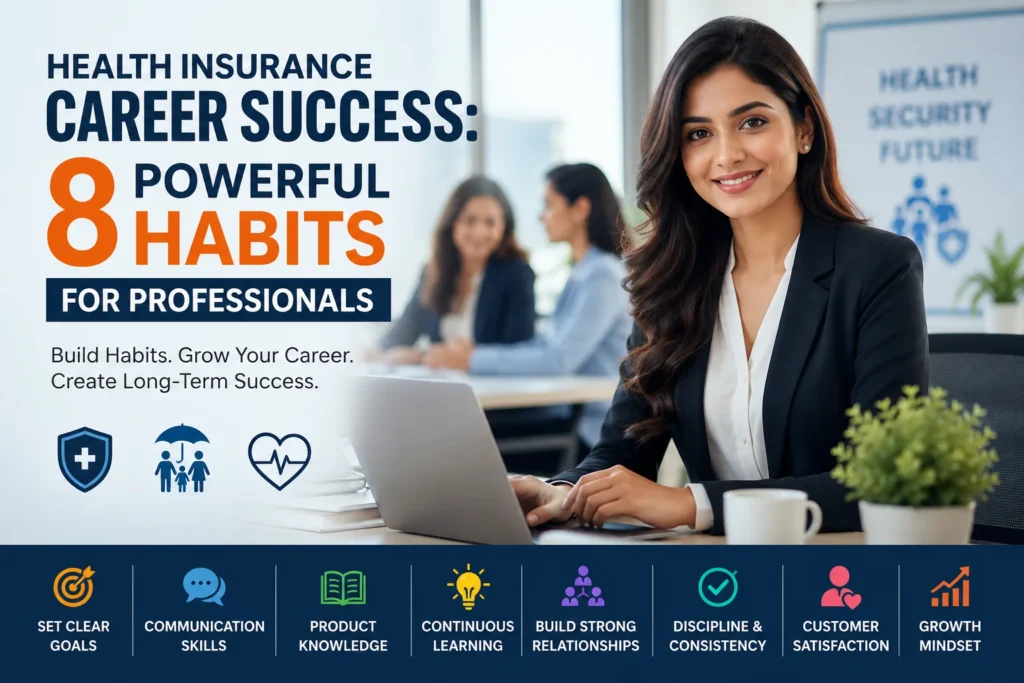
Health Insurance Career Success is not achieved by chance. It is built through consistent habits, discipline, and continuous learning. In today’s competitive insurance industry, professionals who develop strong habits grow faster, earn more, and build long-term stability.
Health Insurance Career Success: 8 Powerful Habits of Top Insurance Professionals
Introduction
Health Insurance Career Success depends on more than just qualifications or experience. In today’s competitive insurance industry, professionals must develop strong, consistent habits for insurance professionals that shape long-term growth, productivity, and performance.
- Many insurance professionals struggle with burnout, inconsistent income, and rejection fatigue.
- Without strong habits, even talented professionals can feel stuck for years.
Whether you are a beginner or an experienced agent, building the right insurance career growth mindset is essential. Research shows that career success is not only about salary or promotions but also about insurance, career development, insurance customer experience, and subjective factors like job satisfaction, recognition, and personal achievement.
In this article, we will explore 8 powerful habits for health insurance professionals that can help you build a successful and sustainable career.
“Health Insurance Career Success means building long-term growth, income stability, client trust, and professional satisfaction through strong daily habits, continuous learning, communication skills, and consistent performance in the insurance industry.”
What is Health Insurance Career Success?
Health insurance career success refers to achieving both professional and personal fulfillment in the insurance industry. It includes:
- Achieving sales targets and promotions
- Building strong client relationships
- Gaining industry knowledge and expertise
- Experiencing job satisfaction and work-life balance
- Career stability
- Insurance sales productivity
- Health insurance advisor skills
Modern studies show that career success is both objective (salary, position) and subjective (satisfaction, recognition, growth) .
In simple terms, success is not only about how much you earn—but also how you feel about your work and growth.
Why Habits Matter in Insurance Career Growth?
Success in the insurance industry is not accidental. It is built through daily habits that improve:
- Sales performance improvement
- Client communication in insurance
- Professional skill development
- Productivity habits for professionals
Research highlights that success habits are repeatable behaviors that improve performance and help individuals achieve long-term goals.
Even top industry research suggests that habits like networking, learning, and goal-setting are key drivers of professional success.
WHY MOST INSURANCE CAREERS STAGNATE?
Many professionals struggle because they:
- Lack daily structure
- Avoid skill development
- Depend only on selling pressure
- Do not build client relationships
This creates unstable income and burnout.
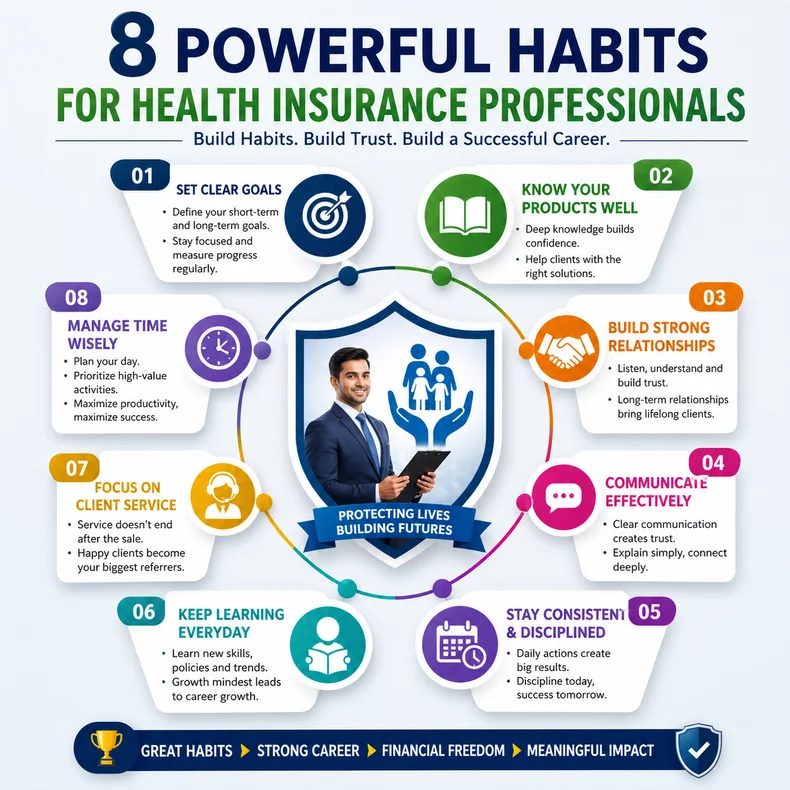
8 Powerful Habits for Health Insurance Professionals
1. Set Clear Career Goals
Successful insurance professionals always define clear short-term and long-term goals.
How to do it:
- Set monthly sales targets
- Define yearly income goals
- Plan client acquisition strategies
Goal setting improves focus and direction, which is essential for insurance career success tips.
2. Build Strong Communication Skills
In the insurance industry, communication is everything.
Why it matters:
- Helps build client trust
- Improves sales conversion
- Strengthens relationships
Professionals who communicate effectively often become top performers in the insurance sales techniques category.
3. Develop Deep Product Knowledge
Successful professionals often study plan structures and market offerings from major insurers such as UnitedHealth Group and Humana to better understand coverage options, pricing models, and client needs. Familiarity with major carriers can improve product recommendations and strengthen client trust.
Understanding insurance policies, benefits, and regulations builds authority.
Clients trust professionals who can clearly explain:
- Coverage details
- Benefits
- Claims process
Example:
A professional who clearly explains policy coverage is more likely to close deals than someone who lacks knowledge.
This supports professional growth in the insurance industry.
4. Practice Daily Learning and Upgrading Skills
The insurance industry changes frequently. Continuous learning is necessary.
Habits include:
- Reading industry updates
- Attending webinars
- Learning new digital tools
Studies show that continuous learning improves employability and long-term career success .
5. Build Strong Networking Relationships
Networking is one of the most powerful habits for career success.
Benefits:
- More referrals
- Better job opportunities
- Industry recognition
Many successful agents credit networking as a key factor in their insurance agent success tips journey.
Many professionals strengthen industry knowledge and referral opportunities through networking groups such as National Association of Health Underwriters. Professional associations can provide education, compliance updates, and valuable industry connections that support long-term career growth.
6. Maintain High Discipline and Consistency
Consistency is more important than talent.
Daily actions:
- Follow up with clients
- Maintain routine schedules
- Track performance regularly
Harvard-backed studies show that consistent habits strongly influence career growth and resilience .
7. Focus on Customer Satisfaction (Real-Life Example Section)
Happy clients lead to repeat business and referrals.
Real-life example:
An insurance agent who regularly checks on clients after policy purchase builds trust and long-term relationships, resulting in higher retention rates.
This directly supports insurance professional habits and business growth.
8. Develop a Positive and Growth Mindset
Your mindset determines your success level.
Key traits:
- Accepting challenges
- Learning from failure
- Staying motivated
Career success research shows that personal motivation and mindset are critical drivers of long-term achievement.(forbs report)
A strong Growth Mindset helps insurance professionals treat setbacks as learning opportunities, improve resilience, and stay motivated. Professionals with a growth-oriented approach often adapt faster, build stronger habits, and achieve better long-term results.
Comparison: Successful vs Average Insurance Professionals
| Factor | Successful Professionals | Average Professionals |
|---|---|---|
| Learning habit | Continuous | Occasional |
| Client follow-up | Regular | Irregular |
| Networking | Strong | Weak |
| Goal setting | Clear & structured | Unplanned |
| Mindset | Growth-oriented | Fixed mindset (Source: Forbes) |
This comparison shows that success is not luck—it is habit-driven behavior.
Data Shows Importance Health Insurance Career Success
According to the U.S. Bureau of Labor Statistics, insurance sales agent employment is projected to remain stable with increasing demand for healthcare-related coverage.
Studies from LinkedIn Learning show continuous learning professionals are promoted faster than peers with stagnant skills.
Research published by Harvard Business Review highlights that consistent habit-building strongly improves professional performance and resilience.
30-60-90 Day Health Insurance Career Success Action Plan
First 30 Days: Build Your Foundation
Focus on creating the habits that support long-term success.
Priorities:
- Set monthly sales and career goals
- Improve product knowledge of major health plans
- Study policy benefits, deductibles, and claims processes
- Use a health insurance calculator to compare plan costs in practice scenarios
- Develop a daily client follow-up routine
Goal:
Build structure, consistency, and confidence.
Expected outcome:
Stronger fundamentals for career growth.
Days 31–60: Improve Performance and Client Relationships
Now focus on applying those habits in real-world situations.
Priorities:
- Strengthen communication and consultative selling skills
- Improve client retention follow-up systems
- Start asking for referrals
- Use your health insurance calculator during consultations to explain premium differences
- Track weekly performance metrics (quotes, conversions, retention)
Goal:
Move from learning to execution.
Expected outcome:
Higher trust, stronger client relationships, improved productivity.
Days 61–90: Optimize Growth and Scale Success
Focus on turning habits into repeatable systems.
Priorities:
- Review results against sales goals
- Improve weak areas in prospecting or closing
- Expand networking with peers and industry groups like National Association of Health Underwriters
- Use digital tools and calculators to standardize recommendations
- Build a long-term personal development plan
Goal:
Turn good habits into a repeatable growth system.
Expected outcome:
Higher performance, better efficiency, and sustainable career growth.
90-Day Success Checklist
By day 90, you should have:
✔ Clear career goals
✔ Stronger product expertise
✔ Better client communication
✔ A repeatable follow-up system
✔ Consistent use of calculator tools
✔ Improved confidence and measurable progress
Why the 30-60-90 Framework Works
The framework follows progressive habit development:
- 30 days = build foundations
- 60 days = apply habits
- 90 days = optimize systems
This aligns with principles tied to Goal Setting Theory and Growth Mindset.
Why the 30-60-90 Framework Works
The framework follows progressive habit development:
- 30 days = build foundations
- 60 days = apply habits
- 90 days = optimize systems
This aligns with principles tied to Goal Setting Theory and Growth Mindset.
Daily Routine of Successful Insurance Professionals
Daily Routine Example
| Time | Activity |
|---|---|
| 8 AM | Lead follow-up |
| 10 AM | Client consultations |
| 1 PM | Product training |
| 3 PM | Prospect outreach |
| 6 PM | Performance review |
Career income growth in the health insurance industry depends on experience, digital skills, certifications, and job performance. Professionals who understand CRM systems, data analysis, underwriting tools, and automation technologies often earn higher salaries because companies value tech-savvy employees. Roles in management, sales, claims analysis, and underwriting usually provide strong promotion opportunities and performance bonuses.
Example 1: An insurance agent with digital marketing and tele-sales skills can increase client conversions and income. Continuous learning and adapting to new technologies help professionals achieve long-term financial growth.
Example 2: An experienced insurance advisor with strong tele-sales and customer management skills can increase their income through commissions, bonuses, and leadership opportunities in remote or hybrid insurance environments.
How Insurance Professionals Build Long-Term Income?
Insurance professionals build long-term income through commissions, policy renewals, referrals, upselling, and customer retention. They earn repeated revenue when clients continue or upgrade policies. Strong relationships and good service help increase trust and referrals. Over time, these strategies create stable, growing income in the insurance industry.
Commissions
Commissions are payments insurance professionals earn for selling new policies. Each successful sale generates a percentage of the premium as income.
Example: An agent selling a health insurance plan may earn a commission on the first-year premium. Higher sales directly increase total earnings and career growth opportunities.
Renewals
Renewals provide ongoing income when clients continue their insurance policies after the initial term. Agents often receive a smaller commission each time a policy is renewed.
Example: If a customer renews their yearly health insurance plan, the agent earns repeat income. This creates stable, long-term financial benefits.
Referrals
Referrals happen when satisfied clients recommend an insurance agent to others. Agents earn new business without heavy marketing costs.
Example: A happy customer may refer a friend needing health insurance, leading to a new policy sale. Referrals help professionals expand their client base and increase earnings efficiently.
Upselling
Upselling means encouraging clients to buy higher-value insurance plans or add-ons for better coverage. This increases both protection for the customer and commission for the agent.
Example: Upgrading a basic health plan to include maternity or critical illness coverage results in higher premiums and increased agent income.
Retention
Retention focuses on keeping existing clients satisfied so they continue their policies long-term. Good service, regular follow-ups, and support improve retention rates.
Example: An agent who quickly resolves claim issues helps customers stay loyal. High retention ensures stable income and reduces the need for constant new customer acquisition.
How Successful Professionals Use Health Insurance Calculators?
Top professionals use digital insurance tools
- Improve client consultations
- Compare plan costs
- Explain premium differences
- Increase conversion rates
- Build trust
Use our Health Insurance Calculator to estimate coverage scenarios, cost planning, and client recommendation comparisons.
Professionals who work with plans from carriers such as UnitedHealth Group and Humana may use calculators to compare premiums, deductibles, and coverage scenarios, helping clients make more informed decisions.
Why Digital Skills Matter in Modern Health Insurance Careers?
Digital skills are essential in modern health insurance careers because the industry now relies heavily on technology for customer service, underwriting, claims processing, and data management. Professionals use CRM systems, automation tools, AI-assisted underwriting, virtual consultation platforms, and data analysis software to improve efficiency and accuracy.
These skills help companies provide faster services, reduce errors, and enhance customer experience.
Employees with strong digital knowledge are more competitive, adaptable, and valuable as health insurance companies continue adopting advanced technologies and digital healthcare solutions.
CRM Systems
CRM systems are essential in modern health insurance careers because they help companies manage customer relationships efficiently. These platforms store client information, policy details, claims history, and communication records in one place. Insurance agents and support teams use CRM tools to provide faster responses and personalized service.
Example: A health insurance advisor using Salesforce can quickly check a customer’s renewal date and recommend updated coverage options.
CRM systems also help sales teams track leads and improve customer retention. Employers prefer professionals with CRM knowledge because it improves productivity, customer satisfaction, and teamwork across departments in today’s digital insurance industry.
AI-Assisted Underwriting
AI-assisted underwriting helps health insurance companies assess risks faster and more accurately. Artificial intelligence analyzes medical records, claim histories, and customer data to support underwriting decisions. Instead of manually reviewing every application, underwriters can use AI tools to identify patterns and predict risks efficiently.
Example: AI software may detect high-risk health conditions and suggest premium adjustments within seconds. Companies using automated underwriting systems reduce processing time and improve accuracy.
Professionals with AI knowledge are increasingly valuable because insurers rely on technology to stay competitive. Understanding AI-assisted underwriting also helps employees work better with digital systems while focusing on complex customer cases and decision-making.
Virtual Consultations
Virtual consultations have become a major part of health insurance services, especially after the rise of telemedicine. Insurance companies now support online doctor appointments through digital platforms and mobile apps. Employees need digital skills to help customers schedule consultations, verify coverage, and process claims related to virtual healthcare.
Example: A customer service representative may guide a patient using Zoom or telehealth software for an online medical appointment.
Virtual consultations improve convenience, reduce travel costs, and increase healthcare accessibility. Professionals familiar with digital communication tools and telehealth systems are highly valued in the modern health insurance industry.
Calculator Tools
Calculator tools are important in health insurance careers because they simplify premium calculations, coverage comparisons, and claim estimates. Insurance professionals use digital calculators to provide accurate quotes and explain policy costs clearly to customers.
Example: An insurance advisor may use an online premium calculator to compare family health plans based on age and medical history.
These tools reduce manual errors and speed up customer service. Many insurance websites also provide self-service calculators that help clients estimate expenses before purchasing coverage. Employees who understand financial and insurance calculator tools can improve customer trust, efficiency, and decision-making in modern insurance operations.
Automation
Automation improves efficiency in the health insurance industry by handling repetitive tasks such as claims processing, policy renewals, and customer notifications. Automated systems save time, reduce paperwork, and minimize human error.
Example: Insurance companies may use automated workflows to approve simple claims instantly without manual review. Employees with automation skills can manage digital systems and improve operational performance. Automation also allows workers to focus on customer support and complex cases instead of routine tasks.
Health insurers increasingly seek professionals who understand workflow software and digital processes. As technology continues to grow, automation knowledge is becoming essential for long-term success in insurance careers.
Data Analysis
Data analysis is a valuable skill in health insurance because companies rely on data to make informed decisions. Professionals analyze customer trends, medical costs, claim patterns, and risk factors to improve services and reduce fraud.
Example: A analyst may use spreadsheets or dashboards to identify which age groups submit the highest medical claims. This helps insurers adjust pricing and coverage plans effectively. Data analysis also supports customer retention and business growth strategies.
Employers prefer candidates who can interpret data and generate useful insights. Strong analytical skills help insurance professionals make smarter decisions and improve efficiency in today’s digital healthcare environment.
What Are Remote Insurance Career Trends?
Remote insurance career trends are growing rapidly as insurance companies adopt digital technologies and flexible work models. Many roles, including customer support, claims processing, underwriting, sales, and data analysis, can now be performed from home using online platforms and cloud-based systems. Companies use video meetings, CRM software, and virtual collaboration tools to manage remote teams efficiently.
Example: A health insurance advisor may work remotely using Microsoft Teams to communicate with clients and coworkers while processing policies online. Remote work reduces operational costs, improves employee flexibility, and allows insurers to hire skilled professionals from different locations worldwide.
Remote and Hybrid Opportunities in Health Insurance
Remote Agents
Remote agents are becoming increasingly common in the health insurance industry as companies shift toward digital operations. These professionals assist customers from home using online communication tools, CRM systems, and cloud-based platforms. Remote agents help clients compare plans, process claims, and answer policy questions without requiring office visits.
Example: An insurance representative may use Zoom to guide customers through policy options virtually. This work model improves flexibility, reduces commuting costs, and allows companies to serve customers efficiently across different locations.
Tele-Sales
Tele-sales has become an important part of modern health insurance careers because companies now reach customers through phone calls, video meetings, and digital communication platforms. Insurance tele-sales professionals explain coverage plans, generate leads, and close sales remotely. Digital tools help agents track customer interactions and manage follow-ups efficiently.
Example: A sales representative may use Salesforce to monitor customer inquiries and renewal opportunities. Tele-sales careers offer flexible work arrangements, performance-based earnings, and broader customer reach, making them highly attractive in the growing digital insurance market.
Digital Enrollment
Digital enrollment allows customers to apply for health insurance plans online without visiting physical offices. Insurance companies now use websites, mobile apps, and automated systems to simplify registration and policy approvals. Employees with digital skills help customers upload documents, verify information, and complete enrollment forms efficiently.
Example: A customer may enroll in a health plan through an online insurance portal using secure digital verification tools. Digital enrollment improves convenience, reduces paperwork, and speeds up policy processing.
This trend has increased demand for tech-savvy insurance professionals who can manage digital customer experiences effectively.
Online Consultations
Online consultations are transforming health insurance services by connecting customers with agents and healthcare providers virtually. Insurance professionals use video conferencing and telehealth platforms to explain policies, discuss claims, and guide customers remotely. This approach saves time and improves accessibility for people in different locations.
Example: A health insurance advisor may conduct a policy review through Google Meet instead of arranging an office visit. Online consultations also support telemedicine services, making healthcare more convenient.
Professionals familiar with virtual communication tools are increasingly valuable in today’s insurance industry.
Flexible Insurance Careers
Flexible insurance careers are becoming more popular as companies adopt remote and hybrid work models. Employees can now work from home, choose flexible schedules, or combine office and remote work depending on company policies. These opportunities are available in customer service, underwriting, claims management, and insurance sales.
Example: A claims specialist may handle customer requests remotely using cloud-based insurance software and digital communication tools. Flexible careers improve work-life balance, reduce commuting stress, and increase productivity.
Health insurance companies increasingly value professionals who can adapt to digital systems and work efficiently in flexible environments.
Author’s Thoughts
“After analyzing modern insurance industry trends, one clear pattern appears: professionals who combine relationship-building with digital skills consistently outperform those who rely only on traditional selling methods.”
5 Mistakes That Keep Insurance Professionals Average
- Weak follow-up
- Poor product knowledge
- Ignoring digital tools
- No networking system
- Inconsistent prospecting
Author’s Thoughts
In my view, Health Insurance Career Success is not achieved overnight. It is built through discipline, learning, and emotional intelligence.
Most professionals fail not because they lack knowledge, but because they lack consistency in applying the right habits.
If you can master even 3–4 of the habits listed above, you will see noticeable improvement in your insurance career within months.
Supporting Research Insight
Studies in career development confirm:
- Subjective success (satisfaction, recognition) is more important than financial success alone
- Career growth depends heavily on human capital and skill development
- Motivation and habits strongly influence long-term success
This proves that insurance success is a combination of skills + mindset + habits.
Research in professional development and frameworks like Growth Mindset suggests long-term career success is influenced by habits, adaptability, and continuous learning, not simply technical knowledge alone.
Conclusion
The insurance industry rewards professionals who stay disciplined, adaptable, and client-focused. Start improving one habit at a time, and over the next 90 days, your confidence, income, and career stability can change dramatically.
Health Insurance Career Success is not just about selling policies. It is about building a professional identity based on strong habits.
By applying these 8 powerful habits:
- You improve performance
- You increase client trust
- You grow your income
- You achieve long-term stability
Success in the insurance industry is predictable when habits are consistent and focused.
FAQs: Health Insurance Career Success
1. What is health insurance career success?
Health insurance career success means achieving long-term growth through higher income, strong client relationships, industry expertise, and professional satisfaction. It includes both objective success, such as promotions and sales performance, and subjective success, such as career fulfillment, stability, and personal development.
2. What are the best habits for insurance professionals?
The best habits for insurance professionals include goal setting, strong communication, continuous learning, disciplined follow-up, networking, and customer-focused service. These habits improve productivity, increase trust, strengthen client retention, and support long-term success in the insurance industry.
3. How can I grow in my insurance career?
Grow in your health insurance career success by improving product knowledge, building stronger client relationships, maintaining consistent prospecting habits, and tracking performance goals. Many professionals also use digital tools like health insurance calculators to improve recommendations, increase efficiency, and support long-term career advancement.
4. Is health insurance a good long-term career?
Health insurance can be a strong long-term career because it offers income potential, flexibility, professional growth, and recurring opportunities through renewals and referrals. Professionals who develop strong habits and adapt to industry changes can build stable and rewarding careers.
5. Why are habits important for career success?
Habits matter because consistent daily actions drive long-term results. Strong habits improve discipline, productivity, client communication, and professional development. In the insurance industry, repeatable habits often determine whether professionals achieve sustainable growth or struggle with inconsistent performance.
6. How do successful insurance agents increase income?
Successful insurance agents often increase income by improving client retention, generating referrals, strengthening product expertise, and maintaining disciplined prospecting systems. Many also use technology and digital tools to improve efficiency, deliver better recommendations, and increase conversion opportunities.
7. How can health insurance calculators help professionals succeed?
Health insurance calculators help professionals compare plan costs, explain premium differences, improve client consultations, and support data-driven recommendations. Using calculators can increase trust, improve conversions, and help insurance professionals apply product knowledge more effectively in real-world client scenarios.
8. What skills are most important for health insurance career success?
Key skills for health insurance career success include communication, consultative selling, product knowledge, relationship management, and adaptability. Professionals who combine these skills with discipline, networking, and continuous learning often achieve stronger performance and long-term career growth.
Author’s Bio
Shahzad Mukhtiar is the CEO and Content Writer at Insurance IQ and a graduate of the University of Wales. He writes about health insurance, insurance careers, professional development, and industry trends, helping readers achieve career success in the insurance sector.