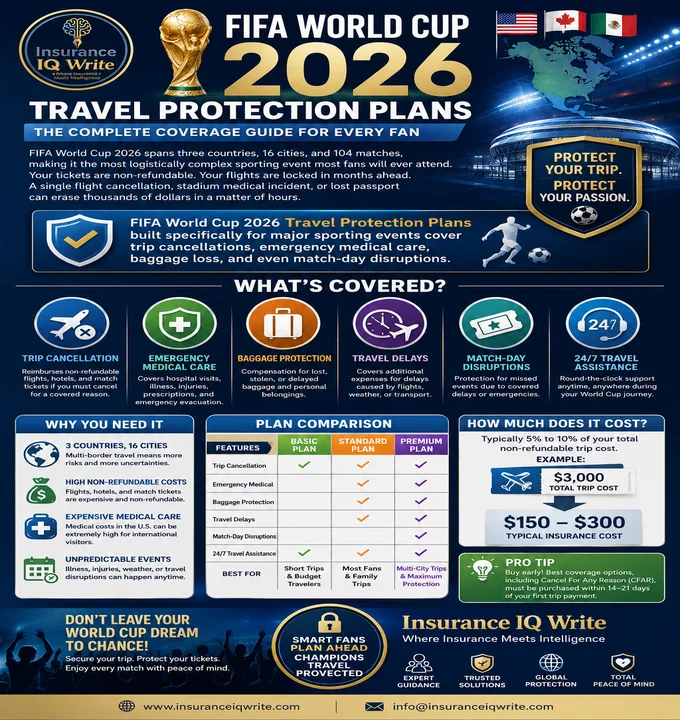
FIFA World Cup 2026 spans three countries, 16 cities, and 104 matches, making it the most logistically complex sporting event most fans will ever attend. Your tickets are non-refundable. Your flights are locked in months ahead. A single flight cancellation, stadium medical incident, or lost passport can erase thousands of dollars in a matter of hours.
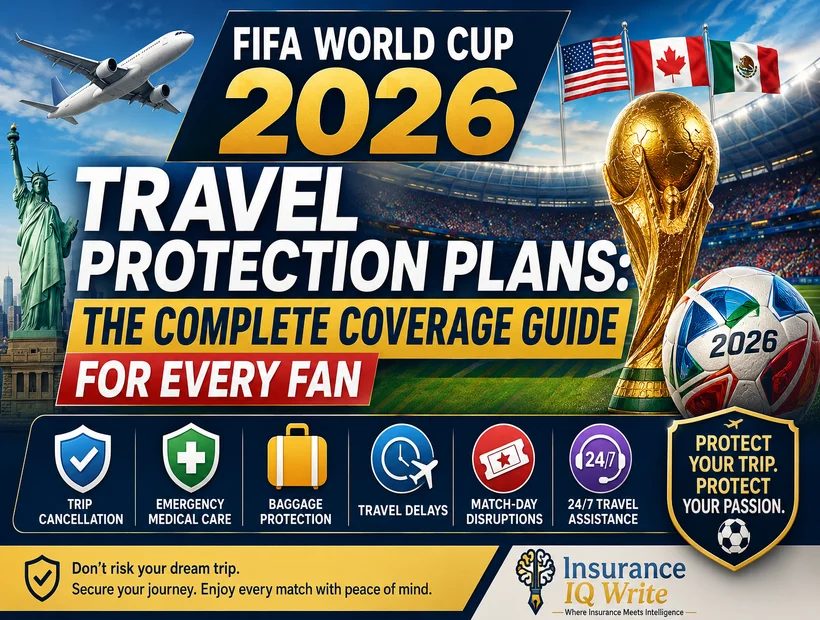
FIFA World Cup 2026 Travel Protection Plans built specifically for major sporting events cover trip cancellations, emergency medical care, baggage loss, and even match-day disruptions. The smartest move any World Cup fan can make isn’t picking the best seat — it’s buying the right protection before they ever board a plane.
FIFA World Cup 2026 Travel Protection Plans: The Complete Guide Every Fan Needs Before Kickoff
Published: June 2026 | Category: Travel Insurance, FIFA 2026, Sports Travel | Reading Time: 8 minutes
Introduction: The Trip of a Lifetime Deserves Serious Protection
There are sporting events, and then there is the FIFA World Cup Insurance Guide. Once every four years, the planet pauses. Cities transform. Strangers become family. And in 2026, for the first time in history, the world’s most-watched tournament spreads across three nations: the United States, Canada, and Mexico with 104 matches played across 16 cities.
Millions of fans are booking flights right now. Hotels in host cities sold out months in advance. Match tickets, in many cases, cost more than a transatlantic flight. And yet, the one thing most fans forget to book is the one thing that sits quietly between them and a financial disaster is a proper travel protection plan.
This guide cuts through the noise. You’ll learn what FIFA World Cup 2026 travel protection plans actually cover, what they don’t, how much they cost, when to buy them, and which type of policy fits your situation. Whether you’re flying solo from London, traveling with family from Argentina, or making a road trip through three U.S. cities, this is the guide you need before kickoff.
What Is a FIFA World Cup 2026 Travel Protection Plans?
A FIFA World Cup 2026 travel protection plan is a specialized travel insurance policy that covers financial losses related to your tournament trip, including trip cancellation, emergency medical care, travel delays, lost baggage, and, in some plans, event ticket protection.
Unlike standard travel insurance, World Cup-specific plans account for the unique risks of international mega-events: border crossings, non-refundable sports tickets, match-day crowd incidents, and the high medical costs of receiving emergency care in the United States.
Think of it as a financial safety net stretched beneath one of the most expensive, most logistically complex trips you’ll ever plan.
Why This World Cup Is Different and Why Standard Insurance May Not Be Enough?
The 2026 edition of the FIFA World Cup is historically unprecedented. Three host nations. Sixteen cities. An estimated 7 million tourists crossing international borders throughout the tournament.
This creates a risk profile that standard travel insurance policies were not designed for:
- Multi-country exposure: A fan flying from Brazil to New York, then driving to Atlanta, then crossing into Mexico for a group-stage match is technically making three separate international trips within one journey.
- Non-refundable stacking: FIFA tickets, international flights, tournament-week hotel rates, and hospitality packages are all pre-paid and largely non-refundable. A single disruption can trigger a cascade of losses.
- U.S. medical costs: An emergency room visit in the United States — for an international visitor without domestic health coverage — can exceed $5,000 for a basic incident. A hospitalisation can reach six figures.
- Match schedule rigidity: Unlike leisure travel, there is no “let’s come back tomorrow.” If you miss kickoff, you missed it.
This is precisely why travel protection plans designed for the World Cup environment are gaining significant attention — and why generic annual travel policies often fall short.
Types of Travel Protection Plans: Explained and Compared
Understanding which plan fits your situation requires knowing what the market actually offers. Here is a clear breakdown:
1. Trip Cancellation Insurance
What it is: Covers prepaid, non-refundable trip costs, flights, hotels, and match tickets if you need to cancel for a covered reason (illness, injury, family emergency, severe weather).
Best for: Fans who have already made significant non-refundable bookings.
Limitation: “Covered reasons” are specific. Cancelling because your team was eliminated, however painful, is not a covered reason.
2. Cancel For Any Reason (CFAR) Coverage
What it is: An optional add-on to trip cancellation insurance that lets you cancel for literally any reason and receive a partial reimbursement typically 50% to 75% of non-refundable costs.
Best for: Fans with uncertain schedules, visa concerns, or anyone who wants maximum flexibility.
Critical timing note: CFAR must typically be purchased within 14 to 21 days of your first trip payment. Miss that window and the option disappears entirely.
Author’s Note: CFAR is the most underrated piece of World Cup travel insurance on the market. The premium is modest, usually 40-50% more than standard cancellation coverage, but the peace of mind is genuinely different. You booked months in advance. Life changes. CFAR acknowledges that.
Use Insurance IQ Write FIFA World Cup 2026 Travel Insurance Calculator for Trip Cancellation, Medical Coverage, Insurance Cost, and Recommended Coverage Amount etc
3. Travel Medical Insurance
What it is: Covers emergency medical treatment that occurs during your trip, including hospital visits, surgery, prescription medication, and in many plans, emergency medical evacuation back to your home country.
Best for: International fans traveling to the USA (where healthcare costs for visitors are among the highest globally), and any fan attending matches in Mexico whose domestic health plan does not extend across borders.
Coverage amounts: Strong policies offer $100,000 to $8 million in medical coverage. Lower limits say $25,000 can be dangerously inadequate for U.S. medical costs.
4. Comprehensive Travel Protection Plans
What it is: An all-in-one policy combining trip cancellation, travel medical, baggage protection, travel delay coverage, and emergency assistance into a single plan.
Best for: International fans making a full multi-match itinerary this is the most practical option for anyone spending serious money on the full World Cup experience.
Cost: Typically 5% to 10% of your total non-refundable trip value. For a $3,000 trip, expect to pay $150–$300.
5. Group Travel Protection Plans
What it is: A single policy that covers multiple travellers typically a minimum of five with individual certificates. Useful for fan groups coordinating matches across different cities.
Best for: Supporters’ clubs, corporate hospitality groups, or families of five or more.
Side-by-Side Comparison: Which Plan Covers What
| Coverage Type | Trip Cancellation | CFAR Add-On | Medical Insurance | Comprehensive Plan |
|---|---|---|---|---|
| Non-refundable flight costs | ✅ | ✅ | ❌ | ✅ |
| Match ticket reimbursement | Sometimes | ✅ | ❌ | Sometimes |
| Emergency medical treatment | ❌ | ❌ | ✅ | ✅ |
| Medical evacuation | ❌ | ❌ | ✅ | ✅ |
| Lost or stolen baggage | ❌ | ❌ | ❌ | ✅ |
| Travel delay compensation | ❌ | ❌ | ❌ | ✅ |
| Cancel for personal reasons | ❌ | ✅ | ❌ | Add-on |
| Pre-existing condition waiver | Sometimes | Sometimes | Sometimes | Sometimes |
Pre-existing condition waivers require purchase within 14–21 days of first payment.
How Much Does FIFA World Cup 2026 Travel Insurance Cost?
Cost depends on three things: your total trip value, your age, and the level of coverage you select.
As a general rule, comprehensive travel protection plans cost between 5% and 10% of your total non-refundable trip costs. Here’s what that looks like in practice:
| Trip Budget | Estimated Protection Plan Cost |
|---|---|
| $1,000 | $50 – $100 |
| $2,500 | $125 – $250 |
| $5,000 | $250 – $500 |
| $10,000+ | $500 – $1,000+ |
For most fans, travel protection is the least expensive line item in a World Cup budget — and the one most likely to save the entire trip financially.
When Should You Buy? Timing Matters More Than Most Fans Realize?
The best time to purchase a FIFA World Cup 2026 travel protection plan is immediately after making your first non-refundable payment whether that’s match tickets, flights, or a hotel deposit.
Here is why timing is critical:
- CFAR eligibility: Most insurers require CFAR add-ons to be purchased within 14 to 21 days of your first trip payment. This window closes fast.
- Pre-existing condition waivers: Purchasing early (within the same window) unlocks coverage for pre-existing medical conditions that would otherwise be excluded.
- Trip interruption coverage: Some benefits only activate if coverage was purchased before a disruption event (such as a hurricane or major weather event) was announced.
Waiting until the week before departure limits your options significantly and may eliminate the most valuable coverage entirely.
Real-World Examples: Where Protection Plans Pay Off
Scenario 1 — The Cancelled Connection A fan from Germany books flights from Frankfurt to Dallas for the round of 16, then connecting to a hospitality package in Houston. A severe storm cancels the Dallas flight. They miss the match, lose their $800 hospitality package, and need emergency accommodation. A comprehensive plan with travel delay coverage reimburses accommodation, meals, and helps rebook flights.
Scenario 2 — The Stadium Medical Incident A 54-year-old fan from Japan experiences chest pains during a match in Los Angeles. He is taken to a nearby hospital, treated, and discharged after two days. Without U.S. health coverage, his bill totals $28,000. His travel medical policy, purchased before departure, covers the full cost above his $250 deductible.
Scenario 3 — The Family Emergency A fan from Australia has already paid $4,200 for flights, tickets, and accommodation when her mother suffers a serious illness back home two weeks before departure. Standard trip cancellation covers the full amount. If she had CFAR, she could cancel even without a qualifying family emergency.
Author’s Perspective
I’ve watched fans lose thousands of dollars at major sporting events simply because travel protection felt like a bureaucratic afterthought. A $200 insurance policy feels less exciting than a $500 match-day jersey. That psychology is understandable — and it’s exactly what insurers are counting on.
The 2026 World Cup is different in scale. You are not booking a weekend city break. You are coordinating flights, border crossings, non-refundable hotel blocks, and event tickets across months of planning, all pointing toward a fixed date and a fixed stadium. The financial exposure is real. The right protection plan does not diminish the experience; it protects the investment that makes the experience possible.
Buy the plan early. Choose comprehensive insurance coverage. Add CFAR if your schedule is uncertain. And then enjoy the football.
Conclusion
FIFA World Cup 2026 represents a once-in-a-generation opportunity for fans around the world. With three host nations, 16 cities, and 104 matches spanning weeks of tournament football, it is also one of the most financially complex trips most fans will ever attempt.
Travel protection plans for fans exist precisely for moments like this. They cover what excitement overlooks: the cancelled flight, the medical emergency, the stolen passport, the unexpected reason you cannot be there at all. They transform a financial catastrophe into a manageable inconvenience — and in some cases, they bring you back for the next match.
The beautiful game deserves a beautiful plan. Get covered before kickoff.
FAQ: FIFA World Cup 2026 Travel Protection Plans
Q: Do I legally need travel insurance to attend FIFA World Cup 2026?
No country hosting the 2026 World Cup requires travel insurance as a legal entry condition. However, given the medical costs in the United States and the non-refundable nature of most bookings, financial advisors and travel experts widely recommend it.
Q: Will my existing health insurance cover me at the 2026 World Cup?
Most domestic health insurance plans provide limited or no coverage outside your home country. International visitors to the USA are particularly exposed, as U.S. healthcare costs rank among the highest in the world for uninsured visitors.
Q: Does travel protection cover my FIFA match tickets if I can’t attend?
Standard trip cancellation insurance may cover match ticket costs if cancellation occurs for a covered reason. Event ticket protection specifically for sports events is available as an add-on with some providers confirm this before purchasing.
Q: What is CFAR and do I need it for the World Cup?
Cancel For Any Reason (CFAR) is an optional policy add-on that reimburses 50–75% of prepaid costs if you cancel for any reason not covered by standard policies. It must be purchased within 14–21 days of your first trip payment. It is particularly valuable for fans with uncertain travel schedules or visa situations.
Q: How much medical coverage is enough for World Cup travel in the USA?
Experts recommend a minimum of $100,000 in emergency medical benefits for travel to the United States. Policies offering $500,000 or more provide stronger peace of mind, particularly for older travellers or those with health conditions.
Q: Can I buy a single travel protection plan for matches in multiple countries?
Yes. Most comprehensive international travel protection plans cover multi-destination trips, including travel between the USA, Canada, and Mexico during the tournament. Confirm that your policy explicitly covers all three host nations.
Q: When is the best time to buy FIFA World Cup 2026 travel insurance?
Immediately after your first non-refundable trip payment, ideally within 14 days, to unlock CFAR eligibility, pre-existing condition waivers, and the broadest possible coverage window.
Q: What does travel protection typically NOT cover at the World Cup?
Standard policies generally exclude cancellation because of team elimination, ticket resale losses, self-inflicted injuries, incidents involving alcohol, and losses arising from civil unrest unless specifically included in your policy terms.