“Climate risk is becoming one of the biggest actuarial challenges of modern insurance.”
Minimise the Climate change impact on Life Insurance. To address this issue, insurance companies must adopt advanced technologies to predict climate risks, while individuals should secure policies early and maintain healthier lifestyles to reduce vulnerability.
Climate Change Impact on Life Insurance
The climate change impact on life insurance is rapidly emerging as a critical global concern, affecting both insurers and policyholders. As extreme weather events, rising temperatures, and environmental risks continue to increase, life insurance companies are facing new challenges in predicting mortality rates and managing long-term financial risk. This shift is leading to rising life insurance premiums and stricter underwriting practices worldwide.
From the United States to India, climate-related health risks are becoming a key factor in insurance pricing, making it essential for individuals to understand how these changes could impact their financial security.
According to the World Health Organization, climate change is expected to significantly increase global mortality rates in the coming decades—directly impacting how life insurance works.
Climate Risk Impact on Life Insurance
| Climate Risk | Impact on Life Insurance |
|---|---|
| Heatwaves | Higher mortality rates |
| Air Pollution | Increased respiratory illnesses |
| Flooding | Long-term health risks |
| Wildfires | Higher claim payouts |
| Disease Spread | Increased underwriting uncertainty |
Why Climate Change Is Now a Financial Threat?
Climate change is no longer limited to environmental discussions. it has become a global financial disruption. One of the most affected yet under-discussed sectors is life insurance.
Across the world—from the United States to Australia—changing climate patterns are increasing health risks, mortality rates, and uncertainty. This directly challenges how life insurance companies calculate premiums and long-term risk.
According to the World Health Organization, climate change is expected to cause hundreds of thousands of additional deaths annually (climate change could cause an additional 250,000 deaths per year between 2030 and 2050), which significantly impacts life insurance systems.
The reality: Life insurance is no longer just about personal health—it’s about environmental risk.
For individuals and families, this shift raises an important question: Will life insurance remain affordable and reliable in the future?
Understanding the Concepts of Climate Change vs Life Insurance
What is Climate Change?
Climate change refers to long-term shifts in temperature and weather patterns, mainly caused by human activities like burning fossil fuels, deforestation, and industrial emissions.
These changes are leading to:
- More frequent heatwaves
- Severe floods and storms
- Rising air pollution levels
- Spread of infectious diseases
The Intergovernmental Panel on Climate Change confirms that extreme weather events are increasing in frequency and severity worldwide.
What is Life Insurance?
Life insurance is a financial contract between an individual and an insurer. In exchange for regular premium payments, the insurer provides financial support to beneficiaries after the policyholder’s death.
Insurance companies calculate premiums based on:
- Age
- Health condition
- Lifestyle
- Life expectancy (risk prediction)
The problem? Climate change is making this risk harder to predict.
The link between the two lies in risk—and climate change is dramatically increasing it.
The problem: Climate change is making those predictions unstable.
How Climate Change Is Affecting Life Insurance?
1. Increased Mortality and Health Risks
Climate change is directly impacting human health:
- Heatwaves increase risk of heart attacks and strokes
- Air pollution worsens respiratory diseases
- Changing climates spread diseases like dengue and malaria
Reports from the Intergovernmental Panel on Climate Change (IPCC) highlight that extreme weather events are becoming more frequent and deadly.
Result: Higher mortality rates → More insurance claims
2. Rising Life Insurance Premiums
As risk increases, insurers must protect themselves financially.
This leads to:
- Higher premium costs
- Stricter approval criteria
- Reduced coverage in high-risk areas
For consumers, this means life insurance may become less affordable over time.
This trend is already being observed globally by reinsurers like Swiss Re and Munich Re
If you want to update premium costs, please use the Insurance IQ Write Calculator for life insurance
3. Uncertainty in Risk Prediction
Life insurance depends on long-term data—but climate change disrupts this system:
- Weather patterns are unpredictable
- Health trends are changing
- Life expectancy is fluctuating
Traditional actuarial models are becoming less reliable. Insurance is shifting from predictable calculations to uncertainty-driven models.
4. Financial Pressure on Insurance Companies
Insurance companies are facing growing challenges:
- Increased claim payouts
- Losses from climate-affected investments
- Market instability
Major global reinsurers like Swiss Re and Munich Re have already identified climate change as a major long-term risk to the insurance industry.
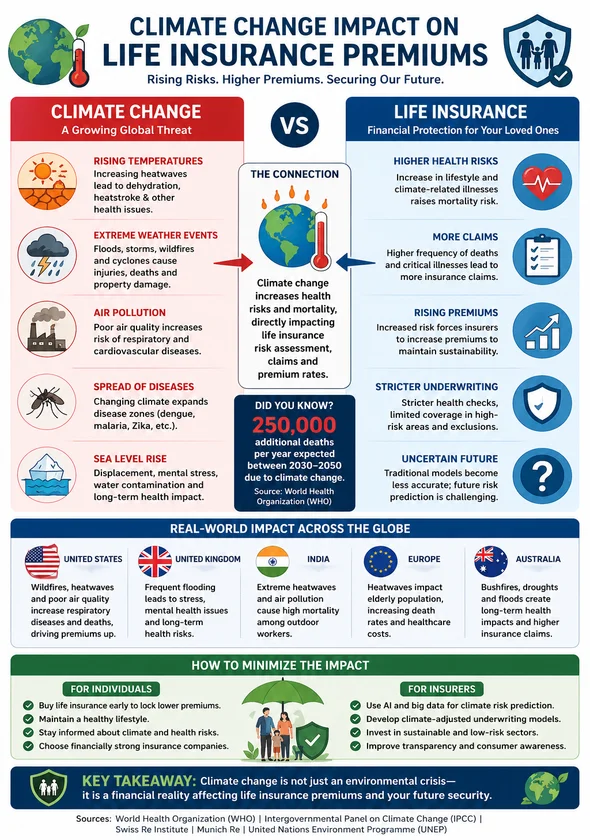
Climate Change & Life Insurance Statistics 2026
Climate change is no longer only an environmental issue. It is now creating serious financial pressure on the global insurance industry, especially life insurance companies. Rising temperatures, dangerous heatwaves, worsening air pollution, floods, and climate-related diseases are increasing health risks around the world.
Because of this, insurers are finding it harder to predict life expectancy and long-term mortality trends accurately.
According to the World Health Organization (WHO), climate change could contribute to nearly 250,000 additional deaths per year between 2030 and 2050 due to heat stress, disease spread, malnutrition, and respiratory illnesses.
At the same time, global reinsurers such as Swiss Re and Munich Re have warned that climate-related mortality risks may significantly change life insurance pricing and underwriting models over the next decade.
Here are some major climate and insurance trends shaping 2026:
| Climate & Insurance Trend | Global Impact |
|---|---|
| Heatwave-related deaths | Rising across Asia, Europe, and North America |
| Climate-related health risks | Increasing heart, lung, and respiratory diseases |
| Insurance claim uncertainty | Growing due to unpredictable mortality patterns |
| Life insurance premiums | Expected to rise in high-risk regions |
| Extreme weather events | Affecting long-term financial risk calculations |
| Air pollution exposure | Increasing chronic illness and mortality rates |
Rising Heatwave Deaths Worldwide
Extreme heat has become one of the biggest climate-related health threats globally.
Countries such as:
- Pakistan
- India
- United States
- Australia
- Southern Europe
have all experienced record-breaking temperatures in recent years.
These heatwaves especially affect:
- elderly people
- outdoor workers
- people with existing health conditions
- low-income communities
As hospital admissions and mortality rates increase, insurers face higher long-term claim risks.
Why Insurance Companies Are Concerned?
Life insurance companies depend heavily on long-term risk prediction. Traditionally, insurers relied on historical health and mortality data to calculate premiums.
However, climate change is making those predictions less stable because:
- weather patterns are becoming unpredictable
- environmental health risks are increasing
- mortality trends are changing faster than expected
This uncertainty creates financial pressure on insurers and may lead to:
- higher premiums
- stricter underwriting
- reduced coverage in high-risk areas
A Major Industry Shift
Many insurance companies are now investing in:
- AI-powered risk modeling
- climate-adjusted underwriting systems
- predictive health analytics
- environmental risk forecasting
The insurance industry is slowly moving away from traditional risk calculations toward climate-based predictive models.
Why These Statistics Matter for Policyholders?
For individuals and families, these climate trends may affect:
- future life insurance affordability
- approval eligibility
- premium costs
- long-term financial planning
People who secure life insurance earlier and maintain healthier lifestyles may have better protection against rising future insurance costs linked to climate-related risks.
Projected Life Insurance Premium Trends Due to Climate Risk
| Year | Estimated Premium Increase |
|---|---|
| 2022 | Stable |
| 2024 | +5% |
| 2026 | +10% |
| 2030 | +20% projected |
Compare and Contrast: Climate Changes vs Life Insurance
| Aspect | Traditional Insurance Model | Climate-Affected Model |
|---|---|---|
| Risk Stability | Predictable | Highly uncertain |
| Premium Trends | Stable | Increasing |
| Data Reliability | Historical data effective | Historical data less useful |
| Risk Scope | Individual | Global + environmental |
Climate change is shifting insurance from a predictable science to a complex risk system.
Global Climate Threats Impacting Life Insurance Risks 2026
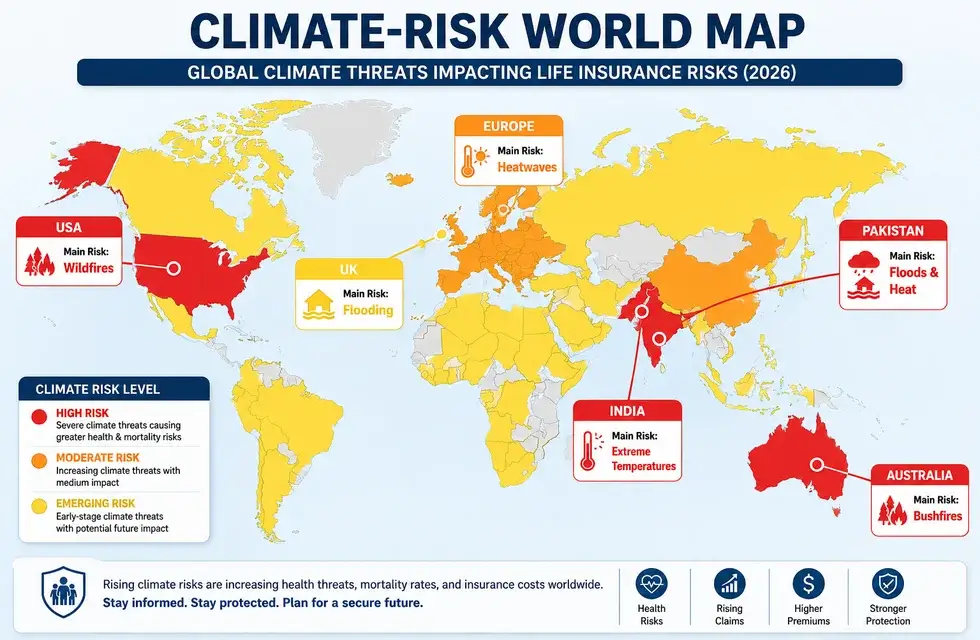
Real-Life Global Examples: Climate Change & Life Insurance Impact
Real-Life Example:Heatwaves in South Asia
Regions like Pakistan frequently experience extreme heatwaves.
- Outdoor workers face life-threatening conditions
- Hospitals report increased emergency cases
- Mortality rates rise during peak summer
For insurers, this means:
Higher deaths → More claims → Increased premiums
This real-world scenario shows how climate change directly connects to life insurance costs.
United States: Wildfires & Heatwaves
In states like California:
- Increasing wildfires and extreme heat events
- Higher respiratory illness cases due to smoke pollution
- Increased mortality during heatwaves
Impact on insurance:
- Insurers adjust risk models
- Premiums rise in high-risk regions
- Long-term uncertainty in health outcomes
United Kingdom: Flooding & Health Risks
The United Kingdom has experienced repeated flooding:
- Damage to infrastructure and living conditions
- Mental health stress and long-term illness
- Increased mortality in vulnerable populations
Insurance effect:
- Rising long-term risk projections
- Increased pricing adjustments
India: Extreme Heatwaves
In India:
- Record-breaking temperatures exceeding 45°C
- High mortality among outdoor workers
- Increased hospital admissions
Insurance impact:
- Higher death claims
- Premium adjustments for high-risk groups
Europe: Heatwaves & Aging Population
Across Europe:
- Severe heatwaves affecting elderly populations
- Thousands of heat-related deaths in recent years
- Increased strain on healthcare systems
Insurance consequence:
- Higher mortality risk in older demographics
- Reevaluation of life expectancy assumptions
Australia: Climate Extremes
In Australia:
- Bushfires, floods, and extreme weather events
- Air quality deterioration
- Long-term health impacts
Insurance result:
- Rising claims
- Financial pressure on insurers
- Increasing premiums
The Future of Life Insurance in a Climate-Risk World
Life insurance is rapidly evolving due to climate change, advanced technology, and data-driven risk modeling. Insurers are now using smarter systems to understand environmental risks and human behavior more accurately.
AI Underwriting
AI underwriting uses artificial intelligence to assess life insurance risk by analyzing large datasets such as medical records, lifestyle habits, and climate exposure. It replaces traditional manual evaluation with faster and more accurate predictions.
Example: A person living in a high heatwave zone with health risks may receive higher premiums compared to someone in a stable climate region. AI helps insurers process applications instantly and adjust pricing based on real-time environmental and health data.
Climate Scoring
Climate scoring evaluates how environmental conditions affect a person’s long-term health risk. It considers factors like air pollution, heatwave exposure, flood risk, and wildfire zones.
Example: Someone living in Delhi or Lahore may receive a higher climate risk score due to extreme heat and pollution levels, compared to someone living in a cooler coastal area. Insurers use this score to adjust premiums and predict future health risks more accurately.
Wearable Health Tracking
Wearable health tracking uses devices like smartwatches to monitor real-time health data such as heart rate, sleep quality, steps, and stress levels. Insurers use this data to assess lifestyle risks more accurately.
Example: a policyholder who exercises regularly and maintains a healthy heart rate may receive lower premiums compared to someone with a sedentary lifestyle.
This encourages healthier habits while allowing insurers to price policies based on real behavior instead of assumptions.
Personalized Pricing
Personalized pricing means life insurance premiums are customized for each individual based on their unique risk profile. Instead of fixed pricing, insurers consider health, lifestyle, occupation, and environmental exposure.
Example: A young non-smoker working indoors in a low-risk area may pay significantly lower premiums than someone working in extreme heat conditions outdoors.
This system ensures fair pricing and rewards healthier and lower-risk individuals with more affordable insurance coverage.
Climate-Adjusted Policies
Climate-adjusted policies are insurance plans designed to reflect changing environmental risks such as heatwaves, floods, and wildfires. These policies adjust coverage and pricing based on regional climate conditions.
Example: A policy in coastal flood-prone areas may include higher disaster-linked mortality protection compared to inland regions. Insurers update these policies regularly using climate data to ensure long-term sustainability.
This approach helps both insurers and customers manage increasing risks caused by global climate change.
Climate Change and Actuarial Science
Climate change is significantly transforming actuarial science, which is the backbone of how life insurance companies calculate risk, premiums, and long-term financial stability. As environmental conditions become more unpredictable, traditional statistical models are becoming less reliable.
Actuarial Modeling
Actuarial modeling refers to the mathematical and statistical methods used by insurers to estimate future risks, especially mortality and financial losses. These models traditionally rely on historical data such as age, health trends, and past death rates. However, climate change is disrupting these patterns.
Example: Rising heatwaves and pollution levels can increase health risks in certain regions, making past data less accurate for predicting future insurance costs and policy pricing.
Predictive Uncertainty
Predictive uncertainty occurs when future outcomes become harder to forecast accurately. In life insurance, this is increasing due to unpredictable climate events like floods, wildfires, and extreme temperatures.
Example: A region that was once considered low-risk may suddenly experience repeated heatwaves, changing mortality trends quickly.
This makes it difficult for insurers to set stable premiums, forcing them to frequently adjust pricing and risk assessments based on evolving climate data.
Mortality Forecasting
Mortality forecasting is the process of predicting death rates within populations over time. It helps insurance companies determine premiums and policy structures. Climate change is now affecting these forecasts by increasing deaths linked to heat stress, respiratory diseases, and natural disasters.
Example: Rising temperatures in South Asia can increase mortality among outdoor workers, which directly impacts life expectancy assumptions used in insurance pricing models and long-term financial planning.
Climate Migration and Insurance
Climate change is not only affecting weather patterns. It is also changing where people live and how insurance systems operate. As certain regions become more exposed to extreme heat, floods, droughts, and sea-level rise, large populations are beginning to relocate to safer areas.
This movement is creating new challenges for life insurance companies in terms of risk assessment and coverage availability.
People Relocating
People are increasingly moving away from high-risk climate zones to safer cities and regions. For example, families living in flood-prone coastal areas or extreme heat regions may shift to inland or higher-altitude locations. This relocation is often driven by repeated natural disasters, rising health risks, and economic instability.
For insurers, this means policyholders are no longer concentrated in stable risk zones, making long-term risk prediction more complex.
Regional Risk Shifts
As populations move, insurance risk is also shifting geographically. Areas once considered low-risk may become high-density zones, increasing pressure on local infrastructure and healthcare systems.
Example: If large populations move from coastal cities to inland urban areas, insurers must reassess mortality risk, pollution exposure, and disease spread.
These regional shifts force insurance companies to continuously update pricing models and adjust coverage based on evolving environmental conditions.
Insurance Accessibility
Climate migration is also affecting insurance accessibility. In high-risk regions, insurers may increase premiums or reduce coverage availability due to rising claims and uncertainty.
Example: People living in flood-affected zones may face higher life insurance costs or stricter approval conditions. At the same time, migrating populations may find better access to insurance in safer regions.
This creates inequality in insurance availability based on geography and climate risk exposure.
Climate Change and Mental Health
Climate change is increasingly recognized as not only an environmental and physical health issue but also a major mental health challenge. Rising temperatures, repeated disasters, and uncertain living conditions are creating long-term psychological stress that directly and indirectly influences mortality risk in populations.
Anxiety
Climate-related anxiety is becoming more common as people worry about extreme weather events, rising costs, and future uncertainty.
Example: An individual living in flood-prone or heatwave-affected regions may constantly feel stress about safety, finances, and survival.
This ongoing anxiety can reduce quality of life, increase stress-related illnesses, and weaken overall health, which may later impact life insurance risk assessments.
Trauma
Severe climate disasters such as floods, wildfires, and hurricanes often leave lasting emotional trauma. People who lose homes, family members, or livelihoods may experience post-traumatic stress disorder (PTSD).
Example: Survivors of major flooding events in Pakistan or hurricanes in the United States often report long-term psychological distress. T
his trauma can affect physical health over time, increasing vulnerability to chronic diseases and reducing life expectancy.
Long-Term Health Effects
Mental health challenges caused by climate change do not remain isolated; they often lead to long-term physical health issues. Chronic stress can contribute to heart disease, high blood pressure, sleep disorders, and weakened immunity.
Example: An individual experiencing prolonged climate anxiety may develop stress-related conditions that require ongoing medical care.
These long-term effects increase healthcare costs and indirectly influence life insurance risk models.
Mortality
The combined impact of anxiety, trauma, and long-term mental health deterioration can contribute to increased mortality risk. Mental health conditions are closely linked to physical health outcomes, especially in high-stress environments affected by climate disasters.
Example: Populations exposed to repeated heatwaves or displacement may experience higher rates of stress-related illness and premature death.
Insurers are now beginning to consider mental health as an important factor in mortality forecasting and risk evaluation.
Life Insurance Industry Challenges by 2030
By 2030, the life insurance industry is expected to face major structural changes driven by climate change, technological disruption, and shifting global demographics.
These challenges will reshape how insurers calculate risk, price policies, and manage long-term financial stability.
1. Rising Climate-Driven Mortality Risks
Extreme weather events such as heatwaves, floods, wildfires, and air pollution will continue increasing health risks worldwide. For example, more frequent heatwaves in South Asia and Europe may lead to higher cardiovascular and respiratory deaths.
This makes it harder for insurers to predict life expectancy accurately, increasing claim uncertainty and forcing higher premiums in high-risk regions.
2. Unstable Risk Prediction Models
Traditional actuarial models rely on historical data, but climate change is breaking these patterns. For example, regions that were once considered low-risk may suddenly face repeated climate disasters.
This creates predictive uncertainty, making it difficult for insurers to maintain stable long-term pricing strategies and forcing constant model updates using real-time environmental data.
3. Increasing Insurance Premium Pressure
As risk levels rise, insurers will likely increase life insurance premiums to maintain profitability. Customers in high-risk areas may face significantly higher costs or stricter eligibility requirements.
Example: An individual living in flood-prone or wildfire regions may pay more compared to those in stable climates, creating affordability challenges for middle and low-income groups.
4. Impact of AI and Automation
Artificial intelligence will reshape underwriting, claims processing, and risk assessment. While AI improves efficiency, it also introduces new challenges such as data privacy concerns and algorithmic bias.
Example: Automated systems may unintentionally assign higher risk scores to certain regions or populations based on climate exposure data.
5. Climate Migration and Market Shifts
Population movement due to climate change will alter insurance markets. As people relocate from high-risk coastal or heat-affected regions to safer areas, insurers must continuously adjust pricing and coverage models.
Example: Migration into urban centers may increase congestion-related health risks, creating new insurance challenges.
6. Regulatory and Compliance Pressure
Governments are expected to introduce stricter regulations around climate risk disclosure and insurance pricing fairness. Insurers will need to justify how climate data influences premiums.
Example: New policies may require transparency in how environmental risk scores affect customer pricing decisions.
Final Outlook Life Insurance Challenges
By 2030, life insurance will become a more data-driven, climate-sensitive, and technology-dependent industry. Companies that adapt early to climate risk modeling, AI underwriting, and predictive analytics will remain competitive, while others may struggle to manage rising uncertainty and financial pressure.
How to Minimize Climate Change Impact on Life Insurance?
For Insurance Companies:
- Use AI and big data for climate risk prediction
- Develop climate-adjusted underwriting models
- Invest in sustainable and low-risk sectors
For Individuals:
- Buy life insurance early (lower premiums)
- Maintain a healthy lifestyle
- Stay informed about environmental risks
- Choose financially strong insurers
Early action can protect you from rising future costs.
Expert Insight : Climate Change Impact on Life Insurance
From a practical perspective, climate change is transforming life insurance into a more complex system.
- Insurers must innovate rapidly
- Governments should support regulatory frameworks
- Individuals must act proactively
Ignoring climate change in financial planning is no longer an option.
Expert Insight:A Global Financial Shift
Climate change is reshaping life insurance worldwide:
- It increases uncertainty in mortality prediction
- It raises financial pressure on insurers
- It affects affordability for individuals
Governments, insurers, and individuals must all adapt.
Conclusion: A Silent but Powerful Shift
The impact of climate change on life insurance is gradual but significant. The effect of climate change on life insurance is not theoretical. It is already happening across the globe.From the United States to Australia, environmental risks are high. The impact of climate change on life insurance is already visible worldwide.
- Premium costs
- Risk calculations
- Accessibility of coverage
- Increasing mortality
- Changing how insurance works
The key takeaway:
Climate change is not just an environmental crisis—it is a financial reality affecting your long-term security.
Planning today can help you stay protected tomorrow.
FAQs: Climate Change Impact On Life Insurance
1. Why is climate change affecting life insurance?
Because it increases health risks and mortality rates, leading to more insurance claims. Climate change impact on life insurance is growing due to heatwaves, air pollution, and natural disasters, which make life expectancy harder to predict and increase financial risk for insurers.
2. Will life insurance premiums continue to rise?
Yes, if climate-related risks continue increasing, premiums are likely to go up. The climate change impact on life insurance is expected to push premiums higher as insurers face more claims, rising mortality risks, and unpredictable environmental conditions that affect long-term risk modeling and pricing structures globally.
3. Who is most at risk?
People in extreme weather regions, outdoor workers, and those with health issues. Individuals exposed to heatwaves, floods, or air pollution face higher mortality risk, making them more vulnerable to the long-term climate change impact on life insurance pricing and coverage decisions.
4. Can insurance companies manage climate risks?
They are adapting with technology, but uncertainty remains a challenge. Insurers are using AI underwriting, climate risk modeling, and predictive analytics to manage the climate change impact on life insurance, but extreme weather unpredictability still makes long-term forecasting difficult.
5. What should I do as a policyholder?
Secure a policy early, stay healthy, and review your coverage regularly. Early planning helps reduce exposure to rising costs linked to the climate change impact on life insurance, while maintaining good health and choosing strong insurers improves long-term financial protection.
6. Which regions are most affected?
High-risk regions like the U.S., India, Pakistan, Australia, and parts of Europe. These areas face stronger climate change impact on life insurance due to heatwaves, floods, wildfires, and rising environmental risks that directly affect health and insurance claim frequency.
Final Thought
Climate change is silently reshaping industries and life insurance is one of the most affected. Understanding this connection today can help you make smarter financial decisions tomorrow.
Author’s Bio
Syedah Arooj is a content writer at Insurance IQ who writes about climate change, life insurance, and financial risk. She focuses on how environmental changes are affecting insurance premiums and long-term financial security.
LinkedIn Profile by Syedah Arooj