Cyber insurance for small businesses is becoming essential in today’s digital world, where cyber threats are increasing rapidly. Small businesses are often targeted by hackers due to limited security resources, making them vulnerable to data breaches, ransomware attacks, and financial losses.
In 2026, cyberattacks against small businesses continue to rise. Studies show that nearly half of all cyberattacks target small businesses because they often lack enterprise-level security. A single ransomware attack can cost thousands of dollars and disrupt operations for weeks. Cyber insurance helps businesses recover financially when these incidents occur.
Cyber insurance helps protect your business by covering costs related to cyber incidents, including data recovery, legal fees, and customer notification expenses. It acts as a financial safety net, allowing businesses to recover quickly and continue operations. Understanding how cyber insurance works can help small business owners make smarter decisions and safeguard their digital assets effectively.
Cyber Insurance IQ Write Calculator
To calculate basic cyber insurance and premium cyber insurance, use Insurance IQ’s write cyber insurance calculator tool
Cyber Threat Statistics Every Small Business Should Know (2026)
Cybercrime continues to be one of the fastest-growing risks facing small businesses worldwide. Recent studies show that cyberattacks against small and medium-sized businesses (SMEs) increased by approximately 16% in 2025, while the average cost of a small business data breach reached around $140,000.
Small businesses remain a primary target for cybercriminals. Research indicates that 61% of small businesses experienced a cyberattack, and many attacks specifically target smaller organizations because they often have fewer cybersecurity resources than larger enterprises.
Ransomware continues to be one of the most expensive cyber threats. Industry reports show that ransomware incidents are becoming more frequent, with ransomware involved in approximately 44% of reported SMB cyber incidents in 2025. Recovery costs, business interruption, and data restoration expenses can quickly reach tens or even hundreds of thousands of dollars.
The cyber insurance market is also growing rapidly as businesses seek financial protection against these risks. More organizations are purchasing cyber insurance policies to help cover data recovery, legal expenses, incident response, customer notifications, and business interruption losses following cyberattacks.
These statistics highlight why cyber insurance is becoming an important risk-management tool for small businesses in 2026 and beyond.
Cyber Insurance for Small Businesses
Cyber attacks are no longer just a problem for big corporations—small businesses are now one of the biggest targets. From data breaches to ransomware, a single incident can cause serious financial damage.
That’s why many companies are turning to cyber insurance. But what exactly is it, and do you really need it?
In this guide, we answer the 11 most common cyber insurance questions for small businesses in simple terms.
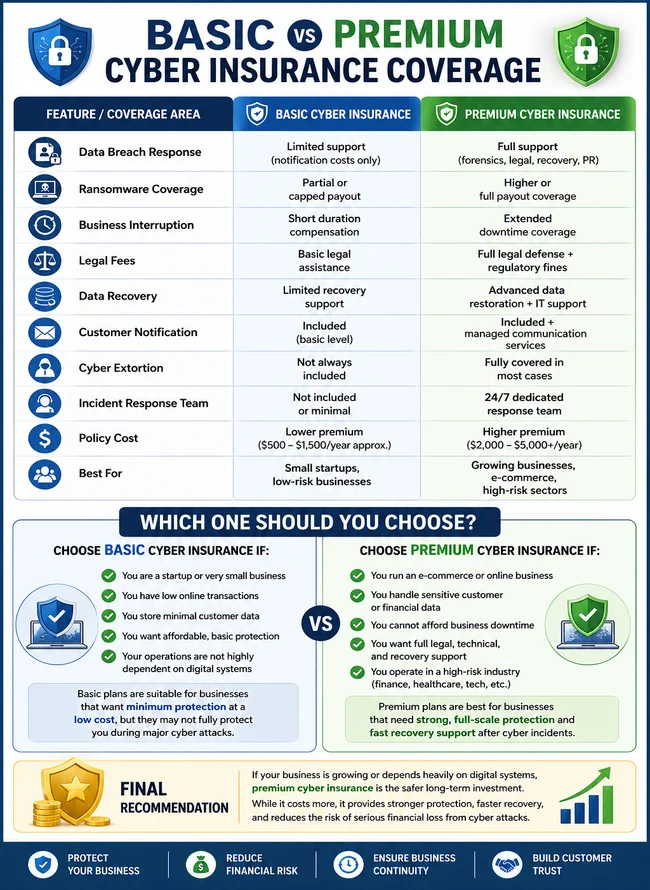
Basic vs Premium Cyber Insurance Coverage
| Feature / Coverage Area | Basic Cyber Insurance | Premium Cyber Insurance |
|---|---|---|
| Data Breach Response | Limited support (notification costs only) | Full support (forensics, legal, recovery) |
| Ransomware Coverage | Partial or capped payout | Higher or full payout coverage |
| Business Interruption | Short duration compensation | Extended downtime coverage |
| Social Engineering Fraud | Limited | Included |
| Data Recovery | Limited recovery support | Advanced data restoration + IT support |
| Customer Notification | Included (basic level) | Included + managed communication services |
| Cyber Extortion | Not always included | Fully covered in most cases |
| Incident Response Team | Not included or minimal | 24/7 dedicated response team |
| Regulatory Fines | Limited | Covered |
| Third-Party Liability | Basic | Extensive |
| Cyber Risk Assessment | No | Yes |
| Security Consultation | No | Included |
| Policy Cost | Lower premium ($500-$1,500/year | Higher premium ($2,000-$5,000+/year) |
| Best For | Small startups, low-risk businesses | Growing businesses, e-commerce, high-risk sectors |
Real-World Examples of Cyber Insurance Importance
A small e-commerce store once became the victim of a ransomware attack. Hackers encrypted all their customer and order data and demanded a ransom payment to restore access.
The business was forced to shut down operations temporarily, resulting in:
- Loss of sales for several days
- Customer trust damage
- Emergency IT recovery expenses
In total, the company lost around $8,000 in revenue and recovery costs.
Fortunately, because the business had cyber insurance, most of the recovery expenses including IT support and data restoration—were covered. This helped them resume operations quickly without long-term financial damage
Real-World Example: How Cyber Insurance Can Help
In 2024, many small and medium-sized businesses worldwide were affected by ransomware attacks that encrypted critical business data and disrupted daily operations. Victims often faced significant costs related to IT recovery, business downtime, customer communications, and legal compliance.
For example, imagine a small online retailer that stores customer information and processes orders through its website. A ransomware attack encrypts its customer database, order records, and payment systems, making them inaccessible.
As a result, the business may face:
- Several days of operational downtime
- Lost sales and revenue
- Emergency cybersecurity and data recovery expenses
- Customer notification and support costs
- Potential legal and regulatory obligations
Without cyber insurance, these expenses could place substantial financial pressure on the business. However, a cyber insurance policy may help cover eligible costs such as incident response services, forensic investigations, data restoration, legal assistance, customer notification expenses, and business interruption losses.
Which Cyber Insurance Should You Choose? (Basic vs Premium)
Choosing between basic and premium cyber insurance depends on your business size, risk level, and how much digital data you handle.
Choose Basic Cyber Insurance if:
- You are a startup or very small business
- You have low online transactions
- You store minimal customer data
- You want affordable, basic protection
- Your operations are not highly dependent on digital systems
Basic plans are suitable for businesses that want minimum protection at a low cost, but they may not fully protect you during major cyber attacks.
Cyber insurance is a type of policy that protects businesses from financial losses caused by cyber attacks.
Final Recommendation (Expert Thoughts)
If your business is growing or depends heavily on digital systems, premium cyber insurance is the safer long-term investment. While it costs more, it provides stronger protection, faster recovery, and reduces the risk of serious financial loss from cyber attacks.
Choose Premium Cyber Insurance if:
- You run an e-commerce or online business
- You handle sensitive customer or financial data
- You cannot afford business downtime
- You want full legal, technical, and recovery support
- You operate in a high-risk industry (finance, healthcare, tech, etc.)
Premium plans are best for businesses that need strong, full-scale protection and fast recovery support after cyber incidents.
Understanding First-Party vs Third-Party Cyber Insurance Coverage
Not all cyber insurance policies provide the same protection. Most cyber insurance coverage falls into two main categories: first-party coverage and third-party coverage.
First-Party Coverage
First-party coverage protects your own business from direct financial losses caused by a cyber incident.
Common examples include:
- Data recovery and restoration costs
- Business interruption and lost income
- Ransomware and cyber extortion expenses
- Incident response and forensic investigations
- Crisis management and public relations support
- Customer notification and credit monitoring services
For example, if a ransomware attack shuts down your online store for several days, first-party coverage may help cover lost revenue and recovery expenses.
Third-Party Coverage
Third-party coverage protects your business when customers, partners, or regulators claim that your organization caused them financial harm due to a cyber incident.
Common examples include:
- Customer lawsuits following a data breach
- Privacy and data protection claims
- Legal defense costs
- Regulatory investigations and penalties (where legally insurable)
- Settlement and compensation expenses
For example, if customer information is exposed during a data breach and affected customers file legal claims, third-party coverage may help pay legal and settlement costs.
Why Both Types of Coverage Matter?
Many small business owners focus only on recovering their own losses after a cyberattack. However, legal claims, regulatory investigations, and customer lawsuits can sometimes cost even more than the initial breach itself.
When comparing cyber insurance policies, make sure you understand how much first-party and third-party coverage is included so your business is protected from both direct and indirect cyber risks.
How Much Does Cyber Insurance Cost?
Cyber insurance costs vary depending on the size of your business, the industry you operate in, the type of data you handle, and your overall cybersecurity posture.
Small businesses typically pay between $500 and $5,000 annually, although premiums can vary significantly depending on:
- Annual revenue and business size
- Industry risk level
- Amount of sensitive customer data stored
- Coverage limits and policy features
- Previous cyber incidents or claims history
- Existing cybersecurity controls and employee training
Businesses with stronger security measures, such as multi-factor authentication (MFA), endpoint protection, regular data backups, and employee cybersecurity training, may qualify for lower premiums.
Because pricing varies by insurer and region, it’s a good idea to compare quotes from multiple providers and carefully review policy coverage before making a decision.
1.What is Cyber Insurance?
Cyber insurance is a type of business insurance designed to protect companies from financial losses caused by cyberattacks, data breaches, ransomware incidents, and other digital threats.
It typically helps cover:
- Data breaches
- Hacking incidents
- Legal costs
- Customer notification expenses
Think of it as a safety net for your digital risks.
2. Why Do Small Businesses Need Cyber Insurance?
Many small businesses assume they’re too small to be targeted—but that’s not true.
Hackers often target smaller companies because:
- They have weaker security
- Less protection systems
- Limited IT resources
Even global firms like IBM report that small businesses are increasingly vulnerable.
3. What Does Cyber Insurance Cover?
Coverage varies by provider, but most policies include:
- Data breach response
- Business interruption losses
- Ransomware payments
- Legal fees and fines
- IT recovery costs
Providers like Allianz and AXA offer different coverage options depending on your business needs.
4. What Does Cyber Insurance NOT Cover?
Cyber insurance usually does NOT cover:
- Employee negligence (in some cases)
- Pre-existing vulnerabilities
- Poor security practices
- Intentional misconduct
Always read the policy details carefully.
5. Is Cyber Insurance Mandatory?
No, cyber insurance is not legally required in most countries.
However:
- Some clients may require it
- It can be essential for compliance
- It protects against major financial risks
6. How Do I Choose the Right Cyber Insurance Policy?
Look for:
- Coverage limits
- Type of risks covered
- Claim process
- Reputation of the provider
Compare multiple providers before deciding.
7. Can Cyber Insurance Prevent Attacks?
No—cyber insurance does NOT prevent attacks.
It only helps you:
- Recover financially
- Manage damage
- Handle legal issues
You still need strong cybersecurity practices.
8. What Are the Requirements to Get Cyber Insurance?
Most insurers require:
- Basic security measures
- Firewalls and antivirus
- Strong password policies
- Employee training
Without these, your application may be rejected.
9. Is Cyber Insurance Worth It for Small Businesses?
In most cases, yes.
One cyber attack can cost thousands—or even millions.
Cyber insurance helps:
- Reduce financial risk
- Protect business continuity
- Build customer trust
10. How Much Does Cyber Insurance Cost for Small Businesses?
Cyber insurance costs for small businesses typically range from $500 to $5,000 per year, depending on several factors.
These include:
- Business size and revenue
- Industry type
- Amount of sensitive data handled
- Existing cybersecurity measures
Businesses with strong security systems often pay lower premiums, while high-risk industries (like finance or e-commerce) may pay more.
Tip: Always compare multiple providers to get the best value
11. What Are the Biggest Cyber Risks for Small Businesses?
Small businesses face several common cyber risks, including:
- Phishing attacks (fake emails stealing data)
- Ransomware attacks (locking systems for money)
- Weak passwords and poor security practices
- Unsecured networks and public Wi-Fi usage
- Insider threats or employee mistakes
These risks can lead to financial loss, data theft, and damage to your business reputation.
The best protection is a combination of strong cybersecurity practices + cyber insurance coverage.
Popular Cyber Insurance Providers Comparison (2026)
The following comparison provides a general overview of some of the most recognized cyber insurance providers. Coverage, pricing, limits, and availability vary by country, industry, and business size, so always request a customized quote before making a decision.
| Provider | Best For | Key Strengths | Potential Limitations |
|---|---|---|---|
| Allianz | Small to large businesses | Global presence, strong cyber risk expertise, incident response support, customizable coverage | Premiums may be higher for high-risk industries |
| AXA | SMEs and mid-sized businesses | Flexible cyber policies, business interruption coverage, risk management services | Coverage options may vary by region |
| Chubb | Small businesses and enterprises | Comprehensive cyber coverage, strong claims reputation, extensive breach response services | Premium plans can be more expensive |
| AIG | Businesses handling sensitive data | Advanced cyber risk solutions, global incident response network, broad coverage options | May require stricter cybersecurity controls during underwriting |
| Travelers | Small and medium-sized businesses | User-friendly policies, cyber risk assessment tools, strong support for SMEs | Coverage limits and options may differ by market |
Which Provider Is Best?
Choose Allianz If:
- You operate internationally.
- You need scalable cyber insurance coverage.
- You want strong global claims support.
Choose AXA If:
- You are a small or medium-sized business.
- You want flexible policy options.
- You need a balance between coverage and cost.
Choose Chubb If:
- You want comprehensive cyber liability insurance.
- Your business handles large volumes of customer data.
- You value extensive breach response services.
Choose AIG If:
- You work in finance, healthcare, technology, or other high-risk sectors.
- You require advanced cyber risk management solutions.
- You need broader coverage for complex cyber exposures.
Choose Travelers If:
- You are a startup or growing SME.
- You want straightforward policy structures.
- You are looking for cyber insurance with risk assessment resources.
Author’s Recommendation
For most small businesses, the best cyber insurance provider is not necessarily the cheapest one. Focus on:
- First-party and third-party coverage
- Ransomware protection
- Business interruption coverage
- Incident response services
- Claims handling reputation
- Coverage limits and exclusions
The ideal cyber insurance policy should provide a combination of cyber liability insurance, data breach insurance, ransomware insurance, and ongoing cyber risk management support to ensure comprehensive business cyber protection.
Important Facts Before Purchasing Policy
Before purchasing a policy, compare multiple cyber insurance providers, review coverage limits carefully, and assess your business’s cyber risks. The right policy can help protect your finances, reputation, and long-term business growth.
Cyberattacks increasingly target small businesses.
Cyber insurance helps reduce financial losses.
Coverage varies by insurer.
Strong cybersecurity can lower premiums.
Compare multiple policies before purchasing.
Author’s Thoughts:Cyber Insurance for Small Businesses
As cyber threats continue to evolve, many small business owners underestimate how vulnerable their organizations can be. In my view, investing in small business cyber insurance is no longer just an optional expense—it is becoming an important part of responsible risk management.
Even businesses with strong security practices can fall victim to phishing attacks, ransomware, or data breaches. While cybersecurity tools help reduce risk, they cannot eliminate it entirely. That’s where cyber liability insurance and cybersecurity insurance play a valuable role by helping businesses recover from unexpected financial losses.
When evaluating policies, business owners should look beyond the premium cost and carefully assess coverage for ransomware insurance, data breach insurance, business interruption, legal expenses, and incident response services. A comprehensive policy should support both financial recovery and long-term cyber risk management efforts.
Ultimately, the best strategy combines proactive cybersecurity measures with adequate insurance coverage. Together, they create a stronger foundation for protecting your business, customers, and reputation in an increasingly digital world.
Conclusion: Cyber Insurance for Small Businesses
Cyber threats are becoming more frequent, sophisticated, and costly for businesses of all sizes. From ransomware attacks and data breaches to operational disruptions and legal claims, a single cyber incident can have significant financial consequences.
While no policy can prevent an attack from occurring, small business cyber insurance provides an important financial safety net that helps organizations recover more quickly when incidents happen. Whether you are considering cyber liability insurance, ransomware insurance, data breach insurance, or a broader cybersecurity insurance policy, the goal is the same: protecting your business from unexpected cyber-related losses.
The most effective approach combines strong cybersecurity practices, employee awareness training, and comprehensive insurance coverage. By making business cyber protection and cyber risk management a priority, small businesses can reduce their exposure to threats and build greater resilience for the future.
As we move through 2026 and beyond, cyber insurance is no longer just a consideration for large corporations—it is becoming an essential component of a smart business protection strategy for companies of every size.
FAQs Cyber Insurance for Small Businesses
Do startups need cyber insurance?
Yes, especially if they handle customer data or online payments.
Can freelancers get cyber insurance?
Yes, many insurers offer policies for freelancers and small teams.
Does cyber insurance cover ransomware?
Most policies do, but coverage varies.
Does cyber insurance cover phishing attacks?
Many policies provide coverage if phishing leads to financial loss or data compromise, but coverage varies by insurer.
Does cyber insurance cover data breaches?
Yes, most policies cover investigation costs, customer notifications, legal expenses, and recovery efforts.
Can cyber insurance reduce premiums if I improve security?
Many insurers offer lower premiums to businesses that implement stronger cybersecurity controls.
Author’s Bio
Shahzad Mukhtiar writes about insurance, technology, cybersecurity, and business risk management. His content focuses on helping small business owners understand complex insurance topics in simple terms.