Emergency medical insurance USA protects you from devastating healthcare costs during unexpected medical crises. Whether you’re a visitor, visa holder, or an uninsured American, U.S. emergency room visits can cost $2,500–$150,000+ without coverage.
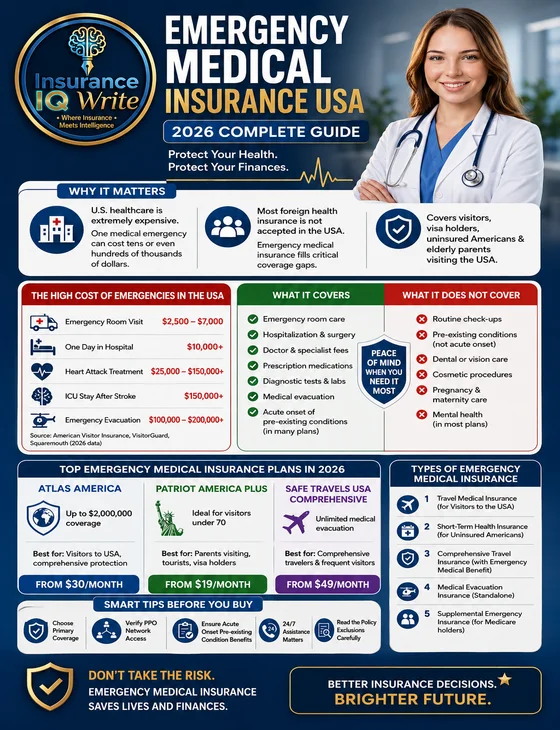
- Atlas America — up to $2M coverage
- Patriot America Plus — ideal for visitors under 70
- Safe Travels USA Comprehensive — unlimited evacuation
Plans start at just $19/month. Choose primary coverage, verify PPO network access, and ensure acute onset pre-existing condition benefits are included.
Do not travel without emergency medical insurance USA saves lives and finances.
Use Insurance IQ Write Health Insurance Calculator For Premium cost and recommendations
Emergency Medical Insurance USA: Your 2026 Complete Guide to Coverage, Costs, Gaps & Best Plans
As someone who has spent years analyzing the U.S. healthcare landscape, I can say with confidence that emergency medical insurance is not a luxury. It is a financial survival tool. Whether you are a foreign visitor, an expat, an uninsured American, or a long-term traveler, understanding how this type of insurance works could be the difference between a manageable inconvenience and financial ruin.
This guide covers everything you need to know from definitions to dollars to decisions.
What Is Emergency Medical Insurance USA Means?
Emergency medical insurance in the United States is a specialized form of health coverage designed to pay for sudden, unexpected medical events such as a heart attack, stroke, serious accident, or acute illness that require immediate treatment.
Unlike standard health insurance, which covers routine doctor visits, preventive care, and ongoing treatment, emergency medical insurance is built around acute, unforeseen events.
It is most commonly purchased by:
International visitors and tourists traveling to the USA
Foreign nationals on visas (H1B, F1, J1, B1/B2)
Uninsured or underinsured Americans
Senior parents visiting their children in the USA
Expats and long-term travelers
Standard U.S. health insurance provides comprehensive coverage. Emergency medical insurance USA fills specific gaps, particularly for people who are not eligible for or cannot afford full domestic plans.
Why Is Emergency Medical Insurance So Critical in the USA?
The United States has one of the most expensive healthcare systems on the planet. Without insurance, a single medical event can devastate your finances:
| Medical Event | Estimated Cost (Uninsured, USD) |
|---|---|
| Doctor’s visit (basic) | $250 – $350 |
| Emergency room visit | $2,500 – $7,000 |
| One day in hospital | $10,000+ |
| Echocardiogram | $1,500 – $4,000 |
| Heart attack treatment | $25,000 – $150,000+ |
| ICU stay after stroke | $150,000+ |
| Kidney failure treatment | $30,000+ |
| Emergency evacuation abroad | $100,000 – $200,000+ |
Source: American Visitor Insurance, VisitorGuard, Squaremouth (2026 data)
According to internal claims data, over 27% of all travel insurance claims stem from medical emergencies, with an average payout of $1,816 per claim, yet the uncovered costs of a serious event could run ten to one hundred times higher.
Types of Emergency Medical Insurance USA
To understand the different plan 5 types are essential.
1. Travel Medical Insurance (for Visitors to the USA)
Designed for non-U.S. citizens visiting America. Covers emergency treatment, hospitalization, evacuation, and in some cases, acute onset of pre-existing conditions. Most standard foreign health policies are not accepted in the U.S., making this essential.
2. Short-Term Health Insurance (for Uninsured Americans)
Available for U.S. residents who missed the ACA open enrollment window. Covers emergency and urgent care for a limited period typically up to 364 days.
3. Comprehensive Travel Insurance (with Emergency Medical Benefit)
A broader policy that includes emergency medical as one benefit alongside trip cancellation, baggage loss, flight delay, and more. Ideal for travelers who want all-in-one protection.
4. Medical Evacuation Insurance (Standalone)
Covers the cost of transporting you from the site of a medical emergency to an appropriate facility, or repatriating you to your home country. Emergency evacuations can cost $100,000–$200,000+, making this a critical, and often overlooked, coverage.
5. Supplemental Emergency Insurance (for Medicare holders)
Original Medicare does not cover medical emergencies outside the U.S. Medi gap plans (C, D, F, G, M, and N) include a foreign travel emergency benefit covering 80% of emergency costs abroad (after a $250 deductible, up to a $50,000 lifetime maximum).
Comparing Emergency Medical Insurance vs. Other Plans
| Feature | Emergency Medical Insurance | Standard Health Insurance (ACA) | Short-Term Health Plan |
|---|---|---|---|
| Covers routine visits | No | Yes | Partial |
| Covers emergencies | Yes | Yes | Yes |
| Pre-existing conditions | Limited (acute onset only) | Fully covered | Excluded |
| Available to visitors | Yes | No | No |
| Cost per month | $19–$172 | $450–$700+ (unsubsidized) | $100–$300 |
| Coverage period | 5 days–24 months | Annual (renewable) | Up to 364 days |
| Medical evacuation | Often included | Rarely | Rarely |
How Much Does Emergency Medical Insurance Cost in the USA in 2026?
Costs vary widely based on age, duration, coverage limits, and plan type.
For Visitors to the USA:
| Age Group | Monthly Cost Range (USD) | Notes |
|---|---|---|
| Under 30 | $19 – $45 | Most affordable bracket |
| 30–50 | $40 – $80 | Mid-tier pricing |
| 50–65 | $75 – $130 | Higher risk = higher premium |
| 65–80 | $100 – $172 | Senior plans; pre-ex exclusions common |
| 80+ | $150 – $300+ | Very limited plan options |
Budget plans start at $1–$5 per day for basic fixed-benefit coverage. Comprehensive plans average around $5–$7/day based on internal Square mouth marketplace data.
Key Factors That Affect Your Premium
- Age: Older travelers pay significantly more
- Coverage Limit: Plans range from $50,000 to $1,000,000
- Deductible: Higher deductible = lower premium
- Plan type: Fixed benefit vs. comprehensive
- Pre-existing condition coverage: Significantly raises cost
- Trip duration: Longer trips cost more
Author’s Overview: Do not optimize purely for the cheapest premium. A $19/month fixed-benefit plan that caps ER visits at $200 is dangerously inadequate when an actual emergency room visit costs $2,500–$7,000. Always check the per-incident caps, not just the headline monthly rate.
Primary vs. Secondary Emergency Medical Coverage: A Critical Distinction
This is one of the most misunderstood concepts in emergency medical insurance and a major content gap that most competing articles fail to explain clearly.
Primary coverage means your travel or emergency insurance pays first, before any other insurance you hold. This speeds up claims and reduces paperwork. If you have no other insurance, this distinction matters less.
Secondary coverage means your emergency insurance pays after your existing health plan has paid its portion. You must first file a claim with your primary insurer, then submit remaining costs to your travel insurer.
Primary vs. Secondary Emergency Medical Coverage
| Type | Who Benefits Most | Claims Process | Premium Impact |
|---|---|---|---|
| Primary | Uninsured, visitors without any U.S. plan | Faster, direct | Slightly higher |
| Secondary | Those with existing health insurance | More complex | Slightly lower |
For most international visitors to the USA, primary coverage is the better choice since they have no domestic health insurance to submit first.
Top Emergency Medical Insurance USA Plans in 2026
Based on coverage limits, customer reviews, PPO network access, and pricing:
| Plan | Provider | Medical Max | Evacuation | Pre-Ex (Acute) | Monthly Cost (40-yr-old) |
|---|---|---|---|---|---|
| Atlas America | WorldTrips | Up to $2M | Up to $1M | Yes | ~$70 |
| Patriot America Plus | IMG | Up to $1M | Up to $1M | Up to age 70 | ~$69–$74 |
| Safe Travels USA Comprehensive | Trawick | Up to $1M | Unlimited | Yes | ~$60 |
| SafeTrip Intl. Travel Medical Premium | UnitedHealthcare Global | High | $1M | Varies | ~$80–$100 |
| FlexiPAX | Travel Insured International | $100K | $500K | (within 21 days) | ~$55 |
| VisitorsCare Plus | Visitors Care | Up to $100K | Included | Yes | ~$40–$55 |
All prices are approximate and vary by age, deductible, and coverage limit.
What Does Emergency Medical Insurance USA Covers?
Most plans cover the following when it comes to an unforeseen, unexpected medical emergency:
Emergency room visits
Hospitalization and inpatient care
Physician and specialist visits (emergency-related)
Diagnostic tests: X-rays, MRIs, CT scans, lab work
Emergency surgery
Prescription medications (emergency-related)
Ambulance services (local)
Medical evacuation to appropriate facility
Repatriation of remains (in the event of death)
24/7 emergency assistance services
Acute onset of pre-existing conditions (on select plans)
COVID-19 treatment (on select plans)
Emergency dental care (accidental)
What Does Emergency Medical Insurance USA NOT Coveres?
1. Routine check-ups and preventive care
2. Ongoing treatment for known pre-existing conditions
3. Elective procedures
4. Mental health/substance abuse (on most plans)
5. Pregnancy and maternity (unless emergency)
6. Medical tourism
7. Self-inflicted injuries
What Happens If You Can not Pay Emergency Medical Bills in the USA?
If you receive emergency care in the USA without insurance and cannot pay, hospitals are legally required to treat you for life-threatening emergencies under the Emergency Medical Treatment and Labor Act (EMTALA). However, this does not eliminate the debt. Consequences can include:
- Medical billing collections
- Damage to your credit score
- Wage garnishments (for U.S. residents)
- Denial of future visa or immigration applications (for some visitor categories)
- Deportation risk (in extreme cases involving large debt and visa violations)
The best protection is securing emergency medical insurance before you travel or while uninsured.
Emergency Medical Insurance USA for H1B, F1, and J1 Visa Holders
Many visa holders are unsure what insurance they need:
- F1 Students: Most universities require you to have health insurance. Some international student plans include emergency coverage; others require separate supplemental plans.
- J1 Exchange Visitors: The U.S. State Department mandates minimum medical coverage of $100,000 per accident or illness, $50,000 for medical evacuation, and $25,000 for repatriation.
- H1B Workers: Employers generally provide group health insurance, but during the gap between jobs or during the waiting period, short-term or emergency medical insurance is a smart bridge.
Emergency Medical Insurance USA for Elderly Parents Visiting
This is one of the fastest-growing niches in visitor insurance. Key considerations:
- Most plans cap coverage for travelers over age 80; a few (like WorldTrips Atlas America) cover up to age 89
- Pre-existing condition coverage is critical for older parents with conditions like diabetes, hypertension, or heart disease
- Look for plans with acute onset of pre-existing condition coverage, meaning if a known condition flares up unexpectedly, it is covered as an emergency
- INF Elite X is one of the few plans offering in-patient and out-patient pre-existing condition coverage for seniors
How to File an Emergency Medical Insurance USA Claim?
Step-by-step process most articles skip entirely:
- Seek treatment first: Your health comes before paperwork
- Call the 24/7 assistance line On your insurance card. They can direct you to in-network facilities
- Retain all receipts, Invoices, and medical records
- Submit a claim form (Available online or via your insurer’s app) within the required window (usually 90–180 days)
- Provide documentation: Passport, policy number, medical records, itemized bills
- Follow up: Most claims are processed within 30–45 days
- Appeal if denied: You have the right to contest any denied claim in writing
Emergency Medical Insurance vs. Standard ACA Health Insurance
Example Scenario: Maria, a 55-year-old visiting from Spain, has a sudden heart attack while in New York.
| Scenario | With Emergency Medical Insurance | Without Any Insurance |
|---|---|---|
| ER Visit | Covered (after deductible) | $5,000+ out of pocket |
| Cardiac Surgery | Covered up to plan max | $80,000–$150,000 bill |
| ICU Stay (5 days) | Covered | $50,000–$100,000 |
| Medical Evacuation | Covered up to $1M | $150,000–$200,000 |
| Total Exposure | Deductible: $500–$2,500 | $300,000+ |
The math is undeniable.
Does Emergency Medical Insurance USA Vary by State?
While emergency medical insurance USA plans are federally portable, some nuances apply by state:
- New York, California, Washington: Stricter insurance regulations; some visitor plans have limited availability
- Florida, Texas, Arizona: Popular destinations for visitors and retirees; wide plan availability
- Hawaii: Remote location increases evacuation costs; higher limits recommended
- Border states (Texas, California, Arizona, New Mexico): Plans that cover cross-border treatment useful for Mexican nationals visiting
Always confirm that your chosen plan is available for purchase in your state of residence and valid at your destination.
Author’s Recommendations Emergency Medical Insurance USA
After analyzing the top-ranking articles, real cost data, and plan structures, here is my honest assessment:
1. The biggest mistake people make is buying the cheapest plan without reading the per-incident caps. A plan that pays only $200 for an ER visit is not emergency coverage; it’s a marketing illusion.
2. The most underrated benefit is medical evacuation coverage. Most people skip it. Most people shouldn’t. A single air ambulance flight within the USA can cost $50,000–$100,000.
3. The best value sweet spot for most international visitors in 2026 is a comprehensive plan with $100,000–$250,000 in medical coverage, $500,000+ evacuation, and acute onset pre-existing condition coverage. Plans like Atlas America, Patriot America Plus, and Safe Travels USA Comprehensive fit this profile at reasonable prices.
4. For Americans without insurance, short-term health plans offer emergency coverage as a bridge, but they exclude pre-existing conditions and are not a substitute for comprehensive ACA coverage.
5. For J1 visa holders, compliance with the State Department minimum is not optional, and the mandated minimums are barely adequate. Upgrade where possible.
FAQs: Emergency Medical Insurance USA
Q1: What is emergency medical insurance in the USA?
It is a type of short-term health coverage that pays for sudden, unexpected medical events such as accidents, acute illness, or hospitalization particularly for visitors, uninsured individuals, or travelers. It does not cover routine or preventive care.
Q2: How much does emergency medical insurance cost in the USA in 2026?
For visitors to the USA, plans range from $19 to $172 per month, depending on age, coverage limits, trip duration, and whether pre-existing conditions are included. Budget plans start at $1–$5 per day.
Q3: Is emergency medical insurance required for visiting the USA?
It is not legally required for most tourists on B1/B2 visas. However, it is strongly recommended given the extremely high cost of healthcare. It is mandatory for J1 exchange visitors per U.S. State Department rules.
Q4: Does emergency medical insurance cover pre-existing conditions?
Most plans exclude ongoing pre-existing conditions. However, many plans cover the “acute onset” of a pre-existing condition, meaning if a known condition suddenly and unexpectedly flares up as a medical emergency, it may be covered up to specified limits.
Q5: What is the difference between travel medical insurance and emergency medical insurance?
They are often used interchangeably. Travel medical insurance is the formal product name; it covers emergency medical events during travel. Emergency medical insurance is the coverage benefit within that product that pays for sudden, unexpected health crises.
Q6: Will my foreign health insurance work in the USA?
Generally, no. Most foreign health insurance policies do not cover medical care in the United States, or will only reimburse you after the fact, requiring you to pay large bills upfront. Dedicated visitor or emergency medical insurance is strongly recommended.
Q7: What does medical evacuation insurance cover in the USA?
It covers the cost of transporting you from the location of a medical emergency to the nearest appropriate medical facility, or back to your home country for continued treatment. Evacuations can cost $100,000–$200,000+.
Q8: Can I buy emergency medical insurance after arriving in the USA?
Yes, many plans allow you to purchase coverage after your trip has already begun. However, most have a waiting period of 24–72 hours before coverage starts for illness (injuries are often covered immediately). Buying before you travel is always preferable.
Q9: How do I file an emergency medical insurance claim in the USA?
Call the 24/7 emergency assistance line on your insurance card, seek treatment at an in-network facility where possible, retain all receipts and medical records, and submit a claim form with documentation within 90–180 days of treatment.
Q10: What is the best emergency medical insurance for elderly parents visiting the USA?
Atlas America (WorldTrips), Patriot America Plus (IMG), and INF Elite X are highly rated for senior visitors. Look for plans that include acute onset of pre-existing condition coverage, high medical maximums ($250,000+), and access to a large PPO network like UnitedHealthcare or First Health.
Q11: What happens if I go to the ER in the USA without insurance?
Under EMTALA law, hospitals must provide emergency treatment regardless of insurance status. However, you will receive a bill for the full cost of care, potentially tens or hundreds of thousands of dollars and the hospital may send this to collections.
Q12: Is emergency medical insurance the same as travel insurance?
No. Travel insurance is broader; it can include trip cancellation, baggage loss, flight delays, and emergency medical coverage. Emergency medical insurance is specifically the health-crisis protection component, which can be purchased standalone or as part of a comprehensive travel plan.
Emergency Medical Insurance USA:Comparison Summary Table
| Plan Type | Best For | Coverage | Cost/Month | Pre-Ex | Evacuation |
|---|---|---|---|---|---|
| Atlas America | All visitors | Up to $2M | ~$70 | Acute onset | Up to $1M |
| Patriot America Plus | Visitors under 70 | Up to $1M | ~$69 | Up to 70 | Up to $1M |
| Safe Travels USA Comprehensive | All visitors | Up to $1M | ~$60 | Yes | Unlimited |
| VisitorsCare Plus | Budget travelers | Up to $100K | ~$40 | Yes | Included |
| INF Elite X | Senior / Pre-ex focused | Up to $300K | ~$100+ | Full pre-ex (in+out) | Included |
| FlexiPAX | Families | $100K | ~$55 | (within 21 days) | $500K |
Author’s Thoughts About Emergency Medical Insurance USA
Emergency medical insurance in the USA is not about pessimism. It is about intelligent preparation. In a healthcare system where a single emergency room visit can cost more than an international flight, being unprotected is the real risk.
Whether you are a tourist visiting for the 2026 FIFA World Cup, a parent flying in to see your grandchildren, a visa holder between employers, or simply someone who missed ACA open enrollment, there is a plan designed for your situation, and most of them cost less than your daily coffee habit.
The right emergency medical insurance does not just pay bills. It gives you access to the right hospitals, the right doctors, and the right support when everything else is going wrong.
Choose wisely. Travel confidently.
Disclaimer: This article is for informational purposes only and does not constitute professional insurance or financial advice. Always review policy documents carefully and consult a licensed insurance professional for personalized guidance.