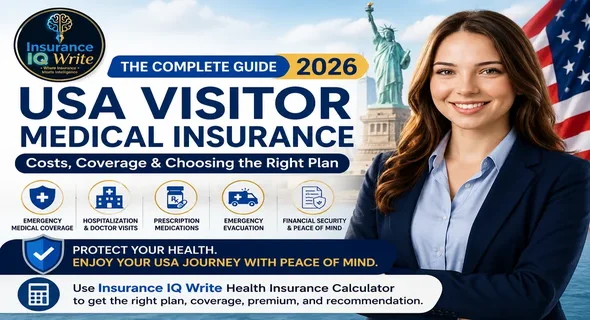
Planning a trip to the USA? Choosing the right USA Visitor Medical Insurance 2026 plan can protect you from unexpected healthcare expenses, which can be extremely costly in the United States. The best policy should include emergency medical coverage, hospitalization, doctor visits, prescription medications, and emergency evacuation benefits. Compare coverage limits, deductibles, pre-existing condition options, and insurer reputation before purchasing.
A quality USA Visitor Medical Insurance 2026 plan offers financial security, peace of mind, and access to quality healthcare throughout your stay. Spending a little on coverage today can save thousands of dollars in medical bills tomorrow.
To get the right plan, coverage, premium, and recommendation,” Use Insurance IQ Write Health Insurance Calculator
USA Visitor Medical Insurance: The Complete 2026 Guide
USA visitor medical insurance is short-term health coverage built for non-U.S. residents, tourists, parents, business travelers, and exchange visitors, who need financial protection against America’s notoriously high healthcare costs. Unlike domestic insurance, it doesn’t require a medical exam, activates quickly, and is sold in flexible durations from a few days to a full year. If you’re flying into the U.S. without it, you’re essentially self-insuring against bills that can run into six figures.
This guide breaks down what it covers, how it compares to other options, real costs, common mistakes, and the questions people are actually asking AI tools and Google about it.
What Exactly Is USA Visitor Medical Insurance?
Visitor medical insurance, also called travel medical insurance, tourist health insurance, or visitor health insurance, is a temporary policy designed specifically for foreign nationals visiting the United States. It is not the same as trip insurance (which covers cancelled flights or lost luggage), and it is not the same as U.S. domestic health insurance (which generally won’t issue policies to non-residents at all).
Instead, it fills a very specific gap: emergency room visits, hospitalization, doctor consultations, diagnostic tests, ambulance transport, and sometimes emergency medical evacuation back to your home country. It’s purchased by individuals on B-2 tourist visas, parents visiting children, J-1 exchange visitors (for whom it’s often legally mandatory), international students, business travelers, and even Green Card holders who haven’t yet enrolled in a U.S. health plan.
Why It Matters More Than People Realize?
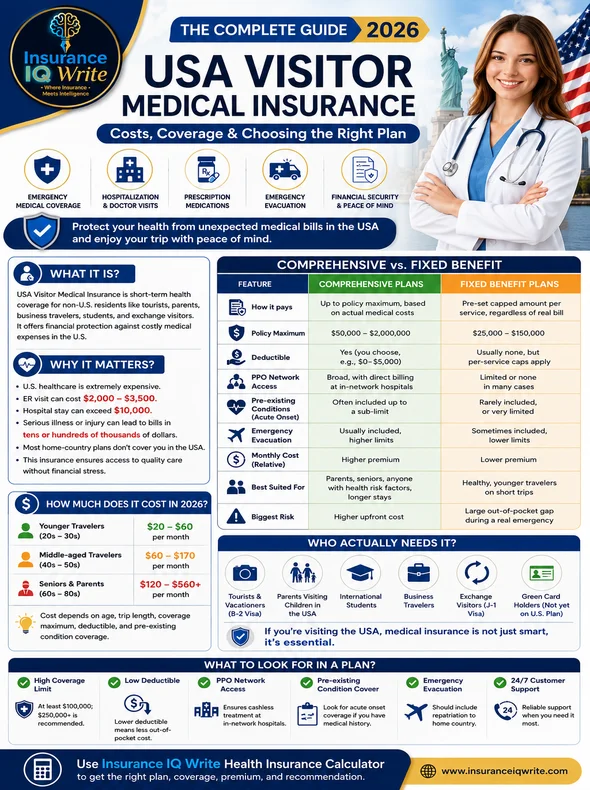
The United States has some of the most expensive healthcare in the world, and there’s no universal public system covering visitors. A single emergency room visit can run $2,000–$3,500 before any procedures, and an overnight hospital stay can easily exceed $10,000. A fractured bone, appendicitis, or a cardiac event can produce bills in the tens or hundreds of thousands of dollars.
Many travelers mistakenly assume their home-country health insurance will follow them abroad. In most cases, it won’t, and even when it technically applies, U.S. hospitals rarely bill foreign insurers directly, leaving the visitor to pay upfront and chase reimbursement for months.
Visitor medical insurance solves this by working directly with U.S. hospital networks, often through PPO (Preferred Provider Organization) arrangements that reduce costs and, in many cases, allow direct billing instead of out-of-pocket payment.
Comprehensive vs. Fixed Benefit: The Core Comparison
Almost every visitor insurance decision comes down to one fork in the road: Comprehensive or Fixed Benefit. Understanding the contrast is the single most important part of choosing a plan.
Comprehensive plans work like real health insurance. They pay up to your policy maximum (commonly $50,000 to $2 million) for covered treatment, after your deductible and any co-insurance. They typically include broader PPO network access, better evacuation benefits, and coverage for the “acute onset” of pre-existing conditions, meaning a sudden, unexpected flare-up of an existing condition (like a heart attack in someone with controlled high blood pressure) may be covered even though chronic, ongoing treatment is not.
Fixed Benefit plans are cheaper but pay a pre-set, capped amount per service, for example, $100 toward a doctor visit, regardless of whether the actual bill is $100 or $400. They suit younger, healthy travelers on short trips who want a safety net without paying premium prices, but they leave a real gap of personal liability during a genuine emergency.
For parents, seniors, or anyone with health risk factors, comprehensive coverage is almost always worth the extra premium. For a healthy 25-year-old on a two-week vacation, a fixed benefit plan may be perfectly adequate.
Comprehensive vs. Fixed Benefit
| Feature | Comprehensive Plans | Fixed Benefit Plans |
|---|---|---|
| How it pays | Up to policy maximum, based on actual medical costs | Pre-set capped amount per service, regardless of real bill |
| Typical policy maximum | $50,000 – $2,000,000 | $25,000 – $150,000 |
| Deductible | Yes (you choose, e.g., $0–$5,000) | Usually none, but per-service caps apply instead |
| PPO network access | Broad, with direct billing at in-network hospitals | Limited or none in many cases |
| Pre-existing conditions (acute onset) | Often included up to a sub-limit | Rarely included, or very limited |
| Emergency evacuation | Usually included, higher limits | Sometimes included, lower limits |
| Monthly cost (relative) | Higher premium | Lower premium |
| Best suited for | Parents, seniors, anyone with health risk factors, longer stays | Healthy, younger travelers on short trips |
| Biggest risk | Higher upfront cost | Large out-of-pocket gap during a real emergency |
For parents, seniors, or anyone with health risk factors, comprehensive coverage is almost always worth the extra premium. For a healthy 25-year-old on a two-week vacation, a fixed benefit plan may be perfectly adequate.
How Much Does It Actually Cost in 2026?
Pricing depends on age, trip length, coverage maximum, and deductible, but as a general benchmark for 2026:
- Younger travelers (20s–30s): roughly $20–$60 per month for solid coverage
- Middle-aged travelers (40s–50s): roughly $60–$170 per month
- Seniors and parents (60s–80s): roughly $120–$560+ per month, depending on age band and pre-existing condition riders
Lower deductibles raise the monthly premium but reduce what you’d pay out-of-pocket during a claim; higher deductibles do the reverse. Adding pre-existing condition coverage, extending the policy maximum, or insuring someone over 70 will all push the price up, but compared to even one uninsured ER visit, the math almost always favors buying coverage.
Who Actually Needs It?
- Tourists and vacationers on a B-2 visa, where insurance isn’t legally required but is financially essential
- Parents and grandparents visiting family, who carry higher health risk and benefit most from comprehensive plans
- J-1 exchange visitors, for whom adequate medical coverage is often a visa condition
- Business travelers, since corporate domestic plans rarely extend overseas coverage
- New Green Card holders in the gap period before enrolling in a permanent U.S. health plan
Common Mistakes Buyers Make
A few patterns show up again and again. People buy the cheapest fixed-benefit plan without realizing how little it actually pays out.
Families assume a parent’s existing condition is automatically excluded, when many comprehensive plans do cover the acute onset of that condition. Travelers wait until after arrival to buy a policy, triggering a waiting period (often 48–72 hours) during which no claims are paid. And some buy a plan with a low policy maximum $50,000 might sound like plenty until a single hospitalization burns through it in days.
The fix is straightforward: buy before departure, choose comprehensive coverage if there’s any health risk involved, confirm the PPO network includes hospitals near where you’ll be staying, and read the exclusions section before, not after, you need to file a claim.
Author’s Thoughts About USA Visitor Medical Insurance
Having looked closely at how these plans actually pay out versus how they’re marketed, the honest advice is this: don’t shop by price alone. The cheapest plan and the best plan are rarely the same thing. A policy that’s $15 cheaper a month but caps a hospital stay at a few hundred dollars isn’t really insurance. It’s a discount coupon. Spend the extra few dollars a day for comprehensive coverage with a real PPO network, and treat the deductible, not the premium, as the number that determines how protected you actually are.
Conclusion About USA Visitor Medical Insurance
USA visitor medical insurance isn’t a legal requirement for most travelers, but in a country where a single ER visit can wipe out a vacation budget – or far worse – it functions as essential financial protection. The right plan depends on age, health history, trip length, and risk tolerance, but the underlying principle stays the same: compare comprehensive and fixed-benefit options side by side, check the policy maximum and PPO network, and buy before you fly.
FAQS: USA Visitor Medical Insurance
Is visitor medical insurance mandatory to enter the USA?
No, it isn’t legally required for most tourist (B-2) visas or Green Card holders. However, J-1 exchange visitor visas often mandate proof of adequate health coverage. Even when optional, it’s strongly recommended given how expensive U.S. healthcare is for the uninsured.
What does USA visitor medical insurance typically cover?
Most plans cover emergency room visits, hospitalization, doctor consultations, diagnostic tests, prescription drugs, and emergency medical evacuation. Routine checkups, chronic pre-existing condition management, and elective procedures are usually excluded.
Can I buy visitor insurance after my parents have already arrived in the US?
Yes, but most insurers apply a waiting period of 48–72 hours before claims are eligible, so it’s better to purchase coverage before travel. Buying in advance also avoids any coverage gap during the first days of the trip.
Does visitor insurance cover pre-existing conditions?
Most standard plans exclude chronic pre-existing conditions but do cover the “acute onset” of one, a sudden, unexpected flare-up. A small number of specialized plans offer broader pre-existing condition coverage, usually at a higher premium.
What’s the difference between comprehensive and fixed benefit visitor insurance?
Comprehensive plans pay up to a policy maximum based on actual medical costs, after a deductible. Fixed benefit plans pay a pre-set capped amount per service regardless of the real bill, making them cheaper but riskier for serious emergencies.
How much does visitor insurance cost for a month in the USA?
In 2026, monthly costs generally range from about $20 for younger travelers on basic plans up to $560 or more for seniors with comprehensive, pre-existing-condition coverage. Trip length, deductible, and policy maximum all affect the final price.
Is travel insurance the same as visitor medical insurance?
Not exactly. Travel insurance often bundles trip cancellation, lost luggage, and delays with limited medical coverage, while visitor medical insurance is purpose-built for healthcare costs and offers far higher medical limits, making it the better primary choice for U.S. trips.
A little research now can save tens of thousands of dollars later.