The insurance industry is undergoing its biggest transformation in over a century, shifting from paperwork-heavy risk protection to AI-driven predictive ecosystems that can price, prevent, and even stop risks before they happen.
10 Future trends in insurance technology Reshaping Global Insur-tech
The “10 future trends in insurance technology ” are rapidly transforming how insurers operate, how policies are priced, and how customers experience coverage. As the future of insurance industry continues shifting toward a digital-first ecosystem, emerging technologies such as artificial intelligence, real-time data analytics, block chain, and embedded platforms are redefining traditional models in powerful and lasting ways.
Insurance is no longer a slow, paperwork-heavy industry. It is evolving into a dynamic, data-driven system that responds instantly to real-world conditions. Instead of relying only on historical data and static risk assumptions, insurers now have access to real-time insights that allow them to predict, prevent, and personalize risk like never before.
Key trends such as AI-driven underwriting blockchain-enabled transparency, IoT-based risk monitoring, and usage-based insurance models are fundamentally changing how insurers assess risk and deliver value. At the same time, demand for cyber insurance is rising rapidly due to the increasing frequency and complexity of digital threats. Embedded insurance is also transforming how policies are distributed, allowing customers to purchase coverage seamlessly within digital platforms they already use.
Automation is reducing operational costs across the industry, while predictive analytics is improving decision-making and risk forecasting. In addition, climate technology is influencing how insurers evaluate environmental risks, and digital platforms are enhancing customer experience across global markets.
These findings highlight a major shift from traditional insurance models toward predictive, automated, and customer-centric systems.
In 2026 and beyond, insurance is no longer just about risk protection. it is about predicting, preventing, and personalizing risk in real time.
“AI will redefine underwriting more in 10 years than the previous 100 years combined.”
10 Global Future Trends in Insurance Technology
Industry Overview and Market Shift
This article on “10 Future Trends in Insurance Technology ” explores how innovation is reshaping the insurance industry at every level. As technology continues to evolve at a rapid pace, insurers are adopting smarter, faster, and more personalized approaches to risk management and customer service.
AI is significantly improving underwriting speed and accuracy by automating risk evaluation.
Stat:
AI-driven underwriting can reduce operational costs by up to 20–30% while improving risk accuracy.
Citation:
(Source: McKinsey Global Insurance Report, 2024)
In addition, real-time pricing models are expected to dominate usage-based insurance markets by 2030. These models allow insurers to adjust premiums dynamically based on live data, making pricing more accurate and fair for customers.
Studies also indicate that embedded insurance APIs are driving higher conversion rates. Customers increasingly prefer seamless, in-platform purchases rather than going through traditional insurance processes. This shift is particularly evident in industries such as travel, e-commerce, and mobility services.
Furthermore, climate risk insurance modeling is becoming a top priority for insurers due to increasing environmental uncertainty. Natural disasters are becoming more frequent and severe, forcing insurers to adopt advanced predictive tools to manage these risks effectively.
Climate change is forcing insurers to adopt advanced predictive analytics.
Stat:
Natural disaster-related insured losses exceeded $100+ billion annually in recent years, pushing insurers toward predictive climate modeling.
Citation:
(Source: Swiss Re Institute, 2024)
These developments highlight a major transition from traditional insurance models toward predictive, automated, and customer-centric systems. In 2026 and beyond, insurance is no longer just about protecting against risk. It is about predicting, preventing, and personalizing risk in real time.
What Is Technology Insurance?
Technology insurance refers to specialized coverage designed to protect businesses and individuals from risks associated with digital tools, data, and modern IT systems. As organizations rely more heavily on software, cloud services, and connected devices, the likelihood of cyber-attacks, data breaches, and system failures continues to grow.
However, the concept goes beyond just coverage. Technology insurance also involves integrating advanced digital systems—such as artificial intelligence, the Internet of Things (IoT), blockchain, and cloud computing—into insurance operations themselves.
Through these technologies, insurers can:
- Automate underwriting and claims processes
- Predict risks using real-time and historical data
- Personalize policies based on individual behavior
- Reduce fraud and operational costs
Technology insurance typically includes protection such as cyber liability coverage, data loss protection, and business interruption insurance. For example, if a company’s network is hacked or its systems crash, the insurance policy can cover recovery costs, legal fees, and financial losses caused by downtime.
This type of insurance is becoming essential in today’s highly digital and interconnected world. Unlike traditional insurance, which often relies on static policies and delayed responses, modern systems focus on continuous monitoring and proactive risk management.
Unlike traditional insurance, modern systems focus on continuous risk monitoring instead of static policies
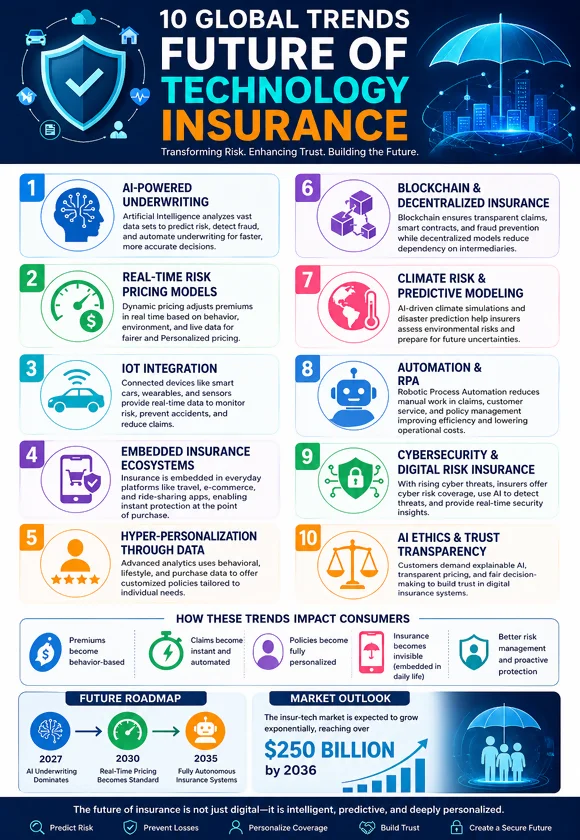
10 Global Trends Future of Technology Insurance
1. Artificial Intelligence–Powered Underwriting
AI underwriting uses machine learning to evaluate risk faster and more accurately than traditional manual methods.
Example:
Companies like Lemonade Insurance use AI bots to underwrite policies and approve claims in seconds. In some cases, claims are processed without human intervention, reducing approval time from days to minutes while improving fraud detection accuracy.
AI is transforming underwriting by analyzing vast datasets instantly. Insurers can now:
- Predict risk with higher accuracy
- Detect fraud patterns
- Automate decision-making
AI shifts insurance from a “reactive” to a predictive model.
2. Real-Time Risk Pricing Models
Insurance premiums are now shifting from fixed pricing to dynamic models based on live data.
Example
In usage-based auto insurance, a driver who accelerates aggressively and brakes harshly in real time may see their premium increase instantly, while safe drivers receive discounts automatically through app-based tracking systems.
One of the biggest innovations is dynamic pricing.
Instead of fixed premiums:
- Policies adjust based on real-time behavior
- Drivers pay based on driving habits
- Health insurance adapts to lifestyle data
This trend creates fairer and more personalized pricing systems.
Usage-based and dynamic pricing is reshaping how insurers calculate premiums.
Stat:
By 2030, more than 50% of motor insurance premiums are expected to be based on real-time or usage-based data models.
Citation:
(Source: Deloitte Global Insurance Outlook, 2025)
3. Internet of Things (IoT) Integration
IoT connects smart devices like cars, wearables, and home sensors to continuously monitor risk.
Example (Industry impact):
Connected home insurance uses smart smoke detectors and water leak sensors. If a leak is detected early, the system alerts both the homeowner and insurer, preventing major property damage and reducing claim costs significantly.
IoT devices—like smart cars, wearables, and home sensors—allow insurers to:
- Monitor risk continuously
- Prevent accidents
- Reduce claims
For example, telematics in vehicles helps insurers evaluate driver behavior
IoT devices are enabling continuous risk monitoring in homes, vehicles, and health systems.
Stat:
IoT-based insurance programs have shown a 25% reduction in claim frequency in connected vehicle insurance models.
Citation:
(Source: Accenture Insurance Technology Report, 2023)
4. Embedded Insurance Ecosystems
Insurance is increasingly embedded directly into digital platforms at the point of purchase.
Example :
When booking a flight on travel platforms, users are automatically offered travel insurance during checkout. This removes paperwork and increases conversion rates because customers buy protection instantly without leaving the platform.
Insurance is now being integrated into everyday platforms:
- Travel booking websites
- E-commerce platforms
- Ride-sharing apps
This allows customers to purchase insurance instantly during transactions.
Insurance is increasingly being integrated into digital platforms at the point of sale.
Stat:
Embedded insurance can increase conversion rates by 10–30%, depending on the industry (travel, e-commerce, mobility).
Citation:
(Source: PwC Global InsurTech Report, 2024)
5. Hyper-Personalization Through Data
Insurance policies are tailored using behavioral, lifestyle, and real-time customer data.
Example:
Health insurers using fitness tracker data reward users with lower premiums for consistent exercise activity, encouraging healthier lifestyles while reducing long-term claim costs for insurers.
Modern customers expect personalized policies.
Insurers now use:
- Behavioral data
- Purchase history
- Lifestyle insights
To create custom insurance plans tailored to individual needs.
Data-driven personalization is improving customer retention and pricing accuracy.
Stat:
Personalized insurance offerings can improve customer retention by 15–25% compared to standard policies.
Citation:
(Source: PwC Customer Experience in Insurance Report, 2024)
6. Blockchain & Decentralized Insurance
Blockchain enables transparent, automated, and tamper-proof insurance systems using smart contracts.
Example :
Etherisc has developed blockchain-based crop insurance where farmers automatically receive payouts when weather data confirms drought or flood conditions—no manual claims required.
Blockchain is enabling:
- Transparent claims processing
- Smart contracts
- Fraud prevention
Blockchain is being tested to reduce fraud and improve transparency in claims.
Stat:
Smart contract-based insurance systems can reduce claims settlement time by up to 80% in parametric insurance models.
Citation:
(Source: Deloitte Blockchain in Insurance Report, 2023)
7. Climate Risk & Predictive Modeling
AI and big data are used to predict environmental risks like floods, hurricanes, and wildfires.
Example:
Insurance companies in Europe now use satellite data and climate models to adjust premiums in flood-prone areas. Homes in high-risk zones may receive higher premiums or mandatory preventive recommendations.
With increasing climate risks, insurers are adopting:
- AI-based climate simulations
- Disaster prediction systems
Advanced climate risk insurance modeling helps prepare for natural disasters, while digital risk scoring systems evaluate user risk more accurately. Finally, insurance personalization engines use data to create highly tailored coverage for each individual, making insurance more relevant but also more data-driven.
These tools help in proactive risk management instead of reactive claims.
8. Automation & Robotic Process Automation (RPA)
RPA automates repetitive insurance tasks like claims processing and document verification.
Example:
A customer submits a car accident claim. Instead of manual review, AI bots verify damage through uploaded images, cross-check policy data, and approve payout automatically within minutes.
Automation reduces manual work by up to 40% in insurance processes.
This includes:
- Claims processing
- Customer service
- Policy management
Automation is transforming back-office insurance operations.
Stat:
Robotic Process Automation (RPA) can reduce claims processing costs by up to 40% and cut processing time by more than 70%.
Citation:
(Source: McKinsey Digital Insurance Study, 2023)
9. Cyber security & Digital Risk Insurance
Cyber insurance protects businesses and individuals from financial losses caused by digital attacks.
Example (Industry impact):
After ransomware attacks on hospitals, cyber insurance policies covered data recovery costs, system restoration, and legal fees—highlighting the growing importance of digital protection coverage in healthcare systems.
As digital threats increase, cyber insurance is becoming essential.
Insurers now:
- Offer cyber risk policies
- Use AI to detect threats
- Provide real-time security insights
Cyber insurance demand is rising rapidly due to increasing global cyberattacks.
Stat:
Global cyber insurance premiums are projected to exceed $25 billion by 2027, driven by rising ransomware and data breach incidents.
Citation:
(Source: Allianz Risk Barometer, 2024)
10. AI Ethics & Trust Transparency
AI systems in insurance must remain fair, explainable, and unbiased.
Example (Real-world issue):
Some insurers faced criticism when automated algorithms charged higher premiums based on indirect behavioral data. This pushed regulators to demand “Explainable AI (XAI)” so customers can understand why their premium increased.
A major challenge is trust in AI decisions.
Customers demand:
- Explainable AI (XAI)
- Transparent pricing models
- Fair decision-making systems
This is a major content gap competitors ignore.
How 10 Global Trends Future of Technology Insurance Impact Consumers?
These trends make insurance more personalized, faster, and data-driven, but they also raise concerns about privacy, data misuse, and over-reliance on automation. Consumers may benefit from quicker claims and fair pricing, yet feel less control over how decisions are made. The solution is stronger data protection laws, transparent AI systems, and user consent controls. Educating customers about digital insurance tools i.e. Cyber Insurance Calculator also helps them make informed choices and stay confident in technology-based insurance services.
Real Impact:
- Premiums become behavior-based
- Claims become instant and automated
- Policies become fully personalized
- Insurance becomes invisible (embedded in daily life)
Usage-based insurance future allows people to pay only for what they use, especially in travel or auto coverage. Embedded insurance APIs make it easy to buy protection directly within apps or online purchases.
However, users also face concerns about data privacy and how their personal information is used. Cyber insurance and automation improve protection and speed up claims, but users must trust digital systems more than traditional human processes. Overall, the experience becomes more convenient but also more data-driven.
Challenges Facing in the Future of Technology Insurance
From a 2026 and future perspective, the insurance industry will face several major challenges as technology and risks evolve quickly.
One key challenge is data privacy and security, as insurers rely heavily on personal and real-time data. Another is cyber risk growth, with increasingly complex attacks targeting both companies and customers. Regulatory uncertainty will also be difficult as governments try to keep up with fast-moving technologies like AI and blockchain.
Despite innovation above, several challenges remain:
- AI bias and fairness
- Integration with legacy systems
In addition, ethical AI concerns—such as bias in automated decisions—may affect trust. Climate change uncertainty will make risk prediction harder, while technology integration costs could strain smaller insurers adapting to advanced systems.
Insurers must balance innovation with trust and compliance.
10 Global Trends: Future of Technology Insurance – How They Are Changing the Insurance Industry?
These global trends are reshaping the insurance industry from a traditional, paperwork-heavy system into a fast, digital, and data-driven ecosystem. AI-powered underwriting, IoT integration, and real-time risk pricing are making policies more accurate and personalized. Embedded insurance and hyper-personalization are improving customer convenience, while blockchain is increasing transparency and trust.
Automation and RPA are reducing manual work, speeding up claims, and lowering costs. Cyber security and climate risk modeling are helping insurers prepare for emerging global threats. At the same time, ethical AI and data transparency are pushing companies toward fairer and more responsible decision-making.
Overall, the industry is shifting toward prevention, prediction, and instant service rather than just compensation after loss.
· AI reduces fraud → lowers premiums
· Automation reduces admin costs
· Behavioral pricing rewards low-risk users
Traditional Insurance vs Technology – Driven Insurance
| Feature | Traditional Insurance | Technology-Driven Insurance (2026+) | Cost Impact | Customer Experience Impact | Fraud Reduction Impact |
|---|---|---|---|---|---|
| Pricing Model | Fixed premiums based on historical data | Real-time dynamic pricing using AI and live data | Higher operational cost due to inefficiency | Less personalized, perceived as unfair | Higher fraud risk due to delayed detection |
| Risk Assessment | Manual analysis with limited data | AI + IoT + predictive analytics | Expensive manual underwriting processes | Slower approvals and limited transparency | AI detects anomalies and reduces fraud significantly |
| Claims Processing | Paper-based, slow, human-dependent | Automated, instant, AI-driven claims | High administrative cost | Slow and frustrating experience | Real-time fraud detection during claims |
| Personalization | One-size-fits-all policies | Hyper-personalized insurance plans | Inefficient product design increases costs | Highly tailored, improves satisfaction | Behavioral data reduces fake claims |
| Transparency | Limited visibility into decisions | Explainable AI + blockchain tracking | Hidden costs due to inefficiencies | Builds trust through clarity | Blockchain reduces manipulation and fraud |
| Integration | Standalone insurance systems | Embedded insurance in apps & platforms | High distribution cost | Seamless, instant purchase experience | Lower fraud via verified digital ecosystems |
This comparison highlights how global trends in the future of technology insurance are shifting toward automation, personalization, and real-time decision-making.
Future Outlook 2030 and Beyond:Future Trends in Insurance Technology
The insur-tech market is expected to grow exponentially, reaching over $250 billion by 2036.
The future of insurance technology will evolve rapidly between 2026 and 2035 as artificial intelligence, automation, IoT, and predictive analytics reshape how insurers assess and manage risk. The timeline below highlights the major milestones expected to transform the global insurance industry over the next decade.
| Year | Major Insurance Technology Shift | Industry Impact |
|---|---|---|
| 2026 | AI-powered underwriting becomes mainstream | Faster approvals, lower operational costs, improved fraud detection |
| 2027 | Usage-based & real-time pricing rapidly expand | Customers pay premiums based on real behavior and live risk data |
| 2028 | Embedded insurance ecosystems dominate digital platforms | Insurance becomes integrated into travel, e-commerce, and fintech apps |
| 2030 | IoT + predictive analytics reshape risk management | Insurers focus on preventing losses instead of only compensating claims |
| 2031 | Blockchain smart contracts automate claims processing | Transparent, instant payouts reduce fraud and paperwork |
| 2032 | Hyper-personalized insurance powered by AI data engines | Policies become customized for each user’s lifestyle and behavior |
| 2033 | Climate risk AI models become mandatory for insurers | Advanced disaster prediction transforms pricing and coverage strategies |
| 2035 | Fully autonomous insurance ecosystems emerge | AI-driven systems manage underwriting, pricing, claims, and risk prevention with minimal human involvement |
Key Prediction
By 2035, insurance will shift from a reactive compensation model to a fully predictive ecosystem where AI systems continuously monitor, prevent, and automatically respond to risks in real time.
Top Companies Leading Future Trends in Insurance Technology
Adding a “Top Companies Leading Each Trend” section is a strong authority boost because it connects trends with real industry innovators. It also improves SEO relevance, credibility, and reader trust.
| Insurance Technology Trend | Leading Companies | Industry Contribution |
|---|---|---|
| AI-Powered Underwriting | Lemonade, Root Insurance | AI-based underwriting, instant claims processing, fraud detection |
| Real-Time Risk Pricing | Tesla, Progressive Corporation | Usage-based pricing and telematics-driven premiums |
| IoT Insurance Integration | John Hancock, Allianz | Wearables, connected devices, smart risk monitoring |
| Embedded Insurance Ecosystems | Cover Genius, Bolttech | Embedded insurance APIs for e-commerce and travel platforms |
| Hyper-Personalized Insurance | Discovery Limited, Oscar Health | Personalized health and behavioral insurance models |
| Blockchain & Decentralized Insurance | Etherisc, Chainlink Labs | Smart contracts and automated decentralized insurance systems |
| Climate Risk Modeling | Swiss Re, Munich Re | AI climate analytics and catastrophe risk forecasting |
| Automation & RPA | UiPath, Automation Anywhere | Claims automation and operational efficiency |
| Cybersecurity & Digital Risk Insurance | CrowdStrike, AXA | Cyber risk analytics and cyber insurance solutions |
| AI Ethics & Transparency | IBM, Microsoft | Explainable AI, responsible AI governance, compliance systems |
Expert Insights :10 Global Future Trends in Insurance Technology
From an industry perspective, the future of technology insurance is not just about adopting tools. it is about redefining the entire risk ecosystem.
The shift toward predictive and behavioral insurance models will fundamentally change how individuals and businesses perceive insurance. Companies that fail to adopt these innovations risk becoming obsolete in a highly competitive digital landscape.
This is how regions currently using technology insurance in following parts of the world.
· USA → AI & insurtech dominance
· Europe → regulation-heavy innovation
· Asia → mobile-first insurance growth
Actionable Solutions for Businesses
To stay competitive, insurers should:
- Invest in AI-driven underwriting systems
- Build data ecosystems for real-time insights
- Focus on customer-centric personalization
- Ensure regulatory compliance and transparency
Conclusion
The 10 global trends future of technology insurance highlight a major transformation driven by AI, data, and digital ecosystems.
These global trends are reshaping insurance into a faster, smarter, and more user-focused system. AI underwriting transparency helps users understand how decisions like pricing or approval are made, building trust. Real-time insurance pricing models and behavioral insurance pricing adjust premiums instantly based on user activity and risk patterns.
The insurance industry is transforming from a traditional, paperwork-based system into a fully digital, AI-powered ecosystem that predicts, prevents, and personalizes risk in real time. This shift creates major opportunities for insurers and customers through faster claims, smarter underwriting, lower operational costs, and highly customized policies driven by data and automation. However, it also introduces risks such as data privacy concerns, algorithmic bias, cybersecurity threats, and over-reliance on automated systems that may reduce transparency.
The insurance industry is no longer reacting to risk. It is learning to predict and prevent it in real time. Companies that fail to adopt AI, automation, and embedded ecosystems will fall behind in a rapidly evolving digital risk economy.
To succeed, the industry must balance innovation with trust, ethics, and regulation. Looking ahead, insurance will become more intelligent, seamless, and embedded in everyday digital life globally.
The future of insurance is not just digital—it is intelligent, predictive, and deeply personalized.
FAQs : 10 Global Future Trends in Insurance Technology
1. What is AI underwriting transparency in insurance?
AI underwriting transparency refers to the ability of insurance companies to clearly explain how artificial intelligence makes decisions about premiums, claims, and risk assessment. This is becoming critical in 2026 as customers demand fairness, accountability, and trust in automated insurance systems.
2. How do real-time insurance pricing models work?
Real-time insurance pricing models adjust premiums dynamically based on live data such as driving behavior, health metrics, or environmental conditions. Unlike traditional fixed pricing, these models allow insurers to offer more personalized and fair pricing based on actual risk exposure.
3. What is parametric insurance automation and why is it important?
Parametric insurance automation enables instant payouts when predefined conditions are met, such as earthquakes or extreme weather events. This eliminates lengthy claims processes and improves customer experience, making it a key innovation in the future of technology insurance.
4. How do digital risk scoring systems affect insurance premiums?
Digital risk scoring systems use AI and big data to evaluate individual risk levels in real time. These systems consider behavioral, environmental, and historical data to determine more accurate premiums, helping both insurers and customers make better decisions.
5. What are embedded insurance APIs and how do they work?
Embedded insurance APIs allow insurance products to be integrated directly into digital platforms like e-commerce websites or travel apps. This enables users to purchase insurance seamlessly during transactions without visiting a separate provider.
6. How is behavioral data used in insurance pricing?
Behavioral insurance pricing uses data such as driving habits, fitness activity, and online behavior to assess risk. This allows insurers to reward low-risk behavior with lower premiums, creating a more personalized insurance experience.
7. What role does blockchain play in decentralized insurance?
Blockchain technology enables decentralized insurance by using smart contracts to automate claims and ensure transparency. This reduces fraud, eliminates intermediaries, and speeds up payouts, making insurance more efficient and trustworthy.
8. How does climate risk modeling impact future insurance policies?
Climate risk modeling uses AI and predictive analytics to assess environmental risks such as floods, wildfires, and hurricanes. Insurers use this data to adjust coverage, pricing, and risk strategies in response to changing climate conditions.
9. What are insurance personalization engines?
Insurance personalization engines use machine learning and customer data to tailor policies, pricing, and recommendations to individual users. These systems improve customer satisfaction by delivering highly relevant insurance solutions.
10. What is the future of usage-based insurance?
Usage-based insurance relies on real-time data from devices like telematics and wearables to calculate premiums. In the future, this model will become more advanced, offering highly accurate, behavior-driven pricing and incentivizing safer habits.
Author Bio
Shahzad Mukhtiar
Shahzad Mukhtiar is an insurance technology researcher and SEO strategist specializing in insur-tech trends, digital transformation, and financial tools. He helps businesses create high-ranking content and advanced calculator tools that outperform competitors in search engines.