Published: June 2026 | Reading Time: 14 minutes | Author Name: Shahzad Mukhtiar |
Use Insurance IQ Write special Calculator to find “Best FiFA Insurance Deal” on page
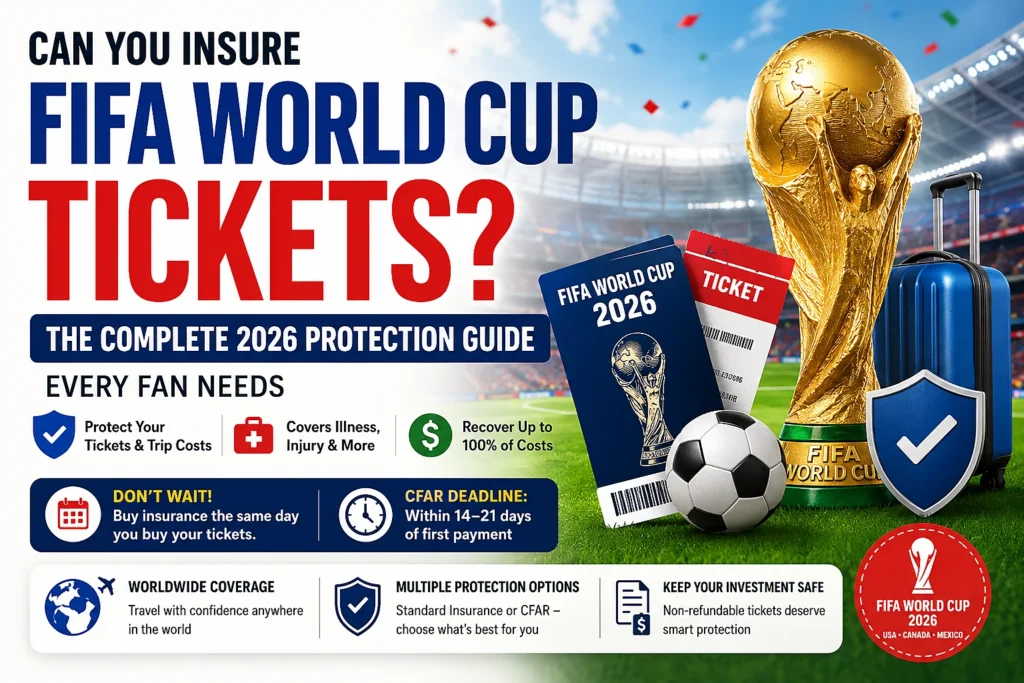
“Can You Insure FIFA World Cup Tickets?” Yes, you can insure FIFA World Cup tickets. Purchase travel insurance immediately after buying your tickets, and do not wait. Standard trip cancellation insurance reimburses your ticket cost if you cancel due to illness, injury, or severe weather. For broader protection, add Cancel For Any Reason (CFAR) coverage, which refunds 50–75% of your total trip cost for literally any reason. CFAR must be bought within 14–21 days of your first payment, and missing this window means losing your best protection.
Always confirm your policy explicitly covers event tickets as prepaid, non-refundable expenses. Keep all receipts. Buy the insurance the same day you buy the tickets.
Can You Insure FIFA World Cup Tickets?
Introduction: The $3,000 Question Nobody Thinks to Ask
Picture this. You spent seven months planning your trip to the 2026 FIFA World Cup. You booked flights from London to Dallas in January, locked in a hotel near AT&T Stadium, and battled through a digital queue to grab two round-of-16 tickets the moment they went live. Your total investment: just over $3,200. Non-refundable, every cent of it.
Then, four days before departure, you wake up with a fever. The doctor says you cannot fly.
This is not a hypothetical. It happens at every major tournament. And most fans, in that moment, discover something painful: their FIFA World Cup tickets were never actually insured.
So can you insure FIFA World Cup tickets? The answer is yes; but the “how” matters enormously, and the differences between policy types can be the difference between recovering $2,500 or recovering nothing. This guide breaks down every layer of that answer, fills the gaps other articles have left open, and gives you the specific, actionable knowledge to protect one of the most expensive sporting investments of your life.
What Does “Insuring a World Cup Ticket” Actually Mean?
Before comparing options, it helps to define what ticket insurance really is because the phrase gets used loosely in ways that confuse fans every tournament cycle.
Ticket insurance is not a product that insures the physical ticket from being lost, stolen, or damaged (though baggage coverage does address lost documents). It is a financial protection mechanism that reimburses you for the cost of a prepaid, non-refundable event ticket when you cannot attend for a qualifying reason.
There are three routes through which a World Cup ticket can be “insured”:
- FIFA’s own Ticket Protection add-on : offered at point of purchase on the official ticketing portal
- Standard trip cancellation insurance : the “covered reasons” model used by mainstream travel insurers
- Cancel For Any Reason (CFAR) coverage : an optional add-on that provides the broadest protection
Each one works differently, costs differently, and delivers a very different experience when you actually need to make a claim. Understanding this distinction is the first thing most existing articles fail to establish clearly.
FIFA’s Own Ticket Policy: What It Actually Says (and What It Doesn’t)
FIFA’s 2026 ticket policy is unusually strict: all ticket sales are final. Once payment is processed, tickets cannot be canceled — including for circumstances beyond your control.
There are two important exceptions worth knowing:
- If you bought Team Specific Tickets and your team is eliminated before the relevant match, FIFA issues a refund minus a small retention fee.
- FIFA offers a Ticket Protection add-on at the point of purchase, which they strongly recommend details are available on the FIFA ticketing portal.
The FIFA World Cup 2026 uses mobile ticket technology rather than traditional paper tickets. That means if your phone is lost or stolen, a reissuance process exists but if you simply cannot attend, the ticket itself has no inherent refund value.
The key gap here: FIFA’s own protection product is narrow. It does not cover the flights you booked to reach the stadium, the hotel you paid in advance, or any other component of the trip. That is where travel insurance steps in.
How Standard Travel Insurance Covers World Cup Tickets?
The Trip Cancellation Model
If you’re traveling domestically or internationally and want insurance that primarily covers prepaid, nonrefundable trip costs such as airfare, hotel charges, and match tickets in case you need to cancel for a reason covered by the policy, trip cancellation insurance is the product to consider.
Under a standard trip cancellation policy, your World Cup tickets are treated as a prepaid, non-refundable expense exactly like a hotel deposit or an airline ticket. Travel insurance may reimburse the cost of non-refundable tickets if the cancellation or interruption is due to a covered reason like medical emergencies or severe weather.
What Qualifies as a “Covered Reason”?
This is the most important and most misunderstood part of the conversation. Covered reasons typically include:
- Sudden illness or injury (yourself, a travel companion, or a close family member)
- Death of an immediate family member
- Severe weather events that prevent travel
- Job loss after ticket purchase
- Jury duty or a court summons
- Travel document theft (in some policies)
- Airline or common carrier failure
Cancelling because your team was eliminated, however painful, is not a covered reason. Neither is deciding the trip is no longer affordable, a change of personal plans, or general anxiety about travel.
The Critical Documentation Requirement
If you get sick the day before a match and can’t attend, trip cancellation coverage may reimburse your ticket cost, provided it’s included in your insured trip total. Save all receipts and documentation for your tickets.
This is an important practical point. Insurance companies require proof that the ticket was a paid, documented, non-refundable expense. Email confirmations from the FIFA ticketing portal, credit card statements, and any booking receipts should be saved and backed up digitally from the moment of purchase.
Cancel For Any Reason (CFAR): The Coverage Most Fans Overlook
What CFAR Is?
Cancel For Any Reason Coverage is an optional add-on to a standard trip cancellation policy. As the name suggests, it removes the requirement that your reason for cancellation falls within a defined list. CFAR is an optional policy add-on that reimburses 50–75% of prepaid costs if you cancel for any reason not covered by standard policies.
For World Cup fans, this matters in scenarios that standard insurance ignores:
- Your visa application is denied
- A work obligation becomes unavoidable
- You have a personal falling-out with your travel companion
- You simply feel unsafe traveling due to geopolitical developments
- Your team’s early elimination takes the wind out of your sails (understandable, if not conventionally reimbursable)
The Cost of CFAR
CFAR typically adds 40–50% to the cost of a standard cancellation policy. For a trip worth $3,000, that might mean the difference between a $150 policy and a $220 policy, A $70 premium for the ability to cancel for literally any reason and recover most of your investment.
CFAR is the most underrated piece of World Cup travel insurance on the market. The premium is modest, but the peace of mind is genuinely different. You booked months in advance. Life changes. CFAR acknowledges that.
The CFAR Timing Trap
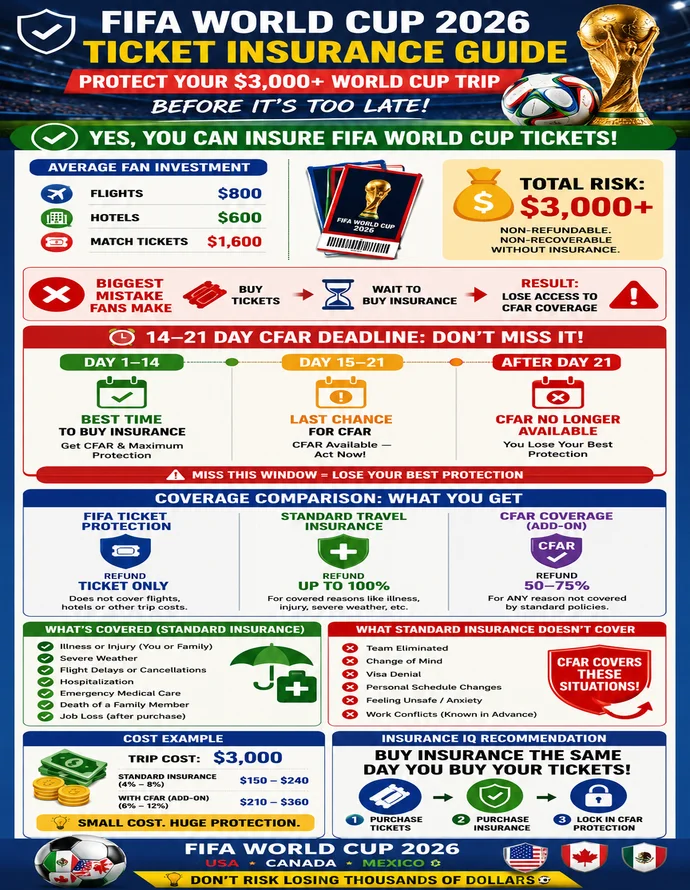
Here is where thousands of fans make an expensive mistake. CFAR must typically be purchased within 14 to 21 days of your first trip payment. Miss that window and the option disappears entirely.
This means the moment you pay for your FIFA World Cup tickets not your flights, not your hotel the clock starts. Most fans assume they can add insurance closer to departure. By the time they think to check, the CFAR window is gone.
Comparing the Three Coverage Routes: A Practical Breakdown
| Coverage Type | What It Covers | Reimbursement | Best For | Key Limitation |
|---|---|---|---|---|
| FIFA Ticket Protection | Ticket cost only, in limited scenarios | Partial | Fans who want minimal coverage | Doesn’t cover travel costs |
| Trip Cancellation Insurance | Tickets + flights + hotel, covered reasons only | Up to 100% | Most international travelers | Must be a qualifying reason |
| CFAR Add-on | Everything in trip cancellation + any reason | 50–75% of trip cost | Fans with uncertain plans | Must buy within 14–21 days of first payment |
| Medical-Only Travel Insurance | Emergency healthcare abroad | Policy limits | Budget travelers | No ticket or cancellation coverage |
Why This World Cup Creates Unique Insurance Challenges?
The 2026 FIFA World Cup is not a typical sporting event in insurance terms. Three host nations, sixteen cities, an estimated 7 million tourists crossing international borders throughout the tournament. This creates a risk profile that standard travel insurance policies were not designed for: multi-country exposure, where a fan flying from Brazil to New York, then driving to Atlanta, then crossing into Mexico for a group-stage match is technically making three separate international trips within one journey.
Multi-Country Coverage Gaps
Some plans have geographic restrictions. If you choose a multi-country plan, verify your policy covers all three host nations the US, Mexico, and Canada before purchasing.
A fan from Argentina who insures a US leg of the trip but not a Canadian match segment could find themselves completely unprotected if a disruption occurs north of the border.
The US Healthcare Cost Problem
In the US home to 11 of 16 venues. A single emergency room visit averages $2,600 to $3,000 without insurance. The US State Department strongly recommends medical evacuation insurance for international visitors, warning that evacuation costs can reach tens of thousands of dollars and many standard policies don’t include it.
With this in mind, it’s wise to consider a comprehensive travel insurance policy with at least $100,000 in emergency medical coverage.
The FIFA Ticketing Investigation Factor
An angle almost no insurance article has addressed: FIFA could be forced to refund 2026 World Cup ticket buyers if US investigators find that its pricing and seat allocation policies violated consumer protection laws. Authorities in New York and New Jersey have opened a joint investigation into FIFA’s ticketing practices amid accusations that the football governing body used unreasonable pricing and possibly misleading sales methods.
What does this mean for insurance? If your seats were materially misrepresented. A different location or category than purchased your insurer may not automatically cover that as a reason to cancel. Fans in this situation should document all original ticket communications carefully and consult their insurer before making any decisions.
When Insurance Pays and When It Doesn’t?
Scenario 1: The Pre-Match Illness (Likely Covered)
Maria from Spain secured two semifinal tickets to the MetLife Stadium final. Three days before her flight, she develops appendicitis and is hospitalized. With a standard trip cancellation policy that includes her tickets as a prepaid expense, she files a claim with her doctor’s report. Her insurer reimburses the full value of flights, hotel, and both tickets.
What made it work: She bought the policy within 14 days of her first trip payment, kept all receipts, and her reason verified medical emergency,and fell squarely within covered reasons.
Scenario 2: The Visa Denial With CFAR, Without
Ahmed from Pakistan secured group-stage tickets for a match in Dallas but his US visa application was denied six weeks before departure. Under a standard trip cancellation policy, visa denial is frequently excluded from covered reasons. With CFAR, he recovers 75% of his total trip cost.
The gap: Most standard policies do not cover visa issues. CFAR is essential for fans from countries where US visa uncertainty is a real risk.
Scenario 3: Team Elimination Disappointment
Carlos from Ecuador bought Team Specific Tickets linked to his national team’s knockout round progression. When Ecuador exits in the group stage, the ticket is refunded by FIFA with a retention fee deducted. His travel insurance, however, does not reimburse the flights and hotel he booked in anticipation of those knockout matches because team elimination is not a covered reason for cancellation of separately-purchased travel.
The lesson: Team Specific Tickets come with their own partial protection from FIFA, but independent travel bookings remain unprotected against elimination scenarios.
Scenario 4: Flight Cancellation, Match Missed
Sophie from Australia was connecting through Los Angeles to reach her match in Atlanta when her LAX connection was canceled due to a runway closure. She missed the match. Trip interruption coverage reimbursed her rebooking costs and the hotel night she needed. Her ticket cost was partially reimbursed as an unused prepaid expense.
What to note: Not all policies treat a missed event as a claimable event. Confirming this language before buying matters.
Scenario 5: Claim Rejection Process
If an insurer denies your claim, request a written explanation and review the policy terms carefully. Gather supporting documents, medical records, and receipts, then submit a formal appeal within the required timeframe. Escalate unresolved disputes through regulators or independent complaint channels.
Scenario 6: Credit Card Ticket Protection
Some premium credit cards include event cancellation, trip interruption, or ticket protection benefits. Before buying tickets, check your card’s coverage details, claim requirements, and reimbursement limits. These benefits can provide extra financial protection without purchasing separate event insurance.
Scenario 7: Resale as an Insurance Alternative
When insurance is unavailable, ticket resale may reduce financial losses. Use an authorized resale platform, verify transfer rules, set a competitive price, and list the ticket early. Selling before demand drops can help recover most or all of your costs.
Scenario 8: Fans Already at the Venue
If illness or injury occurs after entering the stadium, event insurance generally offers limited protection. Seek assistance from venue medical staff immediately and keep records of treatment. Coverage usually focuses on pre-event cancellations rather than incidents occurring inside the venue.
Scenario 9: Group Travel Insurance
Families and friend groups should compare group travel insurance plans before attending major events. These policies often simplify administration, provide shared coverage options, and may reduce overall costs. Review individual benefits carefully, as coverage levels can differ between members.
Scenario 10: Scam Ticket and Insurance Interaction
Insurance typically does not cover losses caused by fraudulent or counterfeit tickets. To reduce risk, purchase only through official sellers or trusted resale platforms. If scammed, contact your payment provider quickly, as chargeback rights may offer possible reimbursement.
How Much Does World Cup Travel Insurance Cost?
World Cup travel insurance typically runs 4–8% of your total trip cost. For a $3,000 trip, expect $120 to $240 for comprehensive coverage. A small fraction of what a single US hospital visit could cost you.
The FIFA world cup travel insurance cost starts at just $1 per day and may provide coverage for medical emergencies, hospitalization, emergency medical evacuation, trip cancellations, baggage loss, and travel delays.
For budget planning purposes:
| Trip Value | Standard Policy (5–8%) | With CFAR Add-on (+40–50%) |
|---|---|---|
| $1,500 | $75–$120 | $105–$180 |
| $3,000 | $150–$240 | $210–$360 |
| $5,000 | $250–$400 | $350–$600 |
| $8,000+ | $400–$640 | $560–$960 |
These figures assume a single traveler. Group policies and family plans often reduce per-person costs.
When to Buy? A Step-by-Step Timeline
The timing of purchase is the single most consequential decision in the entire insurance process. Here is how it should work:
Day 1 — Ticket Purchase: Buy your FIFA World Cup tickets. Immediately after, purchase your travel insurance policy. This is the optimal moment. CFAR window opens today.
Days 2–14: The CFAR add-on and pre-existing condition waiver window is open. If you did not buy on Day 1, buy now. Do not wait.
Days 15–21: Final opportunity for CFAR coverage with most insurers. After this point, the add-on is no longer available.
After Day 21 but before departure: People can still purchase basic travel medical insurance later, but some cancellation benefits may no longer be available.
Day of departure: At this point, most high-value trip cancellation protections are usually already gone.
How to Choose the Right Policy? A Checklist
Before purchasing any travel insurance for your World Cup trip, work through this checklist:
- Confirm event ticket coverage. Ask the insurer directly: “If I cannot attend due to a covered reason, will the cost of my FIFA World Cup ticket be reimbursed?” Get confirmation in writing.
2. Check geographic coverage. If attending matches in multiple countries, verify the policy covers all three host nations USA, Canada, and Mexico.
3. Evaluate CFAR. Given the cost and non-refundable nature of World Cup commitments, CFAR is worth the additional premium for most fans. Confirm eligibility timing before purchase.
4. Assess medical limits. A comprehensive policy should include at least $100,000 in emergency medical coverage. For US-based events, higher limits are advisable.
5. Check pre-existing condition terms. If you have any existing health conditions, verify whether the policy excludes them and whether an early-purchase waiver applies.
6. Save all documentation. Keep digital and printed copies of your policy, ticket receipts, flight bookings, hotel confirmations, and passport.
7. Note the 24/7 claims line. Know the number before you travel. In a crisis, you do not want to be searching for it.
Author’s View: Can You Insure FIFA World Cup Tickets?
The Psychology Problem with World Cup Insurance
There is a behavioral finance pattern at work here that costs fans real money every four years.
When a fan spends $800 on a match ticket, $500 on flights, and $600 on a hotel, the insurance conversation tends to feel abstract. A minor bureaucratic box to check, or an afterthought entirely. The $150 or $200 policy premium feels like spending more money on top of money already spent. The benefit is invisible until the day something goes wrong.
The psychology flips completely on the day of a crisis. A fan who paid $200 for CFAR coverage and recovers $2,400 from a $3,200 trip describes that policy as one of the best decisions they made. A fan who skipped it and lost the same $3,200 describes the tournament as a financial disaster.
Use Insurance IQ Write Travel Insurance Calculator to calculate coverages
The solution is not discipline or willpower. It is timing. Buy the insurance the same day you buy the tickets. When both transactions happen simultaneously, the premium feels like part of the ticket price not an added cost. The CFAR window stays open. Pre-existing condition waivers are available. And the psychological friction that causes most fans to skip coverage is eliminated before it appears.
This is the most practical and underused piece of advice in World Cup trip planning.
Conclusion: Can You Insure FIFA World Cup Tickets?
The question “can you insure FIFA World Cup tickets?” deserves a more honest answer than most articles provide. Yes, you can. But the protection you end up with depends entirely on which policy you buy, when you buy it, and whether your specific ticket expense is explicitly covered.
FIFA’s own FIFA World cup ticket protection is real but narrow. Standard trip cancellation insurance will cover your tickets. if your reason for cancellation qualifies. CFAR provides the broadest safety net but must be purchased within two to three weeks of your first non-refundable payment.
The 2026 World Cup is genuinely unprecedented in scale. Three countries, sixteen cities, seven million travelers, and tens of billions of dollars in collective fan spending. The financial exposure at the individual level is real. A $200 insurance decision made on the same day as a $3,000 ticket purchase is the simplest, most cost-effective risk management a fan can make.
The fans who will regret it are not the ones who bought coverage they didn’t need. They are the ones who bought tickets first, told themselves they’d deal with insurance later, and discovered at the worst possible moment that “later” was already too late.
Trending FAQs: FIFA World Cup 2026 Ticket Insurance
Q1. Can I insure FIFA World Cup 2026 tickets after buying them?
Yes, but you should act immediately. Standard trip cancellation insurance is available until close to departure, but the most valuable add-on – Cancel For Any Reason (CFAR). You must be purchased within 14 to 21 days of your first trip payment. Buying insurance the same day as your tickets is strongly recommended.
Q2. Does standard travel insurance automatically cover World Cup tickets?
Not always. Many standard policies list prepaid, non-refundable expenses as covered, but some explicitly exclude sporting event tickets. Always confirm in writing that your match tickets will be reimbursed under the trip cancellation section before completing your purchase.
Q3. What happens to my tickets if FIFA cancels a match?
If a match is officially canceled or played behind closed doors, FIFA processes refunds automatically to the original payment card. This is handled by FIFA directly, not through your travel insurance.
Q4. Will insurance cover me if my national team is eliminated?
FIFA offers a partial refund on Team Specific Tickets when a team is eliminated early. However, independently-purchased travel costs flights, and hotels are generally not covered by standard insurance for team elimination. Only CFAR would potentially provide any reimbursement in that scenario, and even then it reimburses your total trip cost rather than addressing elimination specifically.
Q5. Is travel insurance mandatory for the 2026 FIFA World Cup?
No country; the USA, Canada, or Mexico requires travel insurance for entry to attend the World Cup. However, all three governments strongly recommend it, and US healthcare costs alone make coverage essential for international visitors.
Q6. How do I file a claim if I can’t attend my World Cup match?
Contact your insurer’s 24/7 claims line as soon as you know you cannot travel. Submit documentation including your medical report (if illness-related), all ticket receipts, flight and hotel confirmations, and the insurer’s required claim form. Response times vary by provider but typically range from 7 to 30 days for straightforward claims.
Q7. Can fans from countries like Pakistan or India insure their World Cup tickets against visa denial?
Standard trip cancellation insurance generally does not cover visa denial as a reason for cancellation. Cancel For Any Reason (CFAR) coverage is the appropriate solution for fans facing visa uncertainty, as it reimburses 50–75% of prepaid costs regardless of the cancellation reason.
Q8. What is the FIFA Ticket Protection add-on and how does it work?
FIFA offered a Ticket Protection add-on at the point of purchase through its official ticketing portal. It provides protection for the ticket cost in certain circumstances. However, it does not cover associated travel expenses like flights and hotels, so it should be considered supplementary to, not a replacement for, comprehensive travel insurance.
Q9. Does travel insurance cover tickets bought from resellers?
This depends on the policy. Tickets purchased through the official FIFA resale marketplace are more likely to be accepted as legitimate documented expenses. Third-party resale tickets carry additional risk, both in terms of insurance acceptance and ticket validity.
Q10. How much does FIFA World Cup travel insurance cost in 2026?
Comprehensive coverage typically costs 4–8% of your total non-refundable trip value. For a $3,000 trip, that is approximately $120 to $240 for a standard policy. Adding CFAR increases cost by 40–50% but provides substantially broader coverage.
Q11. Is there separate insurance for each host country?
Not necessarily. Multi-country plans exist that cover the US, Canada, and Mexico under a single policy. Verify geographic coverage explicitly before purchasing, as some plans have country-specific restrictions.
Q12. What is the biggest mistake fans make with World Cup insurance?
Waiting. The most common and most costly mistake is assuming insurance can be sorted closer to departure. By the time most fans think to check, the CFAR window has closed, pre-existing condition waivers are no longer available, and the flexibility of the policy is significantly reduced.
About the Author: Shahzad Mukhtiar
Shahzad Mukhtiar is an insurance and personal finance writer specializing in travel, health, and consumer insurance topics on Insurance IQ Write. He creates research-based guides that help readers compare coverage options, understand policy terms, and make smarter financial decisions when protecting trips, events, and major life investments.